How to Get Cited by ChatGPT: A 10-Minute Audit and 3 Fixes
Three prompts score your blog out of six, pinpointing whether to clarify your identity, make pages quotable, or earn roundup mentions.

Quick scope check, because this search term gets crossed wires: this guide is about getting ChatGPT to cite your blog as a source in its answers. If you were looking for how to cite ChatGPT in an essay, this is not that. If you want ChatGPT, Perplexity, and Google’s AI results to know your site, describe it accurately, and recommend it to readers, you are in the right place.
Here is how this works. You will run a 10-minute audit: three prompts you paste into ChatGPT about your own blog, each scored 0 to 2.
Your total tells you exactly which of the three fixes to start with. No tools required for the audit itself, just a fresh ChatGPT chat.
And so you can see what real answers look like, I ran the full audit on my own hiking side project, Hike with Ryan. It passed two prompts and failed one, and the failure is the most useful part.
Key Takeaways
- ChatGPT cites pages it retrieves through live web search, so being findable and quotable matters more than any AI trick.
- Three prompts reveal your standing: whether AI knows you, whether it connects you to your topics, and whether it recommends you.
- Short, self-contained answers under question headings are the single strongest citation pattern in the data.
- The recommendation set is assembled from third-party roundups and reviews, not from your own site.
How Does ChatGPT Decide What to Cite?
When ChatGPT needs current information, it runs several related web searches, reads the top results, and quotes whichever pages answer the question most clearly.
That one sentence carries the whole strategy, so let me unpack it. ChatGPT answers in two modes.
For general knowledge it relies on what its model already learned in training. For anything current, specific, or niche (like your blog), it searches the web while composing the answer.
Those searched answers are where citations live. They are the ones you can influence this quarter rather than at some future model update.
The search step is not one query. ChatGPT expands your question into several related searches, a behavior called query fan-out, then retrieves pages that already rank well for those searches. This is not a theory: Microsoft’s own guide to AEO and GEO lists “break down and fan out queries” as part of Copilot’s reasoning phase and says a site “must rank well to be discovered, evaluated, and recommended.”
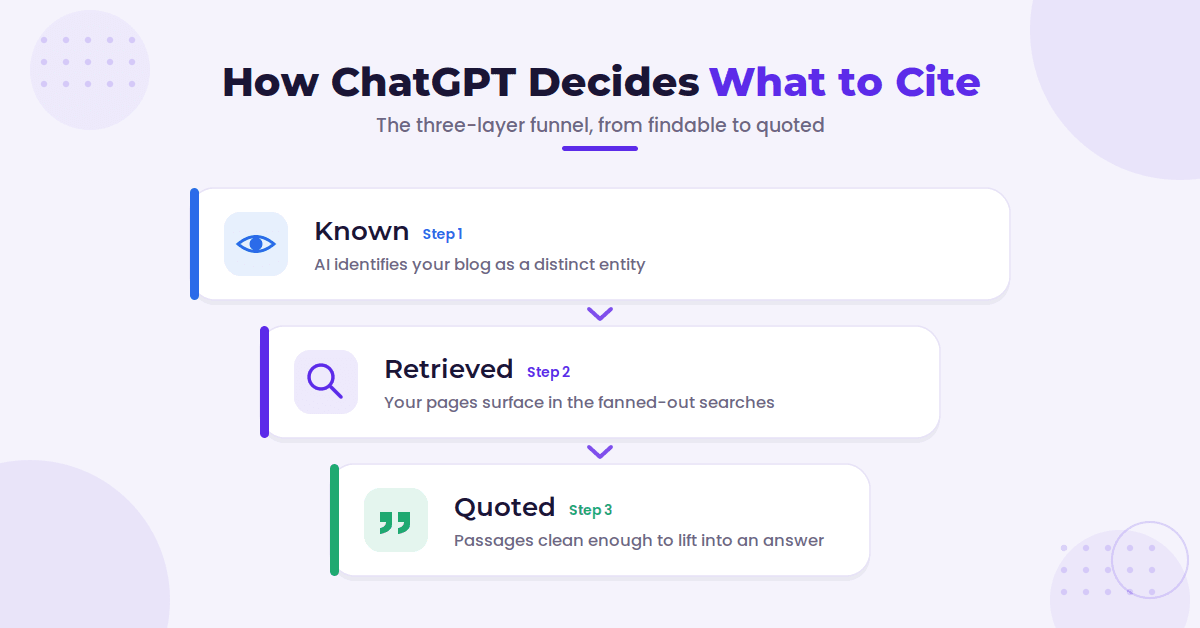
I wrote a full breakdown of how query fan-out works and how to structure content for it, but the short version is a three-layer funnel:
- Known: AI can identify your blog as a distinct thing with a clear subject.
- Retrieved: your pages rank well enough to come back in those fanned-out searches.
- Quoted: your pages contain passages clean enough to lift into an answer.
Each audit prompt below tests one layer, which is why the score maps directly to a fix.
The 10-Minute AI Visibility Audit
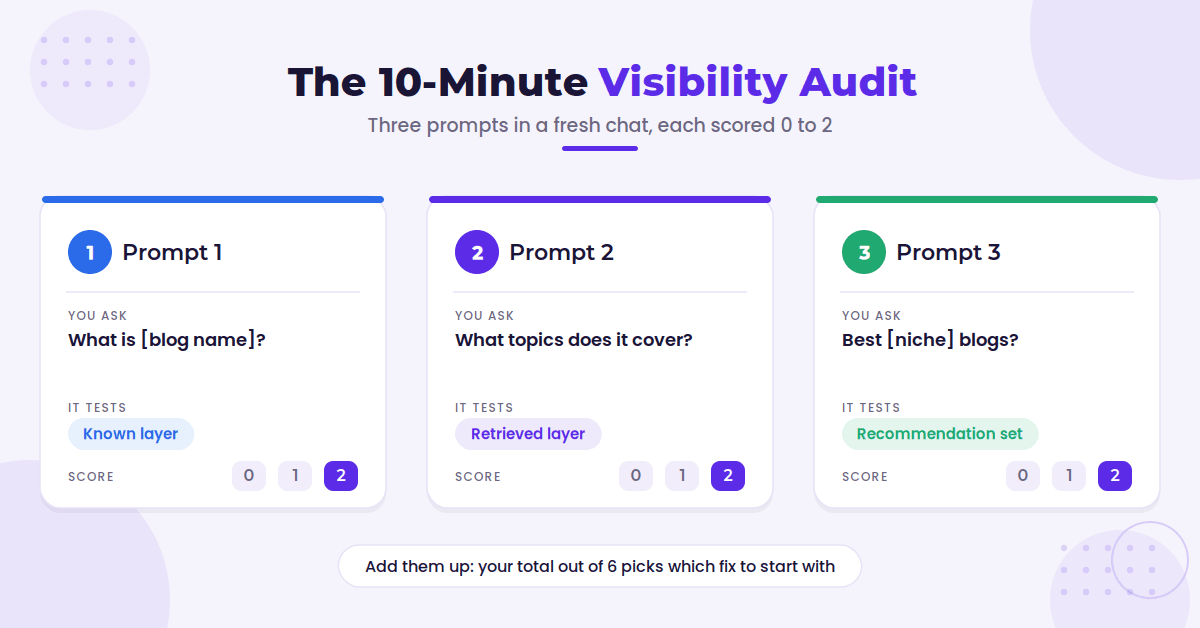
Open a fresh ChatGPT chat, ask three questions about your own blog, and score each answer from 0 to 2. Your total out of 6 tells you where to start.
Two setup rules so your results are honest. First, use a logged-out window or a temporary chat, because ChatGPT personalizes answers based on your history, and you want to see what a stranger sees.
Second, if the answer does not show source links, add search the web to the prompt so you are testing the retrieval path rather than the model’s memory.
Prompt 1: What is [your blog’s name]?
This tests the known layer: whether AI can identify your blog as a distinct entity. If your blog name is generic, add your domain in parentheses.
| What you see | Score | What it means |
|---|---|---|
| Wrong site, a guess, or I could not find information | 0 | AI cannot identify you. Start with Fix 1. |
| Right site, but vague or partly wrong description | 1 | Weak entity. Fix 1 sharpens it. |
| Accurate description: who runs it, what it covers, who it is for | 2 | The known layer is solid. |
Here is what came back for my hiking blog, with web search citations attached:
Hike with Ryan is an outdoor/hiking website created by Ryan Robinson, a hiker, writer, and outdoor enthusiast. It focuses on practical hiking and travel advice rather than being a guided-hiking company.
It went on to list the content types (trail guides, national park planning, gear reviews) and even pulled biographical details from my about page.
That is a 2 out of 2, and notice why it passed: every specific it quoted exists in plain text on the site. AI did not intuit any of it.
Prompt 2: What topics does [your blog] cover?
This tests the retrieved layer: whether AI associates your site with the subjects you want to be found for.
| What you see | Score | What it means |
|---|---|---|
| Generic filler or topics you do not actually cover | 0 | No topical association. Fix 2, plus more coverage. |
| Some real topics, but missing your most important ones | 1 | Partial association. Fix 2 on the missing clusters. |
| An accurate topic list that matches your content strategy | 2 | The retrieved layer is working. |
Hike with Ryan scored 2 out of 2 here too. ChatGPT listed the actual topic areas (national parks, itineraries, gear, beginner-friendly trail lists) and quoted the site’s own tagline back to me: practical trail guides, honest gear reviews, and real hiking tips.
When your positioning line gets echoed word for word, your entity work is done.
Prompt 3: What are the best [your niche] blogs?
This is the money question. It tests whether you are in the recommendation set, the shortlist AI reaches for when someone asks for the best sites in your space.
| What you see | Score | What it means |
|---|---|---|
| You are absent from the list | 0 | Not in the recommendation set. Fix 3. |
| Mentioned in passing or only after a follow-up | 1 | On the bubble. Fix 3 pushes you in. |
| Recommended with an accurate description | 2 | You are in the set. Protect it. |
Here Hike with Ryan scored 0. ChatGPT recommended SectionHiker, The Trek, The Hiking Life, Bearfoot Theory, and a handful of other long-established blogs. My site was nowhere in the answer.
The instructive part is where the list came from. The response cited a third-party blog roundup as its main source and noted that a current 2026 roundup also puts several of them among the strongest active hiking/backpacking blogs.
ChatGPT did not evaluate the whole hiking web and pick winners. It found someone else’s best-of list and summarized it.
That is how recommendation sets get built, and it is exactly why Fix 3 works the way it does.
What Your Score Means
| Score | Diagnosis | Start with |
|---|---|---|
| 0 to 2 | AI barely knows you exist | Fix 1, then Fix 2 |
| 3 to 4 | Known and understood, not recommended | Fix 3 (this is where Hike with Ryan sits at 4/6) |
| 5 to 6 | You are visible and recommended | Maintain freshness, defend the position |
One important routing rule: if you failed prompt 3 but passed prompts 1 and 2, more content on your own site will not move the needle much. AI already knows you and understands you.
What is missing is third-party evidence, and that lives off your site. Match the fix to the failure instead of defaulting to publish more.
Fix 1: Make Your Blog a Clear Entity
Give AI one consistent answer to who you are: the same one-line description on your homepage, about page, author bio, and social profiles.
Write a single sentence in the shape [Blog] is a [what it is] by [who] that helps [audience] [outcome]. Then put that sentence, nearly verbatim, everywhere your blog describes itself. AI systems build their picture of you from whatever is most consistent across the web.
If your homepage says one thing, your about page another, and your X bio a third, the model averages the mess and you get a mushy answer on prompt 1.
Then make your about page do real work. Hike with Ryan passed the entity prompt because the about page tells a specific story with concrete facts, and ChatGPT quoted those facts directly.
Vague I love sharing my passion pages give AI nothing to lift. Specifics get quoted.
Round it out with a real author page and author schema so the person behind the blog is machine-readable too. I covered both in detail in how to build author pages that support E-E-A-T and the author schema setup guide. The entity section of our GEO guide goes deeper on brand consistency.
Fix 2: Make Your Pages Easy to Quote
AI lifts short, self-contained passages. Put a direct 20 to 25 word answer under question-framed headings, keep links out of that answer, and add comparison tables.
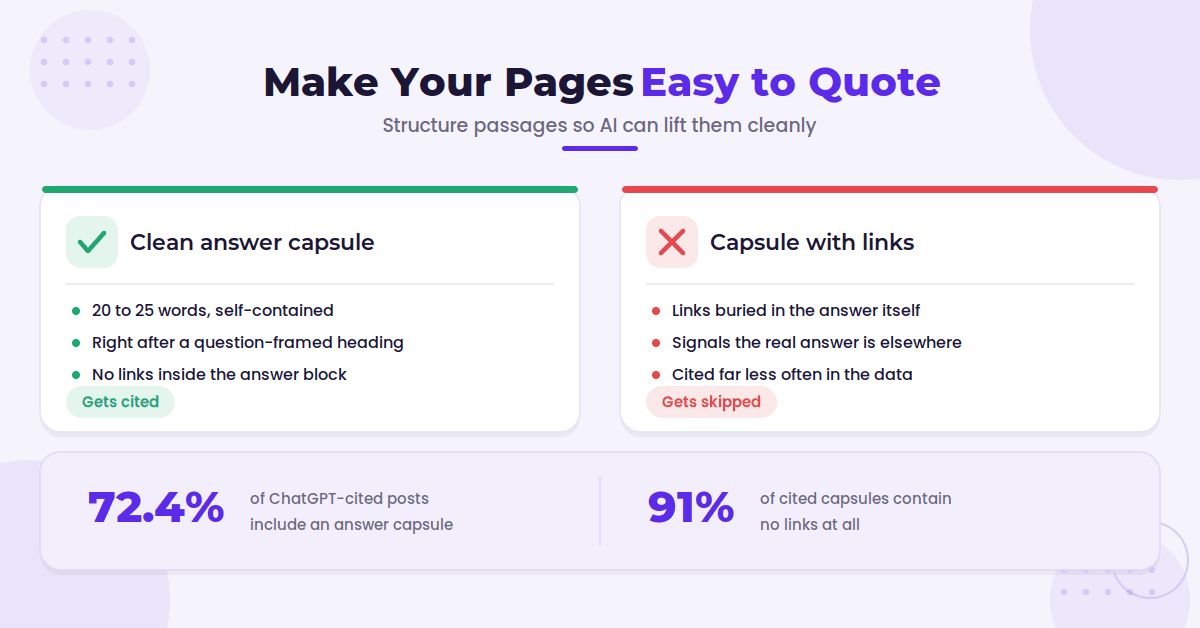
This is the most data-backed fix on the list. A Search Engine Land audit of 15 domains with nearly 2 million monthly sessions found that 72.4% of blog posts receiving ChatGPT citations included a short answer capsule: a self-contained 20 to 25 word explanation placed right after a question-framed heading.
Even more striking, about 91% of the cited capsules contained no links at all. A link inside the quotable block signals that the real answer lives somewhere else.
So keep the capsule clean and put your links in the paragraphs below it.
You may have noticed every section of this post opens with exactly that pattern. That is deliberate, and it is the same structure I recommend for your posts.
Two more quotability levers worth your time:
- Comparison tables. AI assembles best-of and versus answers from extractable tables. We learned this on our own site: one of our roundup posts was being read by ChatGPT but skipped in favor of table-first competitors, because the post had no summary table. The pages filling AI’s answer tables all had one. Add a compact table near the top of any comparison or list post. Microsoft’s guide makes the same recommendation, listing comparison tables and Q&A blocks among the content AI can “reason over and cite.”
- Your own numbers. The same Search Engine Land audit found original or clearly owned data was the second strongest citation trait. A small survey of your readers, your own test results, or a stat only you can produce gives AI a concrete reason to attribute the point to you. Adding a real expert quote works on the same principle.
Freshness matters here too. Search-based answers favor recently updated pages, so a maintained post beats an abandoned one for the same query.
Fix 3: Get Into the Recommendation Set
Best-of answers are assembled from third-party roundups, reviews, and communities. If those sources do not include you, ChatGPT’s shortlist will not either.
Remember what happened on prompt 3: ChatGPT built its best hiking blogs answer by summarizing a roundup site.
Neil Patel’s team saw the same pattern when they analyzed 100+ ChatGPT recommendation queries: brand mentions across the web, review volume, and appearances in third-party best of listicles were among the strongest factors in who got recommended.
Your own site barely participates in this layer. Other people’s sites are the ballot box.
The blogger-sized playbook, in priority order:
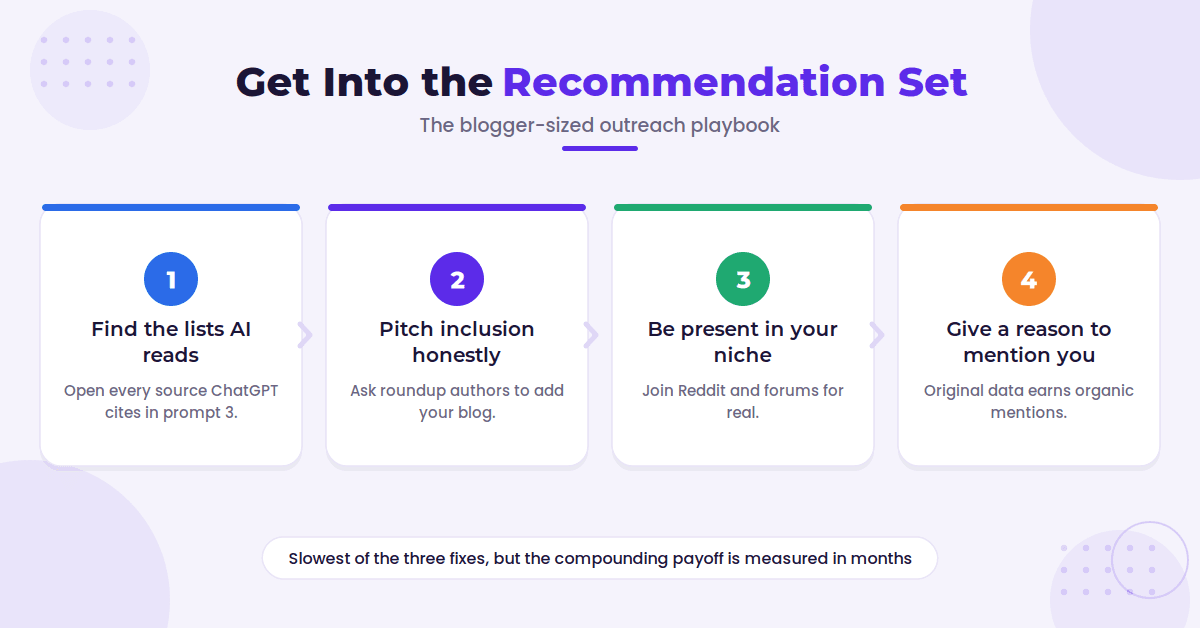
- Find the actual lists AI is reading. Run prompt 3 for your niche and open every source ChatGPT cites. That handful of roundups and review pages is your outreach list, not a guess about what might matter.
- Pitch inclusion honestly. Email the authors of those roundups with a short, specific case for why your blog belongs: what you cover that their current list misses. Some will ignore you. Some will add you, and one addition to a list AI already trusts outweighs a dozen random backlinks.
- Be genuinely present where your niche talks. Reddit threads, niche forums, and community sites get retrieved constantly. Participate for real, because manufactured self-promotion gets recognized and removed, which is worse than absence.
- Give people a reason to mention you. Original data, a genuinely useful free resource, or the definitive guide on one narrow topic all earn organic mentions, which compound while you sleep.
Honest expectation-setting: this is the slowest of the three fixes, usually measured in months. It is also the one with compounding returns, because every list you join keeps voting for you in every future answer.
How Do You Measure Whether It Is Working?
Track ChatGPT referrals in your analytics, watch for conversational AI queries in Search Console, and re-run the three-prompt audit monthly in a fresh chat.
In GA4, ChatGPT visits arrive with the referrer chatgpt.com, so a simple filter shows the trend (the setup mirrors our Perplexity referral tracking guide).
In Search Console, look for long, conversational queries that read like questions typed to an assistant. Those are often AI systems fanning out searches through Google, and we see them hitting our own posts every week.
Our guide to finding AI Overview keywords in GSC shows the filtering approach.
For a page-level check, our free Answer Engine Optimizer scores any URL on the extraction traits from Fix 2 and lists what to change.
And if you would rather not do the maintenance loop by hand, the RightBlogger Site Agent re-checks published posts on a schedule and keeps them fresh and extractable. That is the part most bloggers quietly stop doing after month two.
Then re-run the audit monthly. Same three prompts, fresh chat, honest scoring. If you would rather not re-run prompts by hand, this is exactly what RightBlogger’s AI Brand Monitor automates: it asks your buyer questions on ChatGPT, Gemini, Perplexity, and Claude on a schedule, tracks whether you are mentioned and how, and can hand a fix straight to the Site Agent when you are not.
Answer-level changes genuinely move: when we tightened how our own product describes itself, ChatGPT went from a vague one-liner to quoting exact pricing within a few weeks.
What Does Not Move the Needle
Skip llms.txt files, AI-specific schema, and mass-produced posts. AI answers are built on normal search infrastructure, and the retrieval step reads what already ranks.
Google says this outright in its AI features guidance: no special AI files, no AI-only schema, no chunked AI-friendly rewrites, and mass-produced page variations can trip spam policies. We keep a running breakdown of that guidance in the Google section of our GEO guide.
The boring conclusion is also the freeing one: everything that makes you citable is standard SEO plus clear writing plus third-party reputation. There is no secret AI lever, which means nobody in your niche has one either.
FAQ About Getting Cited by ChatGPT
Here are a few more questions that come up about getting cited by ChatGPT.
How do I get my blog mentioned by ChatGPT?
Make your blog a clear entity, structure posts so passages can be quoted alone, and earn spots in the third-party roundups and reviews AI reads. The three-prompt audit above shows which layer needs work first.
Does ranking in Google still matter for ChatGPT?
Yes. ChatGPT’s web search retrieves pages that already rank in traditional indexes. OpenAI does not publish its full retrieval stack, but it has drawn on third-party search indexes alongside its own crawler, so ranking well in Google and Bing remains the most reliable path to being retrieved.
How long does it take to get cited?
Weeks for answer-level changes, months for the recommendation set. Search-based answers refresh whenever AI re-retrieves your pages, so entity and quotability fixes can show up fast. Roundup inclusion compounds slowly.
Is ranking in ChatGPT actually a thing?
There is no ranked results page, but the practical effect is similar: AI retrieves a handful of sources per answer and quotes fewer still. Winning those slots takes the same work this guide covers, so the phrase is imprecise but the goal is real.
Should I block AI crawlers to protect my content?
Not if you want ChatGPT citations. OpenAI separates the bots: GPTBot is for model training, while OAI-SearchBot is what surfaces sites in ChatGPT search answers. You can disallow GPTBot and still allow OAI-SearchBot. Blocking GPTBot alone does not remove you from AI answers. Blocking OAI-SearchBot (or a blanket plugin rule that catches it) can. Check robots.txt for both tokens, and see our AI crawler access guide for allow/block patterns. Allowing a crawler still does not guarantee citations.
Does schema markup help me get cited?
Standard schema helps the way it always has: it makes your pages easier to understand and supports the rankings that retrieval depends on. AI-specific schema does not exist, and Google explicitly says not to invent it.
Final Thoughts on Getting Cited by ChatGPT
Ten minutes gets you a score out of 6 and a diagnosis you can act on this week. My hiking blog sits at 4 out of 6 with a clear assignment: go get on the lists.
Run yours, pick the one fix that matches your failure, and put a reminder on the calendar to re-run the audit in a month. The bloggers showing up in AI answers next year are the ones keeping score now.

Article by
RightBlogger Co-Founder, Ryan Robinson teaches 500,000 monthly readers about online business and AI visibility. He is a recovering side project addict.

Automated SEO Blog Posts That Work
Try RightBlogger for free, we know you'll love it.
7-day free trial. Cancel anytime.





Leave a comment
You must be logged in to comment.
Loading comments...