Claude Watermark and SEO: How AI Text Watermarks Work and Whether Google Cares
A few hundred words can reveal Claude’s watermark, but Google says rankings depend on quality, not provenance.

A question came up in the RightBlogger Discord that I have been hearing everywhere since August: now that Claude marks text from new models, should bloggers worry about AI watermarking and SEO?
Short version: no, not for rankings. An AI watermark is a provenance receipt. It lets the company that built the model check whether its model produced a passage of text. It says nothing about whether the text is any good, and Google has said nothing about using it to rank pages.
The longer version still matters, because the receipt is real, it is new, and it changes what an unedited AI blog can hide. Here is what changed, how the watermark actually works, what it can and cannot prove, and what to do about it.
Key Takeaways on the Claude Watermark
- Claude models launched on or after August 2, 2026 mark text at launch (marks apply worldwide) to meet the EU AI Act’s transparency rules; older models are being added through December 2, 2026. Google has marked Gemini output with SynthID since 2024. Official: How Claude marks AI-generated content.
- OpenAI took a narrower route, announced October 5, 2026: an invisible watermark on ChatGPT and Codex text in the EU only, rolling out over the following weeks, plus opt-in watermarking for API customers worldwide. Official: Our approach to EU text provenance rules.
- The watermark is a statistical pattern in word choice that only the provider can check with a secret key. It needs a few hundred words to be reliable and fades with heavy editing.
- Google judges pages on quality, not on how they were produced, and has never tied a watermark to rankings. Its new SynthID labels in Search and Chrome are for images and media provenance.
- The one place this touches your blog: raw, unedited AI text at scale becomes provable instead of guessable. The fix is the editing you should be doing anyway.
The Short Answer for Bloggers
If you use Claude, ChatGPT, or Gemini to draft, then edit, fact-check, and add what only you know, a watermark changes nothing about your SEO. Google’s guidance on AI-generated content has said since February 2023 that it rewards high-quality content however it is produced. Its spam policies target scaled content abuse, which means publishing piles of pages to manipulate rankings, not the tool you used to write them.
If you pipe unedited AI output straight to your site, the watermark does not change how Google ranks you either. It changes something else: anyone with access to the provider’s detector can now prove where the text came from. That matters for publishers with disclosure rules, for client work, and for your own credibility. It is not a ranking signal.
What Changed on August 2, 2026
The trigger is Article 50 of the EU AI Act, the transparency obligations that took effect on August 2, 2026. Providers of generative models have to make their output detectable as artificially generated in a machine-readable way.
Anthropic’s answer, described in its own write-up of how Claude’s text watermarking works, is to embed an invisible watermark in text from new Claude models and to attach signed C2PA provenance metadata to generated files such as images. The marks apply worldwide, not only in the EU, across Claude Platform (API), Claude, Claude Code, Claude Cowork, and Claude Tag. Anthropic’s help center article lists the products and models covered and says models launched before August 2, 2026 are being added under the law’s transition period, with all covered by December 2, 2026. Anthropic applies the mark globally because, in its own words, it does not yet have a durable way to scope it by region. It also notes that other major providers signed the same code of practice and will ship watermarks of their own.
Google got there first. Its SynthID technology has marked Gemini’s text output since 2024, with the method described in a 2024 paper in Nature, and Google’s image and audio models carry the mark as well.
OpenAI went narrower. In its October 5, 2026 announcement, it said an invisible watermark is coming to eligible ChatGPT and Codex text output in the EU over the following weeks, on all plans, but not as a global default. API customers anywhere can opt in for select models (it stays off by default), and the detector is limited to approved researchers and expert organizations. OpenAI calls the technology textGrain, says it matched or beat the other approaches it tested, including SynthID, and plans to release it as open source.
The wider picture explains why this exists at all. China’s labeling rules for AI-generated content took effect in September 2025. In the United States, NIST’s report on reducing the risks of synthetic content treats watermarking and provenance data as the main tools for authenticating media, while being candid about their limits. The bills in Congress that would standardize it are driven by deepfakes in elections and fraud, not by search.
| When | Who | What |
|---|---|---|
| 2024 | SynthID text watermarking ships in Gemini | |
| September 1, 2025 | China | Mandatory visible and embedded labels on AI-generated content |
| July 2026 | EU and providers | Code of Practice on Transparency of AI-Generated Content signed by Anthropic, Google, and others |
| August 2, 2026 | EU | Article 50 transparency obligations apply |
| August 2, 2026 | Anthropic | New Claude models mark text + C2PA on files at launch (worldwide); older models through Dec 2, 2026 |
| October 5, 2026 | OpenAI | Invisible watermark on ChatGPT and Codex text in the EU, rolling out over the following weeks; opt-in for API customers worldwide |
My read, and the reason I wanted to write this up: this is provenance and accountability infrastructure. Governments want a way to trace synthetic media in elections, fraud, and national security cases, and platforms want to show where a file came from. Search rankings were never the point.
How a Text Watermark Actually Works
The clearest explanation I have seen is Dr Mike Pound’s walkthrough on Computerphile, which builds a working version of the SynthID approach on a small local model. Here is the plain-English version.
A language model writes by scoring possible next words. After “the cat sat on the,” it might give “mat” a 70 percent chance, “chair” 20, and “sofa” 10. Normally the model samples from those odds. A watermark changes which word gets picked in a way that follows a secret key, but only when several words fit about equally well. When one word is overwhelmingly likely, it still wins, so the text reads exactly as it would have. Anthropic’s own description makes the same point with a dice analogy: the choices are still random, only the source of the randomness changes. Nothing is added to the text, there are no hidden characters, and it costs no extra tokens.
Detection runs the process in reverse. With the secret key, the detector rescores each word in the text and checks whether the choices lean the way the key would have pushed them. Unmarked text averages out to a coin flip. Watermarked text leans, and over a few hundred words that lean becomes statistically overwhelming. The detector reports a confidence, not a yes or no.
Two details follow from that design. The key stays secret, so only Anthropic can check for Claude’s mark and only Google can check for Gemini’s, which is why providers are expected to offer a detection service rather than publish the method. And because the check is statistical, short passages cannot be marked reliably; the signal needs length to stand out from chance. The mark also carries no identifying information. It says a Claude model produced the text, not which account or conversation did.
What It Can and Cannot Detect
| What a watermark can prove | What it cannot prove |
|---|---|
| That a provider’s model produced the text, checked with that provider’s key | That the text is bad, thin, or unhelpful |
| That a passage of a few hundred words carries the mark, with a confidence level | Who published it or who edited it |
| That light edits were made to marked text, because the signal fades slowly | How the page ranks in Google |
- It works best on open-ended prose. Code, JSON, and highly structured text leave few free choices per word, so the signal there is weak.
- Light edits leave it intact, because each word’s mark depends only on the few words before it. Heavy rewriting erases it, and at that point you have written a new text.
- Mixing marked and unmarked passages still leaves a detectable signal in the marked half.
- Models you run on your own machine are not covered. The marks come from the provider’s servers.
OpenAI’s announcement put numbers on how fast its own mark erodes. At a 1% false positive rate, its detector caught the watermark in about 80% of 200-token passages and about 95% of 400-token passages on topics like psychology, and far fewer on math, where word choice is tight. In 400-token passages, swapping 10% of the words for synonyms cut detection from about 92% to 66%, and swapping 25% cut it to 17%. That is the editing pass this article keeps recommending.
Sean Goedecke argues that text watermarks will always be easy to remove, and for a determined person that is fair. Pound’s own framing is the more useful one: this is a numbers game aimed at the average case, not a lock. The output of a fully automated site that pastes AI text to the web with nobody editing it will be easy to identify. A post that a human rewrote will not be.
The tooling for this already exists, and it proves the point. The most visible option, an open source project called watermarks-remover, passed 21,000 GitHub stars within a month of Anthropic’s announcement. It strips hidden Unicode characters and provenance metadata from files, which is ordinary privacy hygiene. For the statistical text mark, though, its method is to rewrite the text with a different model. Its own documentation is candid about what that costs. A substantial share of the sentences have to change, the result is capped by the quality of the model doing the rewriting, and it asks why you would pay for a premium model in the first place if a cheaper one is going to rewrite the output anyway. That is the whole argument of this article in one line.
One more practical limit: Anthropic’s watermark detector is in private preview for eligible organizations such as regulators, media, fact-checkers, and researchers, plus enterprises with their own compliance obligations, with an access request form and plans to widen the detection API over time. A blogger cannot run it today.
The UNU Campus Computing Centre put the limits well in its piece Provenance, Not Proof. A positive result says a Claude model produced that text at some point. It does not say who published it, whether they edited it, or whether it is any good.
What Google Actually Does With SynthID in Search
This is the part the Discord question was really about. Google has watermarked its own Gemini output since 2024 and has never tied that mark to rankings. Its published guidance is that it evaluates content on quality, expertise, and usefulness regardless of how it was produced. What gets sites demoted is scaled content abuse, meaning many pages generated primarily to manipulate rankings.
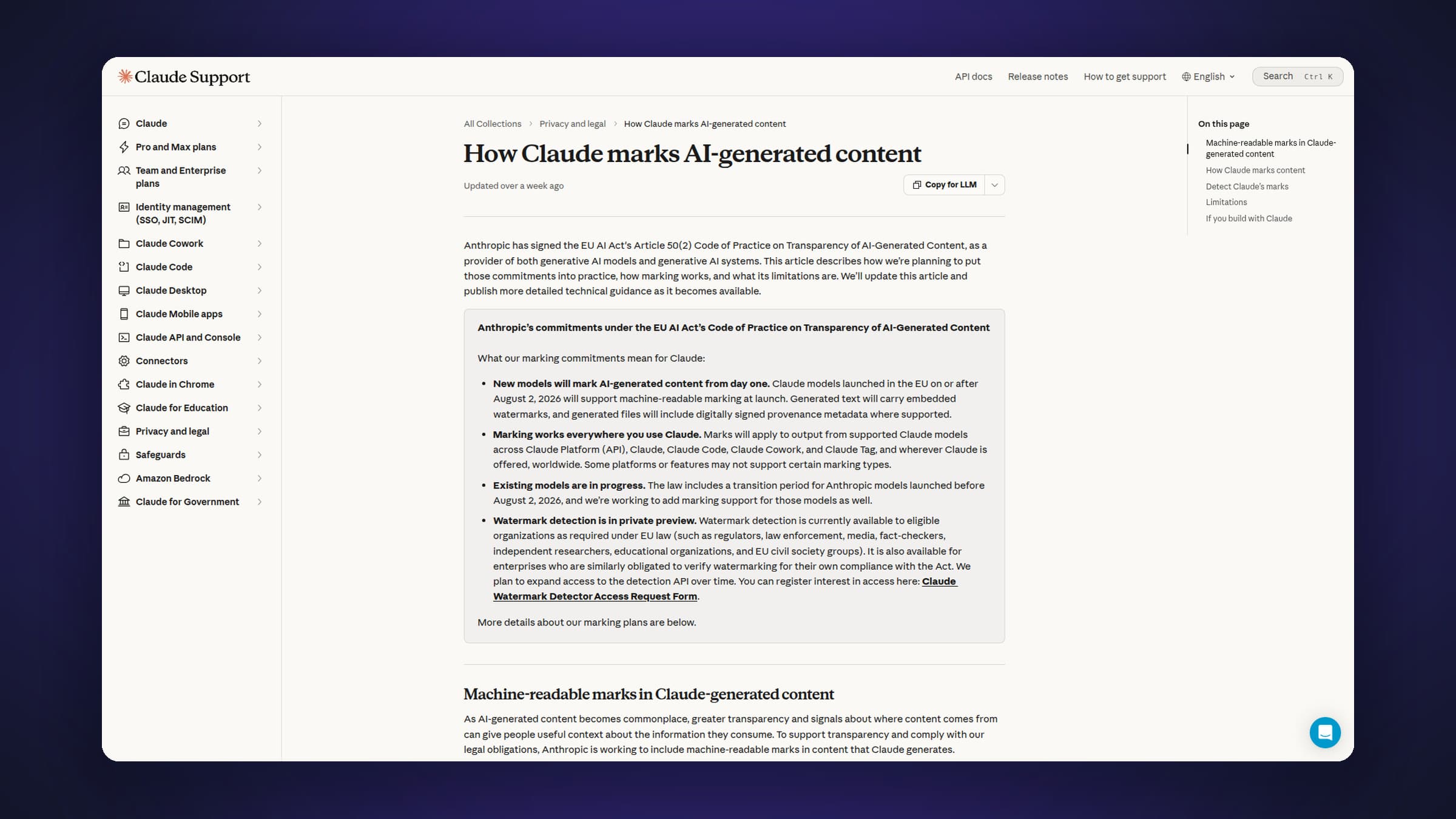
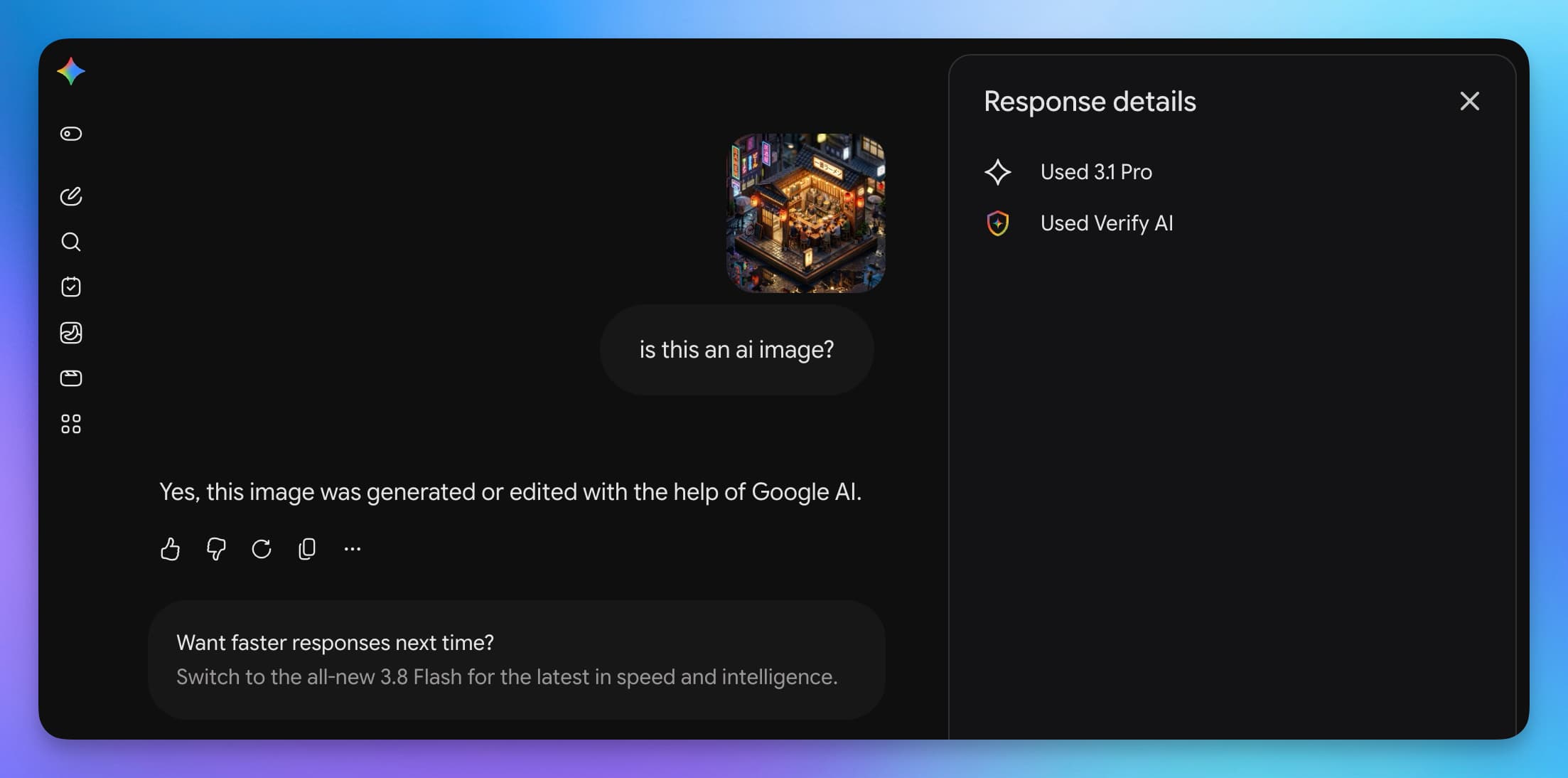
At Google I/O in May 2026, Google announced that SynthID and C2PA verification are coming to Search and Chrome, so you can ask whether an image was made with AI through Lens, AI Mode, and Circle to Search, with labels following in the months after. The same post says SynthID has already watermarked more than 100 billion images and videos and 60,000 years of audio. The check already works in the Gemini app, which is where the screenshot below comes from. That is media provenance for images and video. Nothing in the announcement uses text watermarks as a ranking input, and Google has not said it plans to.
Could that change? Anything could. But a watermark only says a model touched the text, and Google already ranks plenty of AI-assisted pages well and plenty of human-written pages badly. Demoting on provenance alone would also demote its own Gemini-drafted content, which is a strange incentive to build.
A watermark is a receipt for where text came from, not a verdict on whether it is worth reading.
If that ever changes and we see evidence that a mark costs a page rankings, we will build mark removal into RightBlogger’s editing tools. We are not seeing it, and we will update this post when that changes.
Where This Touches Your Blog
Three places, none of them rankings.
- Disclosure. Many publishers and journals now require AI disclosure, and client contracts increasingly ask the question. A watermark makes the honest answer checkable.
- Unedited AI at scale. If your process is prompt, paste, publish, the mark is a permanent receipt. That was always a quality problem. Now it is also a provable one.
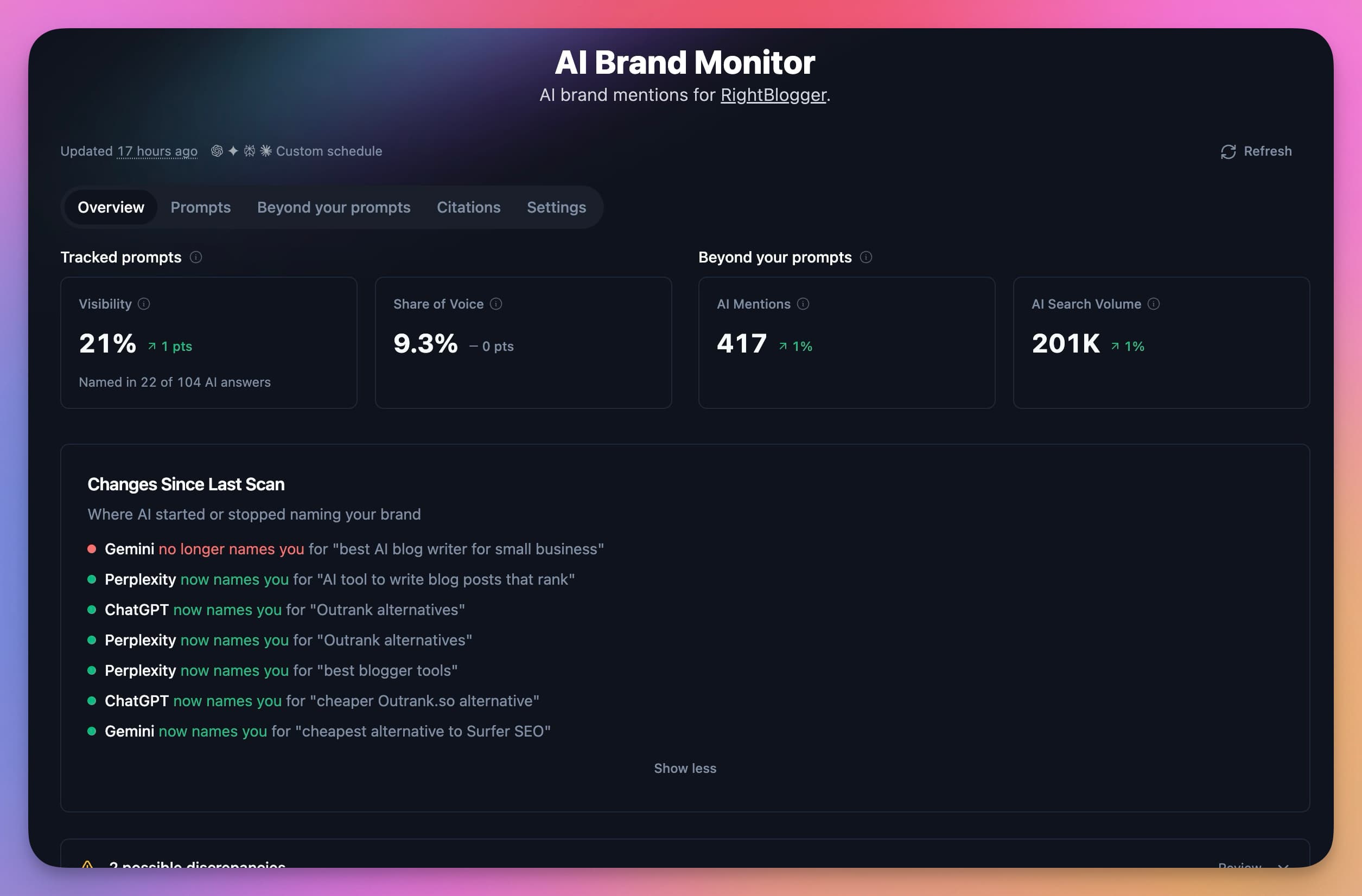
- AI answer engines. Nobody has shown that ChatGPT, Perplexity, or Google AI Mode weigh provenance marks when choosing what to cite. Watch it, but do not build a strategy on it. If you want to know whether AI answers cite you today, that is what the AI Brand Monitor tracks.
Here is what that looks like for RightBlogger itself. The monitor tracks which buyer prompts name the brand on ChatGPT, Gemini, Perplexity, and Claude, and flags where that changed since the last scan. Nothing in it reads a watermark, and nothing suggests the AI answers read one either. They cite the pages that answer the question well.
For what does move AI citations, see our guide to generative engine optimization. The short version is that clear, well-sourced, specific pages get cited, and a watermark has nothing to do with any of that.
Watermarks Are Not AI Detectors
Two things get lumped together here that should not be. AI detectors guess from writing style and are known for flagging human writing. A watermark check uses a secret key and produces a statistical confidence about one provider’s models. The first is a guess. The second is closer to a receipt.
| AI detector | Watermark check | |
|---|---|---|
| How it works | Patterns in writing style | A secret key and the model’s word choices |
| Who can run it | Anyone | The provider that holds the key |
| Human text flagged by mistake | Common | Controlled by a confidence threshold |
| Short passages | Unreliable | Too little signal to call |
| Heavily edited text | Sometimes still flagged | Mark is gone |
OpenAI’s announcement makes the same point from the other side: a watermark does not measure how much a human contributed, and the absence of one does not prove a human wrote the text.
What to Do About It
- Edit for value, not for evasion. Add your data, your examples, and your judgment, and cut the filler. That is what ranks, and it happens to erode the mark as a side effect. Our guide to running an AI content pilot shows how to keep a human in the loop at scale.
- Disclose where it is required. If a client, publication, or platform asks, answer honestly. The receipt exists now, so the honest answer is also the safe one.
- Skip the “watermark remover” tools for text. If you are editing heavily enough to remove a mark, you have already rewritten the post. Rewriting is the work, so do it for the reader.
If you maintain older posts with automation, the same rule applies: review the edits. Our Site Agent queues its changes for approval for exactly this reason, and the AI image copyright audit covers the C2PA side for the images you publish.
Claude Watermark FAQ
Does Claude watermark text?
Yes for supported models. Claude models launched on or after August 2, 2026 embed an invisible watermark in generated text (worldwide) and attach C2PA provenance metadata to generated files. Anthropic’s help center lists which products and models are covered and says models launched before that date are being added under the law’s transition period, with all covered by December 2, 2026.
How does the Claude watermark work?
It nudges which word the model picks when several would fit, following a secret key, without changing the odds enough to affect quality. A detector with the key rescores the text and looks for that lean across a few hundred words. Anthropic describes its approach in its own write-up linked above.
Is there a Claude watermark detector?
Yes, but not for the public yet. Anthropic’s detector is in private preview for eligible organizations (regulators, law enforcement, media, fact-checkers, researchers, educational organizations, and EU civil society groups) and for enterprises that must verify marks for their own compliance, with an access request form and plans to expand the detection API. Only a holder of the key can check for the mark, so anything else that claims to detect the Claude watermark is guessing from style, which is a different and far less reliable thing.
Does Claude Code output get watermarked?
Anthropic says the marks apply across its products, including Claude Code. In practice the signal is weak in code, because syntax leaves few free word choices, so the mark mostly lives in comments and variable names and is easy to lose.
Does ChatGPT watermark text?
In the EU, yes, as of OpenAI’s October 5, 2026 announcement. An invisible watermark is rolling out to eligible ChatGPT and Codex text in the EU over the following weeks, on all plans, and API customers anywhere can opt in for select models. Outside the EU, ChatGPT text is not watermarked by default for now. As with Claude, the detector is not public: access is limited to approved researchers and expert organizations.
Can Google detect AI content?
Google can verify SynthID and C2PA marks on images and media, and it announced Search and Chrome labels for that at I/O 2026. For text, it has never claimed to detect AI writing as such, and its guidance is to rank on quality rather than on how a page was produced.
Does SynthID affect rankings?
There is no evidence that it does. Google has marked its own Gemini output since 2024 without any ranking effect, and it has announced none.
Is AI content bad for SEO?
Unedited, generic AI content is bad for SEO because it is thin, not because it is AI. Google’s policies target scaled content abuse. Edited, specific, useful AI-assisted content ranks fine, watermark or not.
Final Thoughts on AI Watermarks and SEO
Watermarks are here to stay, and they are a reasonable thing for regulators to want. If you were worried about them as an SEO signal, you can stop. If you were counting on nobody being able to tell that your site was untouched AI output, that era is ending, and it was never a good era for readers anyway.

RightBlogger Co-Founder, Andy Feliciotti writes about AI, SEO, and website development. He also enjoys photography and travel.


Automated SEO Blog Posts for Your Site
Research, write, publish, and share from one account.
7-day free trial. Cancel anytime.





Leave a comment
You must be logged in to comment.
Loading comments...