How to Build an SME Review Queue for AI Drafts
Route drafts by risk and expertise, then give SMEs focused questions, clear approval stages, and an auditable record.

AI can produce a useful draft in minutes. It can also invent a statistic, miss a critical detail, or make a confident claim a subject matter expert would never approve.
That is why content teams need more than a simple approval button. A well-designed SME review queue sends the right drafts to the right experts, gives them clear questions to answer, and tracks the outcome of every edit.
The goal is not to force your team members to rewrite every AI draft. Instead, the focus should be on utilizing their time where their specialized knowledge makes the biggest difference for your brand authority.
Key Takeaways for an SME Review Queue
- Route drafts based on topic, risk, audience, and the specific technical skills required for an accurate review.
- Provide SMEs with focused review questions rather than handing them a blank document.
- Separate factual approval from standard editing, SEO, legal, and brand review processes.
- Track queue age, revision rounds, approval rates, and recurring errors.
- Conduct a regular skills assessment of your review process to ensure the workflow remains effective.
- Use expert feedback to improve future AI drafts, not just the content currently under review.
Why AI Content Needs a Structured Review Queue
Sending every AI draft to every expert sounds safe. In practice, it creates delays, duplicate work, and review fatigue.
An SME may spend 30 minutes fixing minor wording issues before reaching the one technical claim that needs attention. An editor may ask for a fact check that falls outside the SME’s field. A legal reviewer might receive content that never needed legal approval.
Your queue should prevent those problems before the draft ever reaches a reviewer, so each piece only lands with the person best suited to handle it.
Start by separating content risk from content volume. A short product update about a familiar feature may need a quick accuracy check. A medical, financial, legal, security, or compliance-related article needs a much more careful review.
Risk often depends on four factors:
- How much harm an incorrect claim could cause.
- How technical or specialized the subject is.
- How quickly the information may become outdated.
- Whether the draft makes claims about your company, product, customers, or competitors.
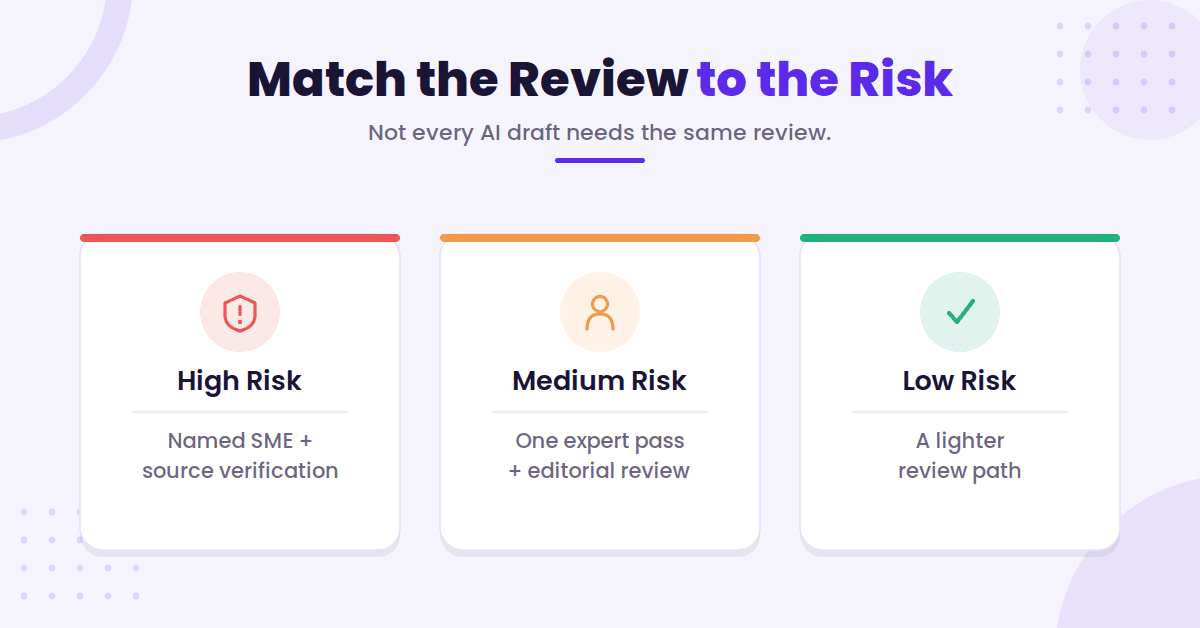
High-risk drafts need a named SME, source verification, and a clear approval record. Medium-risk content may need one expert pass plus editorial review. Low-risk drafts can often move through a lighter review path.
The queue should also protect your SMEs from unnecessary requests. Their time is expensive, and their role is not to repair every sentence produced by an AI tool.
Editors should handle structure, clarity, grammar, formatting, and basic search optimization. SMEs should apply their domain expertise to focus on accuracy, missing context, accepted terminology, practical limits, and claims that require firsthand knowledge.
The best review queue does not send more work to experts. It sends them better-defined work.
Define the Review Policy Before Building the Queue
A review queue needs rules that stakeholders can understand without needing a formal meeting. Write those rules before choosing a project board, ticketing system, or content platform. Write them down so they apply the same way to every AI-generated draft.
Begin with the approval conditions. A draft should not move to approved until the required reviewer confirms the points that matter for that content type. Every review task should also carry a unique ID, so you can trace a draft from intake through to publication.
For most AI-generated articles, the policy should answer these questions:
- Which claims require a source?
- Who verifies statistics, dates, prices, and product details?
- Which topics require an SME review?
- When does legal, security, or compliance review apply?
- Who can approve changes after the SME requests revisions?
- What happens when the assigned expert does not respond?
Do not ask SMEs to review the article without providing specific direction. Give them a short review brief that includes the audience, purpose, target query, publication date, and known risk areas.
A useful brief might say:
Confirm that the product workflow is accurate, check all technical terms, and flag any claim that needs a source. Ignore sentence-level edits unless the wording changes the meaning.
That instruction reduces low-value comments and helps the reviewer make a decision faster.
Set evidence rules as well. Your team might require a source for research claims, a current internal document for product information, or a named expert sign-off on high-risk claims. Most teams do not need new software for any of this. A shared board with a review column, or your CMS’s own editorial statuses, is enough to see what is waiting on an expert and for how long.
1EdTech’s AI-Generated Content Best Practices, written for the education sector, makes a similar point: storage practices for AI-generated content should support transparency, accountability, and compliance across the full lifecycle of the content. Keep the prompt, draft version, reviewer comments, final approval, and publication date together.
That history matters when someone asks why a claim appeared, who approved it, or whether the content was reviewed before publication. Harvard’s generative AI guidance makes the same basic point under the heading “Review content before publishing or sharing”: you are responsible for any AI-generated material you publish.
Build the Queue Around Clear Review Stages
Once the policy exists, turn it into a small number of visible queue stages. Avoid creating a separate status for every minor action. People should know what each stage means and what they need to do next.
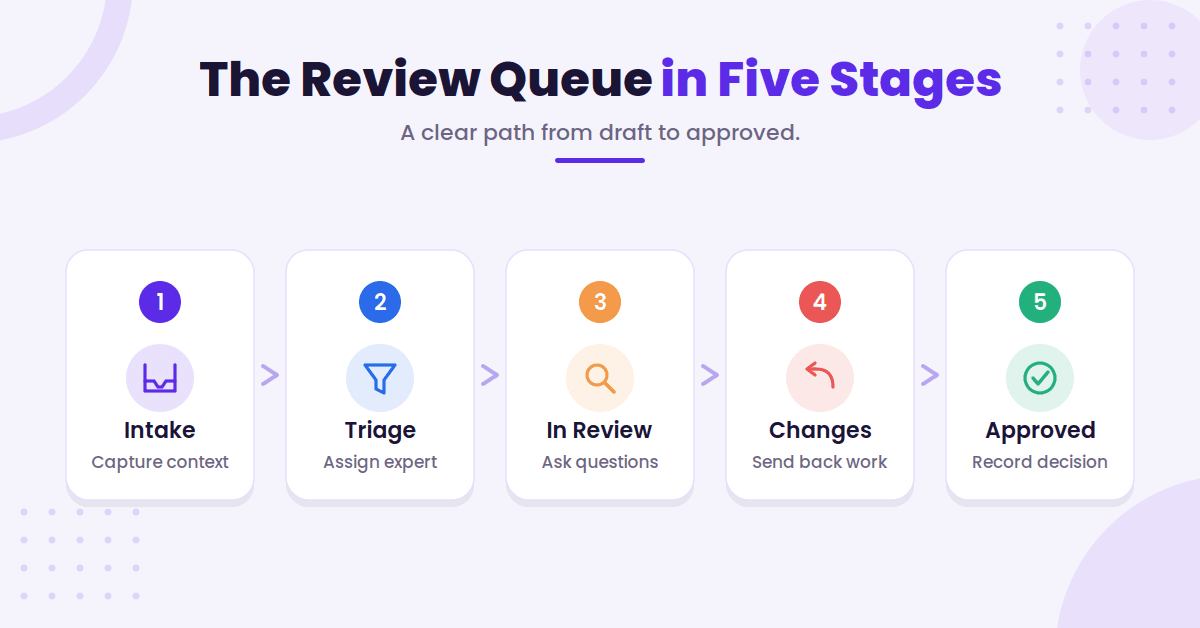
A practical workflow looks like this:
1. Intake Captures the Review Context
Every draft enters the system via an application flow that captures the information an SME needs to make a good decision. Include the title, content type, owner, target audience, subject area, risk level, due date, and links to relevant source material.
Add the AI tool or workflow that created the draft. If the article came from a template, record that too. Different templates often create different errors, and that pattern becomes useful later.
2. Triage Sends the Draft to the Right Expert
A content lead or managing editor reviews the intake details and assigns the draft. Routing can follow topic, product area, region, customer type, or technical specialty.
Do not assign based only on job title. A product marketer may know the positioning but not the implementation details. A developer may understand the feature but not the customer workflow. Choose the reviewer who can check the claims the draft actually makes.
3. In Review Gives the SME a Defined Task
The reviewer receives the draft, brief, source links, and a deadline. Keep the review request focused on three to five questions.
For example:
- Is the process accurate for the current product version?
- Does any statement overpromise the result?
- Are the terms correct for this audience?
- Which claims need stronger evidence?
- What important limitation is missing?
A focused request is easier to complete than a general call for feedback.
4. Changes Requested Sends Work Back With Reasons
An SME should never need to rewrite the whole draft to communicate one correction. Comments should identify the problem, explain the accurate version, and point to a source when possible.
The editor then makes the change and returns only the relevant section for confirmation. Don’t send the entire article back for approval when a single sentence changed.
5. Approved Records the Decision
Approval should identify who approved the content, what they reviewed, and when they approved it. Set the status to approved only after required changes are complete.
Use separate labels for SME approved, editor approved, and legal approved. One approval shouldn’t imply that every review is finished.
A visible workflow keeps drafts moving without hiding unresolved questions.
Make SME Feedback Fast and Useful
The quality of your queue depends on the precision of the comments inside it. A vague note like this doesn’t sound right may be true, but it fails to tell the editor exactly how to improve the content.
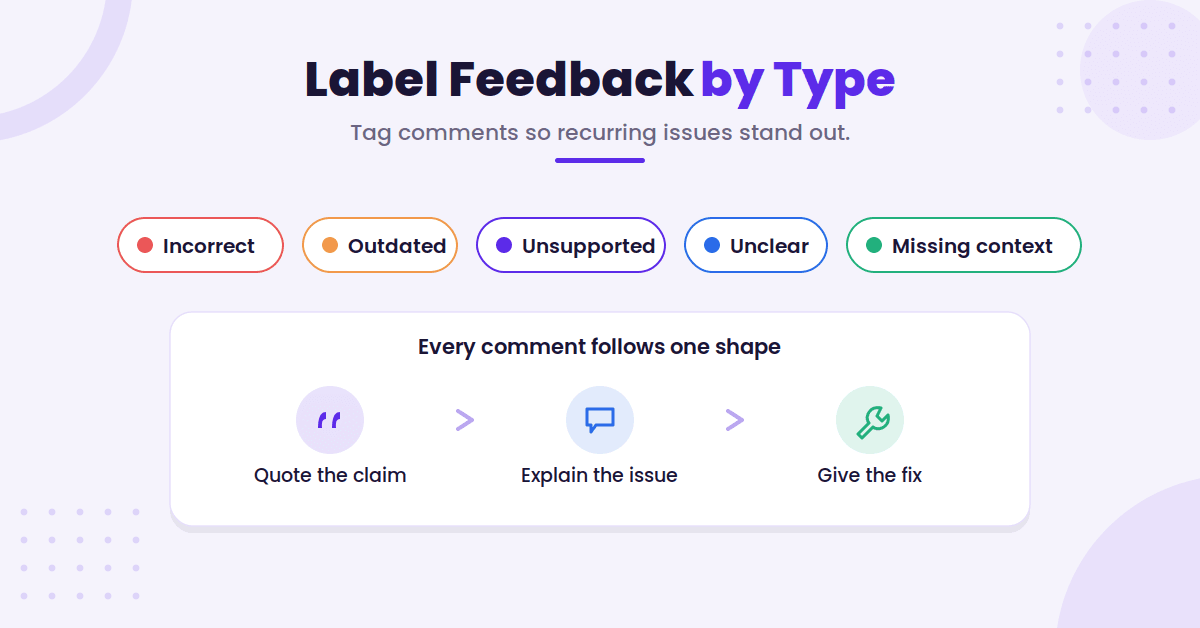
Ask reviewers to focus on accuracy and reasoning rather than just performing basic factual checks. Encourage them to label feedback by type. Useful labels include incorrect, outdated, unsupported, unclear, and missing context. These labels make recurring patterns easier to spot across many drafts.
Request comments at the sentence or paragraph level. The reviewer should quote the claim, explain the issue, and provide the approved wording or supporting source. It helps to keep a few examples of well-formed corrections on hand, so editors can see exactly how a reviewer expects fixes to be applied.
For example:
The integration sends data instantly is too broad. It runs on a scheduled sync, so change instantly to during the next scheduled sync.
That comment is far superior to a general note about accuracy. It gives the editor a clear fix and teaches the content team how the product works.
Keep editorial and expert comments separate. If an expert starts correcting every heading and transition, the queue becomes slow. Conversely, if an editor changes a technical statement without vetting it, the draft can become less accurate.
For teams using RightBlogger, the human editing guide for AI blog posts offers a useful division of work between clarity, trust, and factual review. RightBlogger’s guide to providing feedback for AI generation also shows how specific feedback can shape later content in the same project.
That feedback loop is vital. If experts repeatedly correct the same product term, missing caveat, or weak claim, feed those insights straight back into your AI prompts. By reviewing the corrections, you can update your reference material or content templates. Don’t make experts solve the same problem in every draft.
Set Ownership, Deadlines, and Escalation Rules
A queue needs one clear owner to function effectively. That person spots blocked drafts, balances the load across reviewers, and decides when a review needs escalating.
Give each risk level a review window that aligns with your broader publishing schedule. A low-risk update might have a one-business-day target, while a technical guide may require several days to allow the subject matter expert to verify documentation, test workflows, or confirm release details.
Do not measure your experts solely by their speed. A fast approval that overlooks a serious error is far more costly than a careful review that takes an extra day.
Create a clear escalation path for common problems:
- If the expert does not respond, the queue owner contacts a pre-assigned backup reviewer.
- If two experts disagree on a technical point, the subject lead makes the final decision.
- If the draft contains a high-risk claim without supporting evidence, the publication process stops immediately.
- If the content is outdated, return it to the writer instead of asking the expert to rebuild the entire piece.
Make the next action for every draft obvious. Each item in your queue should have one owner, one due date, and one current question. If a status card simply says waiting, the team will not know if it is waiting for a source, an edit, a decision, or an expert’s input. Providing this clarity ensures your review process remains efficient and accountable.
Measure What the Queue Is Teaching You
Track a small set of metrics each month to gauge your progress. You do not need a complex dashboard to identify useful patterns.
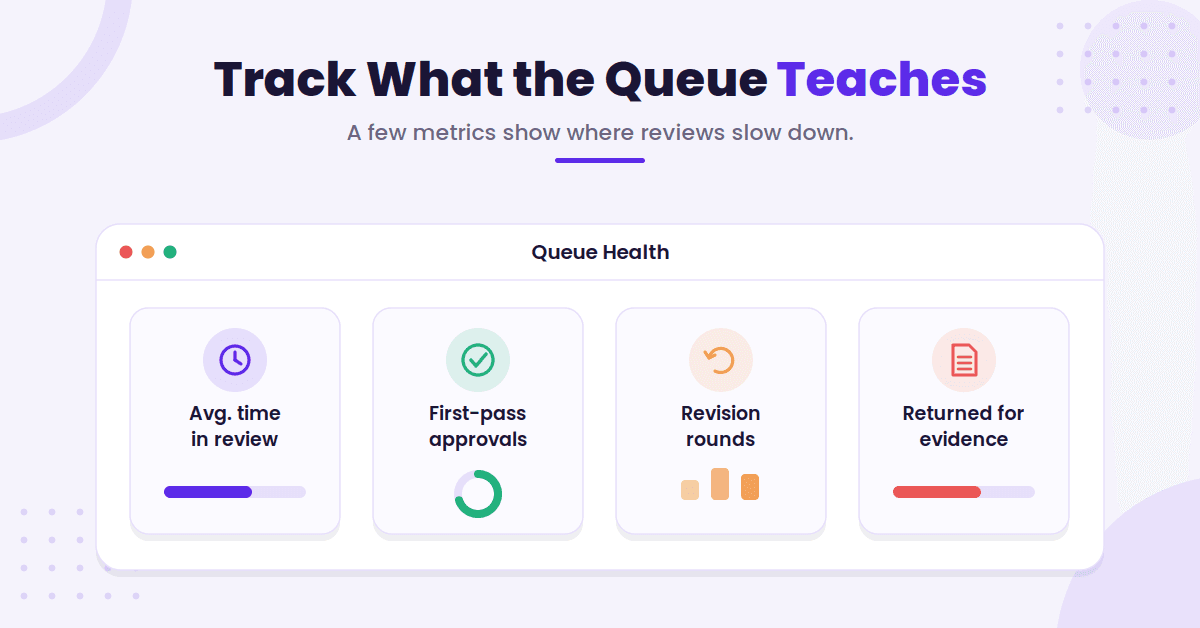
Start with average time in review, the percentage of drafts approved on the first pass, the number of revision rounds, and the volume of drafts returned for missing evidence. Track how often a draft gets reassigned, too, since that tells you whether triage is routing to the right expert.
If technical terms are consistently wrong, improve your reference material. If claims are too broad, update the prompt and include examples of approved language. If drafts frequently reach the wrong person, refine your routing rules.
Watch for queue aging. A growing number of overdue drafts usually points to a capacity problem, unclear ownership, or poor triage rather than a need for faster work. Ask the team where drafts keep getting stuck, since they usually know before the metrics do.
Review the queue with your content team, not just your operations team. The writers and editors can often spot a recurring AI failure before it appears in the data. Reviewing the queue this way will help you refine your AI-driven content strategy for better long-term results.
FAQs About SME Review Queues
Here are a few additional questions you might have.
Should every AI draft receive SME review?
No. Route drafts according to risk and subject complexity. High-risk or highly technical content requires a subject matter expert, while low-risk content may only need standard editorial and source checks. Anything touching medical, financial, legal, or security topics should always get an expert pass.
What should an SME review in an AI draft?
The subject matter expert should check facts, terminology, limitations, technical steps, current product details, and any claims that require specialized knowledge. That matters most on regulated or high-stakes topics, where procedural accuracy is not optional. Editors should handle grammar, structure, formatting, and general readability.
How long should an SME review take?
Set the time based on risk, length, and complexity. A short accuracy check may take only a few minutes. A long technical article can require a longer stretch of focused attention. Track your real review times and adjust deadlines so the process stays sustainable.
What if the SME wants to rewrite everything?
Ask the subject matter expert to identify the specific claims that are incorrect or incomplete. Allow the editor to handle the rewrite based on those notes, then send the changed sections back to the expert for final confirmation. This workflow ensures that expert time is focused on verifying accuracy rather than manual drafting.
Final Thoughts on Building an SME Review Queue
A well-designed review queue transforms how your organization leverages expert knowledge to create a repeatable, high-quality content process. By making the workflow explicit, you ensure that the right subject matter expert is assigned to the right content, while using focused questions to streamline their feedback into the broader AI production loop.
Do not treat every subject matter expert as a simple proofreader for AI drafts. Instead, leverage their unique insight to protect your brand trust and ensure long-term accuracy. When the process works, your experts spend less time on minor edits and more time validating the core value of your content. By refining your review queue, you turn expert oversight into a strategic asset that keeps your AI-generated content reliable, authoritative, and consistently valuable.

Article by
RightBlogger Co-Founder Ryan Robinson teaches creators to build trusted online businesses and is a recovering side project addict.




Automated SEO Blog Posts for Your Site
Research, write, publish, and share from one account.
7-day free trial. Cancel anytime.





Leave a comment
You must be logged in to comment.
Loading comments...