Google AI Mode SEO: How Bloggers Win in 2026
Lead with a direct answer, add original evidence AI can’t flatten, and refresh posts with impressions but few clicks.

Google search does not feel like the same place it did two years ago. Navigating the modern AI search landscape now means thinking about how your post gets quoted, featured in AI Overviews, or skipped entirely, rather than just focusing on traditional rankings.
That shift can feel rough if you previously built traffic from simple how-to posts or quick answers. However, it also opens a cleaner path for bloggers who write with clarity, proof, and a distinct point of view.
The blog posts that win in 2026 are the ones that answer fast, go deeper, and give Google something worth citing. Here is how to make that work without turning your site into a pile of generic summaries as you adapt to the standards of generative engine optimization.
Key Takeaways for Google AI Mode SEO
- AI-generated answers often increase zero-click searches by resolving simple queries instantly, particularly for questions that fit within a single paragraph.
- Strong posts that address complex queries still earn consistent traffic when they lead with a direct answer before providing deep, expert-level proof.
- Incorporating original examples, personal experience, screenshots, and proprietary research is essential for establishing brand authority in an AI-driven search landscape.
- While a clean structure helps Google interpret your page, technical formatting alone cannot compensate for thin or low-value content.
- Prioritizing a steady content refresh system is far more effective for long-term growth than maintaining a random publishing streak.
If you want a broader system for this, build an effective SEO content strategy around topic clusters, regular updates, and supporting links. Focusing on user intent and a structured internal linking architecture will serve you much better than publishing whatever pops into your head that week.
How Google AI Mode Changes Your Traffic Potential
AI Mode is out of Labs and available globally, and Google made Gemini 3.5 Flash its default model at I/O 2026. It is not the default search experience, though: Google says you will “continue to get a range of results from Search, just like you do today,” and in June 2026 its VP of Search Engineering said flatly that AI Mode would not become the default for Chrome searches. What has changed is the mix. An answers first, links second layer now sits on top of the classic results, which changes how we define a high performing blog post.
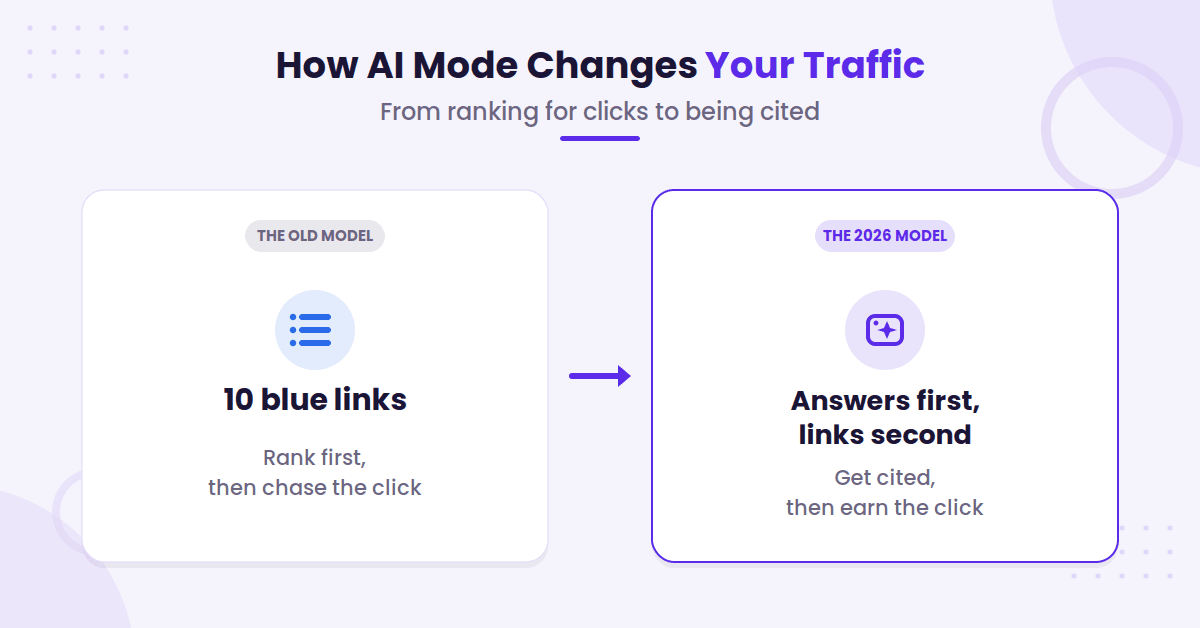
For many bloggers, this evolution means a dip in traffic for simple informational queries. Through conversational search, Google can now answer questions like what is X or how do I do Y directly on the results page.
While your content still plays a role in shaping these responses, the classic rank and get the click flow is becoming significantly less reliable. Furthermore, Google often uses query fan out to explore broader topics, meaning they pull from multiple sources to synthesize an answer before a user even considers clicking a site.
If a post can answer the question in one paragraph, AI Mode can probably answer it in one paragraph too.
This environment increases the risk of zero-click searches, where users find what they need without ever leaving the search engine. However, your blog is not doomed.
It simply means the bar for success has moved. Posts that rely on thin details or generic research are the first to fade. To remain competitive, your work must feature original examples, actionable advice, and a distinct human voice.
Think of it like this: Search used to hand out full meals. Now, it serves a synthesized sample first.
If your content is the kind that leaves readers satisfied with that initial summary, they will not click through. But if your content offers deeper insights that make them still hungry for more, they will click to learn exactly how you arrived at those conclusions.
What Content Still Gets Clicks
Lead With The Answer
The first lines of your post matter more now. Don’t hide the answer behind a warm-up paragraph, a long story, or a cute opener that says nothing.
Say the point fast. Then unpack it.
If someone lands on your page from a search result, they want to know three things in a blink. Did they reach the right page? Did you solve the problem? Is there more worth reading?
A strong first paragraph handles all three. It gives a short answer, names the problem, and promises the rest without sounding stiff. That style works for readers and for search systems that try to pull clean answers from your page.
Give Readers Something AI Can’t Flatten
Google AI Mode can summarize common advice, but it cannot replace what only you know. Relying on generic insights leads to content that feels shallow, while incorporating real texture demonstrates your E-E-A-T (Experience, Expertise, Authoritativeness, and Trustworthiness). To earn citations, back your claims with named sources and original data that only your work can produce.
Adding personal screenshots or documentation from your own workflow helps build brand authority, signaling to both readers and algorithms that you are the original source. The more your post sounds like it came from actual work, the more likely it is to stand apart from every other article on the same topic.
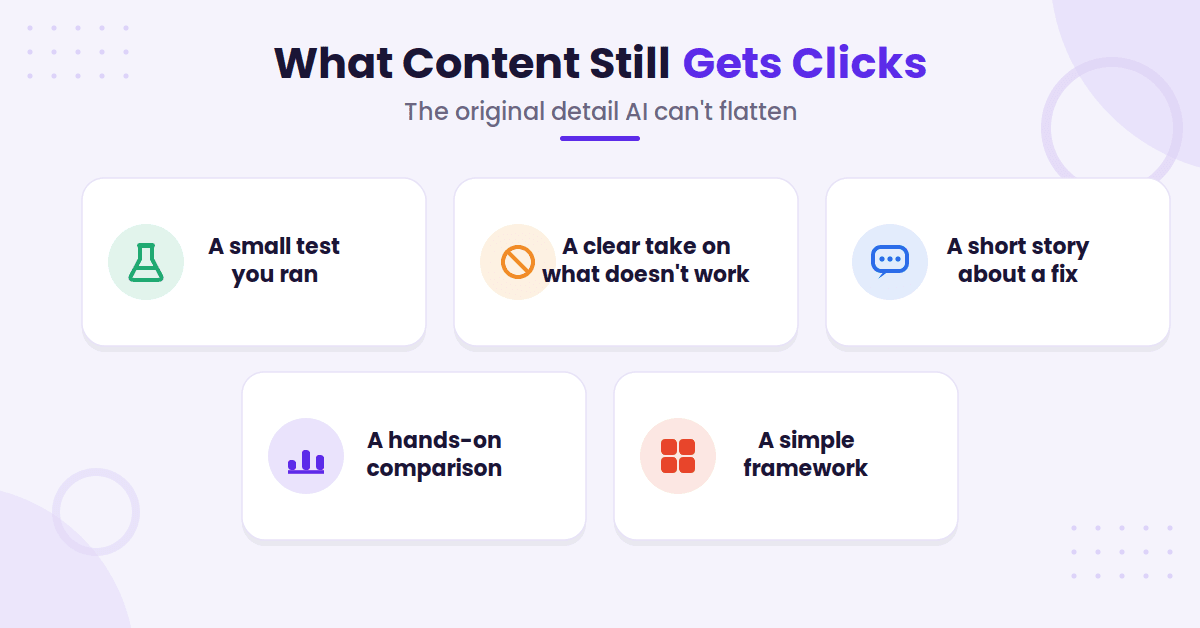
Here are the kinds of details that still pull weight:
- A small test you ran and what changed.
- A clear opinion on what does not work.
- A short story about how you fixed a problem.
- A comparison based on your own use, rather than a copy of existing product descriptions.
- A simple framework readers can use right away.
This mix does two jobs. It helps the reader, and it gives Google a stronger reason to treat your page as a trusted source instead of just another echo.
Write For Specific Questions, Not Just Broad Terms
Broad topics are where AI answers hit hardest. Specific questions are easier to own because they address complex queries where a nuanced, human perspective is preferred.
A post about email marketing has to fight a huge crowd. A post about how to write a welcome email for a paid newsletter has a better shot because the intent is tighter and the need is clearer. Focusing on these specific needs helps you build topical authority over time.
That doesn’t mean you should chase tiny topics forever. It means your content should answer a clear job-to-be-done.
One page, one promise, one outcome. That is the shape that survives when search results become more competitive.
On-Page SEO That Still Helps in 2026
Google’s AI features changed the click path, but they did not erase basic on-page work. Clean pages are still prioritized by search algorithms, and content written in natural language remains easier for both readers to digest and AI models to quote. Mastering Google AI Mode SEO is less about gaming the system and more about ensuring your content is optimized for the era of personalized search.
Start with headings that match exactly what readers want to know next. Use short sections and keep the first few paragraphs tight. Put the main answer near the top, then use the rest of the post to provide evidence or depth.
Titles still matter as much as ever. Google trims by visual space rather than character count, so a tidy title often beats a clever one. If a title looks chopped on mobile, it may lose the click before the reader even sees your first sentence.
Supporting links also play a vital role. They provide Google with a clearer map of your site and help readers move from one related answer to the next.
If you publish content around a cohesive theme, you are not just writing posts, you are building a structure. If you need a more reliable rhythm for publishing and updates, automate your blog publishing so your content calendar does not depend on your daily mood.
A few small habits go a long way in 2026:
- Keep one page focused on one specific search intent.
- Use descriptive headings instead of clever ones.
- Answer the main question early using natural language.
- Implement structured data to help search engines understand your content.
- Include supporting links to related posts where the next step makes sense.
- Trim fluff that repeats what the title already said to become one of the cited sources.
The goal is not to make every page look the same. The goal is to make every page easy to scan, easy to trust, and easy to pull into a citation if Google wants to use your work as a reliable answer.
Refresh Old Posts Before You Write New Ones
The fastest wins in 2026 often come from pages you already have. If a post gets impressions but weak clicks, that is a clear signal. If a page keeps slipping in rank, that is a signal too.
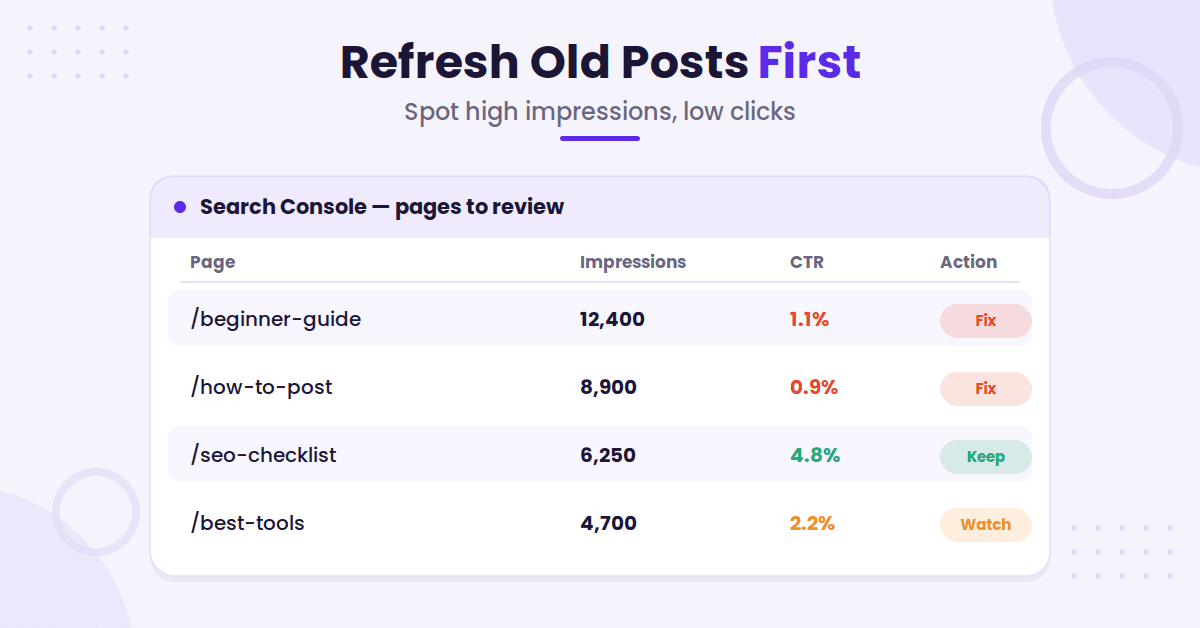
Google Search Console is the first place to look when identifying these opportunities. Find pages with high impressions and low click-through rates, then check the specific queries they show up for.
Sometimes the fix is simple: the title is vague, the opening is weak, or the answer starts too late. By using Search Console to pinpoint these gaps, you can better satisfy the intent of the searcher.
When you update these pages, you are doing more than just polishing text. Fresh, clearer copy changes how Google’s systems interpret the page, which helps them match it to current search intent the next time it is crawled.
If you do not have analytics set up, you can still improve your site by tightening headings, adding internal links, and updating stale examples. Removing outdated claims is equally important for maintaining authority.
This refresh work is vital because AI Mode favors pages that look current, clear, and useful. A post that already has traction is far easier to elevate than a brand new piece of content fighting from zero. By maintaining older posts alongside new publications, you build a site that feels active and authoritative without sounding frantic.
What a Strong 2026 Blogging Workflow Looks Like
The best workflows in 2026 are not about churning out content for the sake of volume. Instead, they focus on making each post contribute to a comprehensive Google AI Mode SEO strategy. By focusing on quality, you ensure that every article helps establish your brand authority across the web.
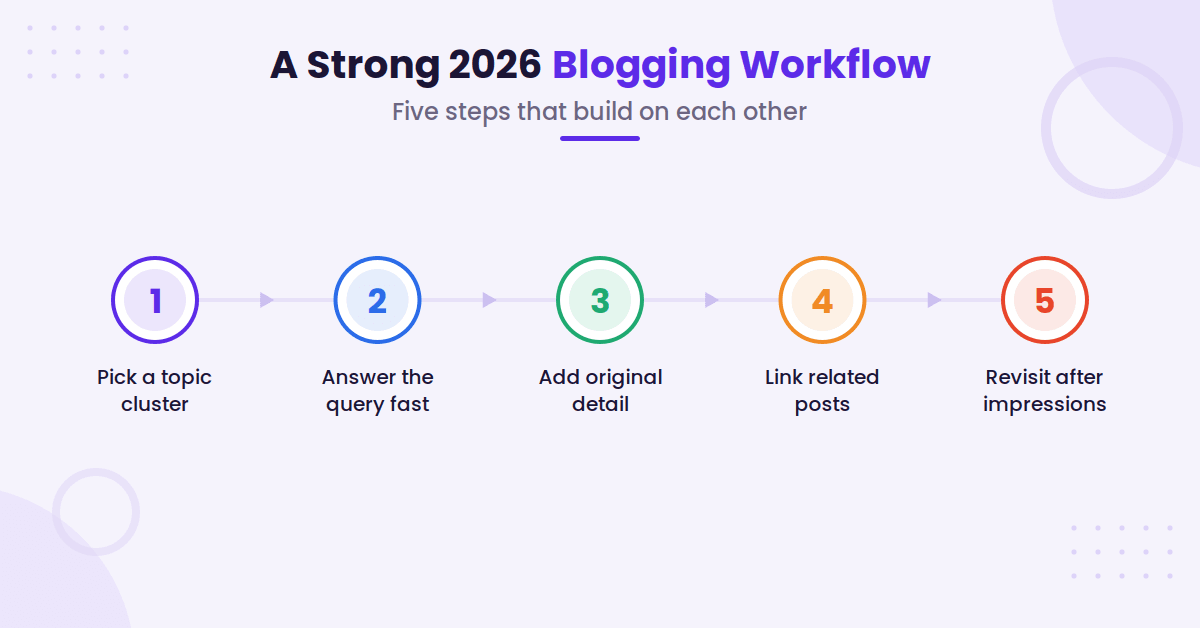
A simple, effective workflow looks like this:
- Pick a topic cluster that matches your site’s core theme.
- Write one page that answers the main query fast.
- Add original detail that AI cannot flatten.
- Link that page to related posts so each piece supports the others.
- Revisit it after it starts getting impressions.
That rhythm is boring in the best way. It keeps you from chasing shiny topics that never build on each other.
It also fits the way search is changing. Google AI Mode rewards pages that feel like part of a larger body of work. The more connected your posts are, the easier it is for readers and search systems to recognize your expertise.
If you want a deeper planning model, use a content map before you write. That is where most bloggers win or lose in 2026. Success is not found in the final edit or a minor title tweak, but in the deliberate choice of what to publish next to solidify your topical relevance.
FAQs About Google AI Mode SEO
Here are a few additional questions you might have about Google AI Mode SEO.
Does Google AI Mode kill blog traffic?
No. It changes where the traffic comes from and what kind of page earns it. While AI overviews may capture simpler queries, deeper posts that offer original insight can still drive high-quality traffic and improved brand authority.
What kind of posts are most at risk?
Definition posts, quick tips, and thin how-to articles are the easiest to replace with an AI summary. Content that only rewords common information struggles to compete, especially when users perform complex queries that require a more comprehensive, expert perspective.
How do you get cited in AI answers?
To get cited, write clear answers near the top of your post, then support them with useful, authoritative detail. Google values content that utilizes natural language to address user intent. Incorporating proper structured data can also help search engines better understand your content, making it easier for them to feature your work as a trusted source within a conversational search experience.
Should bloggers publish more or less in 2026?
Neither extreme works well. Success in 2026 comes from publishing with a clear strategy. A smaller number of high-quality, interconnected posts will consistently outperform a flood of weak, thin pages that lack depth.
Is internal linking still worth the time?
Yes. Internal links help readers move through your site and provide search systems with a clearer map of your topical authority. In a search environment that places significant weight on context, a well-linked site structure is more important than ever.
Final Thoughts on Google AI Mode SEO
Google AI Mode changed the old bargain. A ranking is no longer the whole prize, and a click is no longer automatic.
The bloggers who adapt fastest will write for answers, add real proof, and keep their best pages fresh. That is the sweet spot now, as it is clear enough for search and strong enough for people.
If your posts can still give someone a reason to keep reading after the summary, you are on the right track. That is the real work in Google AI Mode SEO now, and it is work that still pays. As you move forward, remember that success depends on your ability to stay agile and responsive within the constantly shifting AI search landscape.

RightBlogger Co-Founder Ryan Robinson teaches 500,000 monthly readers how to grow an online business and writes about SEO and blogging.
Automated SEO Blog Posts for Your Site
Research, write, publish, and share from one account.
7-day free trial. Cancel anytime.





Leave a comment