AI is Quietly Reshaping the Economics of Content Marketing
AI-heavy creators publish faster, but lasting gains depend on human judgment, original insight, and visibility across search and AI answers.

A massive shift is already underway in marketing. Artificial intelligence hasn’t replaced content marketing, but it’s fundamentally changed what it costs, how fast it moves, and who can actually compete in the arena.
For years, the economic model of content marketing relied heavily on large teams and big budgets acting as the primary barrier to entry. Thanks to AI tools, that model is now being disrupted from below.
Today, smaller and leaner teams can produce a volume of content that was out of reach just a few years ago. This is not abstract theory; it is happening right now in daily workflows and across marketing budgets everywhere.
The fundamentals of good content have not changed, but the economics underneath them are shifting fast. Here is a practical look at what that new reality means for your business and your bottom line.
Key takeaways for AI in content marketing
- AI is transforming content marketing by lowering production costs and speeding up processes, allowing smaller teams to compete effectively.
- Generative Engine Optimization (GEO) is on the rise, requiring marketers to adapt their content strategies for better visibility across platforms.
- Successful brands leverage AI for efficiency while maintaining strong human oversight in editorial judgment and strategic insights.
- It’s crucial to avoid common pitfalls like creating generic or inaccurate content, and focus on quality over quantity.
- Save time with AI on repetitive tasks but preserve human creativity and unique brand voice for impactful content.
What AI has actually changed about content production costs
Let’s get specific about the economic shift happening at the production level. Tasks like drafting, editing, ideation, repurposing, and translation are all meaningfully faster and vastly cheaper when you bring AI into your workflow. This new efficiency directly affects team sizing decisions, agency pricing structures, and the break-even point for your content investments.
When you create a website with an easy-to-use builder (like Wix), which has designer-made, fully customizable templates, setting up your blog and filling it with well-structured material no longer requires an enormous initial investment of time or money.
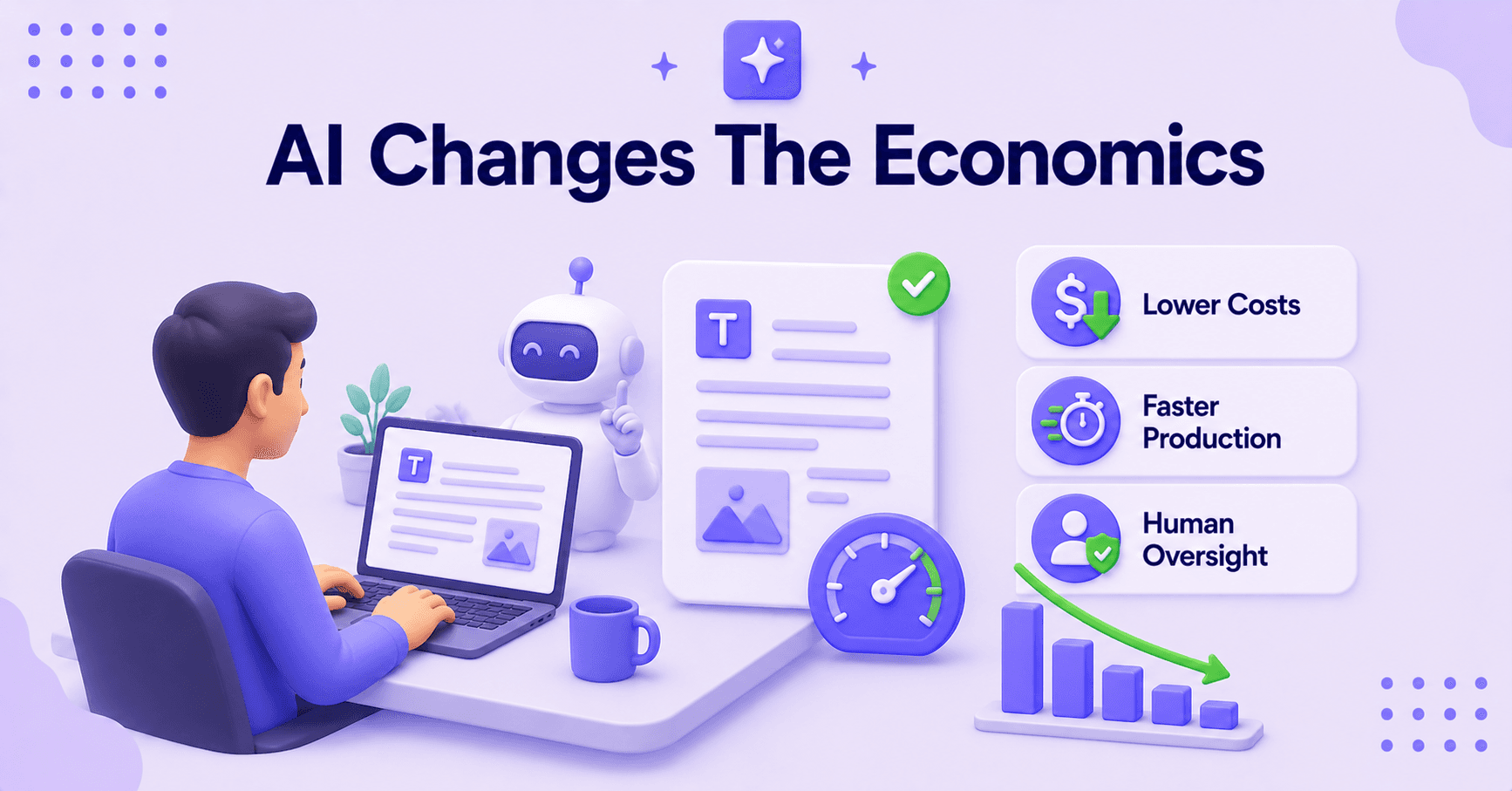
However, you need to acknowledge exactly what AI has not changed. Technology can’t replace your strategic thinking, your deep subject matter expertise, your sharp editorial judgment, or your unique ability to produce genuinely original insights.
The smartest content operations know this. They use artificial intelligence to handle the repetitive, tedious parts of the process. This frees up human effort to concentrate exactly where it matters most: creating the distinct, valuable perspectives that set your brand apart from the rest of the pack.
That’s the theory. Here’s what it looks like in practice.
We surveyed 81 bloggers, SEOs, and founders in 2026, asked how long a typical post takes them, then split the answers by how much of their content is AI-assisted.
The State of Blogging
Heavy AI users are the ones publishing in under an hour
% who publish a post in under an hour, by how much of their content is AI-assisted
Not shown, too few respondents to report: “0% — all human-written” (4). Any group under 8 is left out.
View the data
| Under 1 hour | 1 – 3 hours | 4 – 7 hours | 8 – 15 hours | More than 15 hours | Varies too much to say | Respondents | |
|---|---|---|---|---|---|---|---|
| 1 – 25% | 15.4% | 30.8% | 30.8% | 7.7% | 7.7% | 7.7% | 13 |
| 26 – 50% | 8.3% | 66.7% | 25% | 0% | 0% | 0% | 24 |
| 51 – 75% | 7.1% | 57.1% | 28.6% | 7.1% | 0% | 0% | 14 |
| 76 – 100% | 36% | 36% | 20% | 4% | 4% | 0% | 25 |
Source: State of Blogging survey, April–May 2026. 76 of 81 respondents answered this question.
The speed gain is real, but it only shows up at the deep end. Among creators whose content is 76–100% AI-assisted, 36% publish a post in under an hour. In the 26–50% band, it’s 8%.
The lightest users are the slowest group in the survey. Nearly half of them still spend four hours or more on a post — longer than the people using no AI at all.
That’s worth sitting with before you budget for a cautious pilot. A half-adopted workflow seems to cost you the overhead of the new process without the throughput that pays for it.
The new traffic landscape: GEO, SEO, and how to adapt
The most consequential shift we are seeing right now involves content distribution. Generative engine optimization (GEO) is rising rapidly alongside traditional search engine optimization (SEO), completely changing how you must structure and position your content to remain visible.
AI-driven search and answer engines are altering where readers arrive from and deciding which specific content formats get cited or surfaced as top answers.
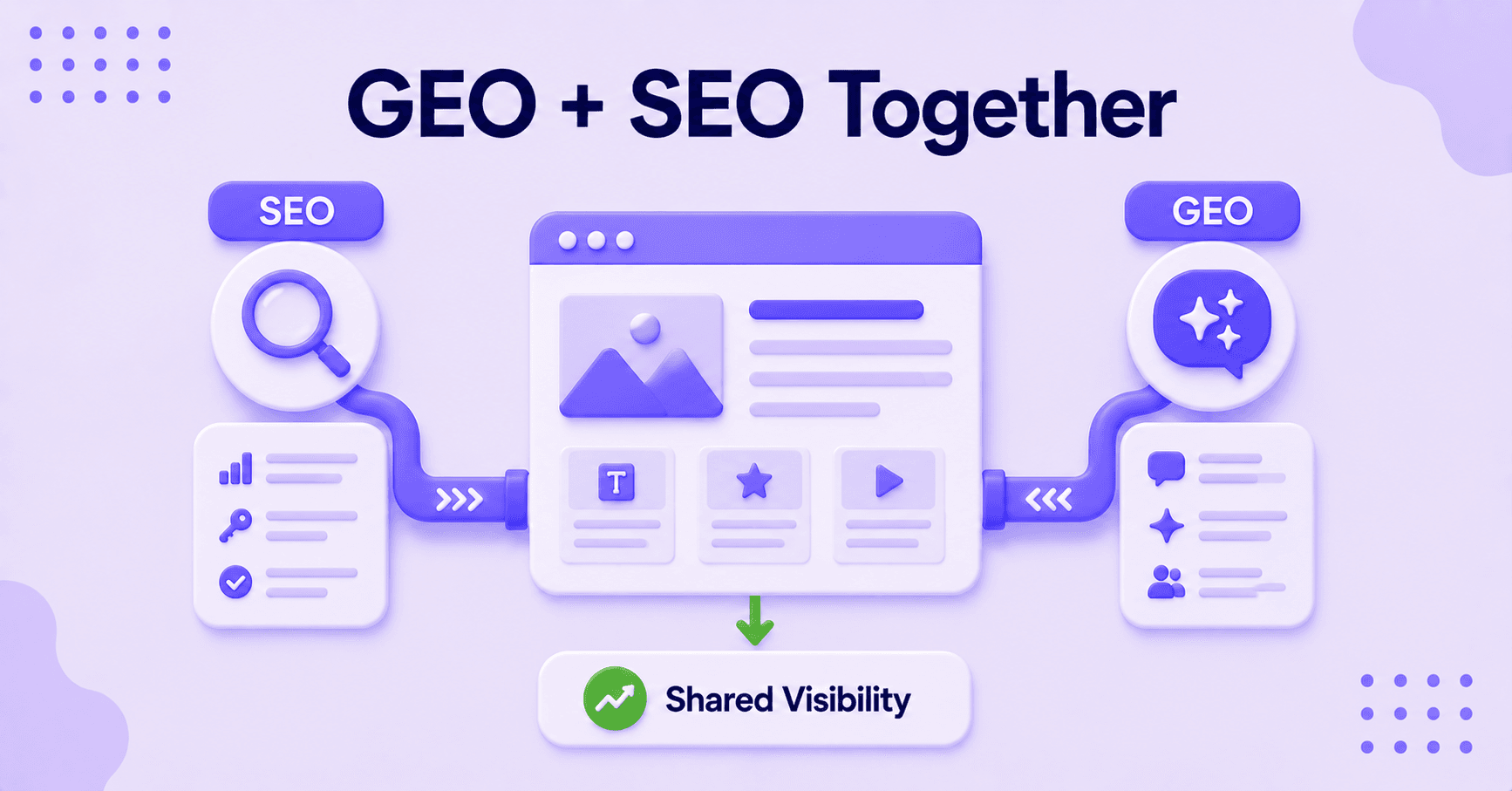
If you want to grow steady traffic across both of these distinct channels, you must understand the practical implications of this shift. You will often feel a tension between optimizing for a traditional crawler, the classic work of search engine positioning, and formatting for an AI model that synthesizes quick answers.
Establishing a clear, forward-thinking distribution plan helps you decide exactly where to invest your content effort, ensuring you reach eager readers without spreading your resources too thin.
The brands winning with AI-assisted content and what they have in common
If you look closely at the content operations currently pulling ahead in this new environment, you will notice they share a few powerful traits.
First, they hold a clear editorial point of view that a machine cannot replicate. They share bold opinions, draw from real-life experiences, and take strong stances on industry topics.
Second, they maintain a remarkably consistent publishing cadence, which AI-assisted production makes completely sustainable. Third, they use a diversified distribution plan that balances GEO vs SEO, so they do not lean on any single platform.
Finally, they maintain a tight feedback loop between their content performance data and their next round of topic ideation. They watch what works and immediately feed those insights into their prompts for the next project. This powerful combination creates a compounding advantage.
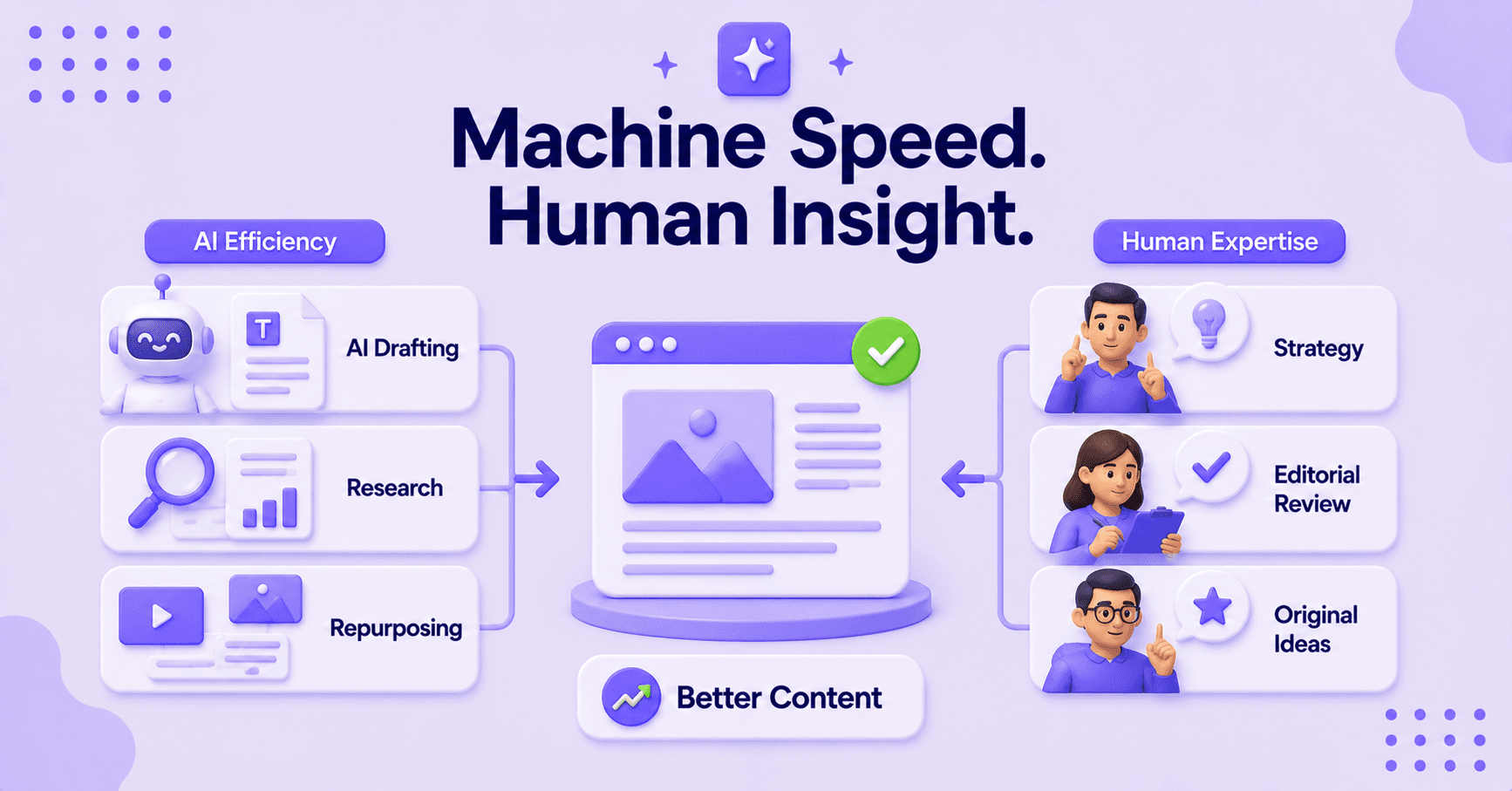
Pure AI output, lacking any strategic direction or human personality, simply cannot match the resonance of a brand that perfectly blends machine speed with human insight.
The content marketing mistakes AI can make at scale
Let’s flip the frame for a moment. While AI significantly lowers the cost of producing good content, it also dramatically lowers the cost of producing bad content. As more teams lean heavily on AI without sufficient editorial oversight, we’re seeing a few common failure modes multiply.
- The biggest offense is publishing generic content that matches a search query but adds zero original value for the reader.
- We also see content that sounds incredibly authoritative but contains confident, blatant inaccuracies.
- Relying on scattered prompts without a clear style guide leads to brand voice erosion, making a site sound like five different companies wrote it.
- A dangerous volume-first mentality often takes over, too. Teams confuse churning out daily articles for an actual growth strategy, trying to fill a calendar without putting any effort into building a meaningful relationship with their audience.
These mistakes are entirely avoidable with the right AI content marketing workflows in place, so treat them as warnings rather than reasons to avoid using modern tools.
How to build a content operation that uses AI without being defined by it
You can integrate AI into your workflow while keeping your quality and identity intact. You just need a model that separates the work the right way.
Start by dividing your process into AI-assisted tasks and human-owned tasks. Give the machine the heavy lifting: let it handle research synthesis, rough first drafts, metadata, and repurposing long articles into short social posts. A platform like RightBlogger rolls most of that AI-assisted work into one place.
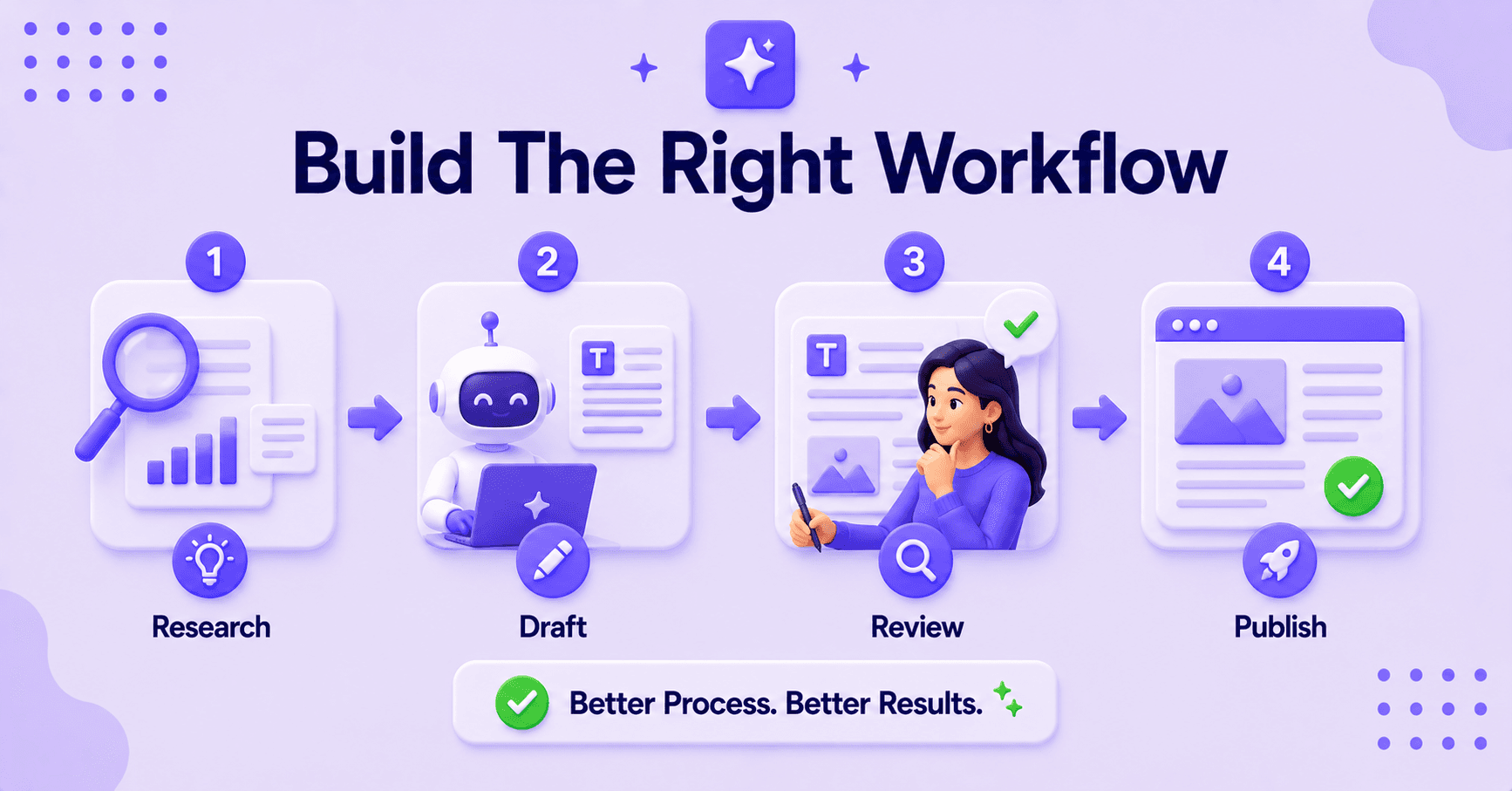
Keep the soul of the work for yourself. Humans must own the angle selection, the original reporting, the expert commentary, and the final editorial voice. To hold that balance, build a dedicated prompt library and a clear style guide.
These documents keep the machine output consistent with your tone. Most importantly, build a mandatory human review process that catches awkward phrasing or factual errors long before they ever reach the publish button.
FAQ about AI and content marketing
Will AI replace content marketers?
No, AI will not replace skilled content marketers. Instead, it replaces the tedious, repetitive tasks associated with content creation. Marketers who adapt and use AI to speed up their workflow will quickly outperform those who refuse to use the technology at all.
What is GEO and how is it different from SEO?
SEO focuses on ranking your web pages in traditional search engine results so users can click your link. GEO focuses on structuring your information so AI models and answer engines cite your brand as a reliable source in their synthesized responses.
How do I maintain brand voice when using AI writing tools?
You maintain your voice by giving the AI highly specific instructions. Create a comprehensive prompt library that defines your exact tone, specifies words to avoid, and provides clear examples of your past writing for the machine to study and mimic.
Is AI-generated content penalized by Google?
Google does not penalize content simply because AI helped create it. However, Google does heavily penalize content that is spammy, low-quality, or published solely to manipulate search rankings without providing any genuine value to the human reader.
What content tasks should I never hand off to AI?
Never hand off the final editorial approval, fact-checking, or the formulation of original opinions. AI cannot share personal experiences, conduct original interviews, or truly understand the nuanced emotions of your specific target audience.
How do I measure whether my content strategy is working?
Track meaningful engagement metrics rather than raw page views. Look at how long visitors stay on your page, how often they sign up for your newsletter, and how frequently your articles are shared or cited by other respected voices in your industry.
The economics have shifted, the fundamentals haven’t.
The underlying math of content marketing has undeniably changed. Production costs are lower, and the speed of execution is faster than ever.
Yet despite all the technological progress, what actually makes content work has not changed. Your audience still craves absolute clarity, deep relevance, established trust, and a compelling reason to come back tomorrow.
The brands successfully threading this needle treat AI as helpful infrastructure and process management, not as their entire strategy. Smart teams take the time and money they save on drafting and reinvest it into the creative work that still needs human judgment.
The economic shift is completely real, and the opportunity sitting in front of you is massive. You just need to use these incredible new tools to do vastly better work, not just more of it.
Build your workflow and start sharing your perspective with the world. Just make sure to weave your own personality into the mix. Your customers will notice. Ready to turn that opportunity into income? Our guide to making money with AI covers 11 proven ways to earn real income.

RightBlogger Co-Founder Ryan Robinson teaches readers how to grow an online business and writes about using AI in content creation.


Automated SEO Blog Posts for Your Site
Research, write, publish, and share from one account.
7-day free trial. Cancel anytime.





Leave a comment