How to Run an AI Image Copyright Audit Before You Publish
Separate copyright ownership from publishing permission, then screen for copied visuals, trademarks, likenesses, and campaign risks.

An image can make a campaign feel finished in 10 seconds, then create legal risks that last months. Generative artificial intelligence can produce a polished image, but that doesn’t prove you can publish it.
An AI image copyright audit gives your team a repeatable way to spot ownership gaps, copied visual cues, protected logos, and risky faces before an asset hits a landing page or paid ad. It also replaces a rushed Slack debate with a clear record of who approved what.
Start by treating every generated image as an asset that needs a rights review, not a free stock photo.
One note before we start: this is a practical review process drawn from how the rules currently work, not legal advice. Rules differ by country and change often, so loop in a qualified lawyer for high-value or high-risk campaigns.
Key Takeaways
- In the United States, fully AI-generated image elements usually don’t qualify for copyright protection. The U.S. Copyright Office’s AI guidance centers on human authorship.
- Copyright status, ownership, and permission to publish are separate questions. You may have a platform license to use an output, yet still face claims tied to a logo, a living artist’s recognizable work, or a person’s likeness.
- Review the asset, its expressive inputs, including prompts and reference files, the provider’s current terms, and the final campaign context. One clean-looking image can still become risky when paired with a claim, headline, or product offer.
- Keep a simple approval record. The strongest audit trail shows the source, model, prompt, human edits, rights checks, reviewer, and final use.
Separate Copyrightability From Permission to Publish
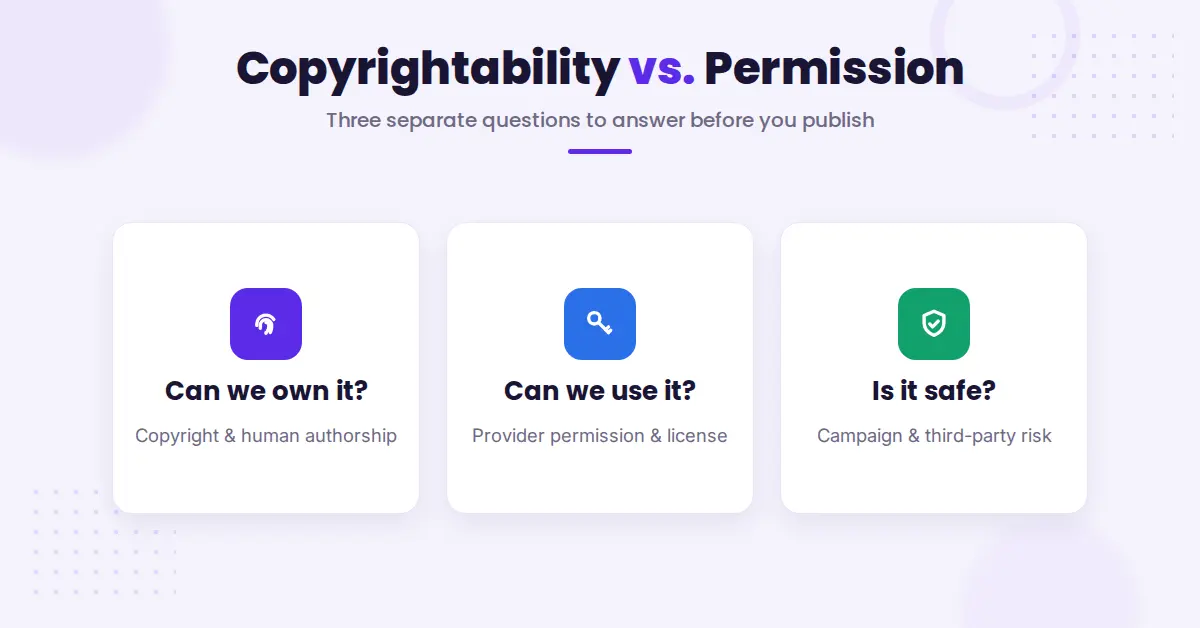
The first mistake is treating ownership, permission, and campaign safety as one question. Can we own this image? Can we use it? Is it safe for this campaign? Those questions overlap, but they don’t have the same answer.
With generative artificial intelligence, prompts and reference files are expressive inputs. They may influence an output without automatically establishing human control over every expressive detail.
Copyrightability Isn’t the Same as Commercial Permission
The U.S. Copyright Office says copyright requires human authorship. Prompts alone usually don’t give the user enough control over the expressive details in a generated image to claim authorship of those AI-created portions.
That doesn’t mean the file is free of risk. An output may not give your company exclusive rights while still raising questions about permission or third-party claims.
Your company may hold a commercial-use license from an AI platform. That license can let you publish the image, but it doesn’t automatically give you exclusive rights against every other user. It also doesn’t erase third-party claims.
Record ownership, provider permission, and third-party risk in separate fields. Mixing them up is how teams approve an image they can’t truly defend.
Trace the Human Work You Added
Human-created parts may still qualify for copyright protection. Original photography, illustration, compositing, or meaningful edits may qualify as original works of authorship. Those additions can affect the analysis involving derivative works, but they don’t automatically make the entire output protectable.
The Office made that distinction in its decision letter on Zarya of the Dawn. The book’s text and arrangement could support copyright registration, while the Midjourney-generated images could not. Its registration guidance for AI-assisted works also calls for applicants to identify human authorship and exclude more than minimal AI-generated material.
Save layered source files, edit histories, and the original assets your team contributed. A flattened JPEG won’t tell the story later.
Run a Repeatable AI Image Copyright Audit
This repeatable review starts before a designer exports the final file. It becomes easier when each asset has a record from the moment it enters your content workflow.
Create an Asset Record Before You Judge It
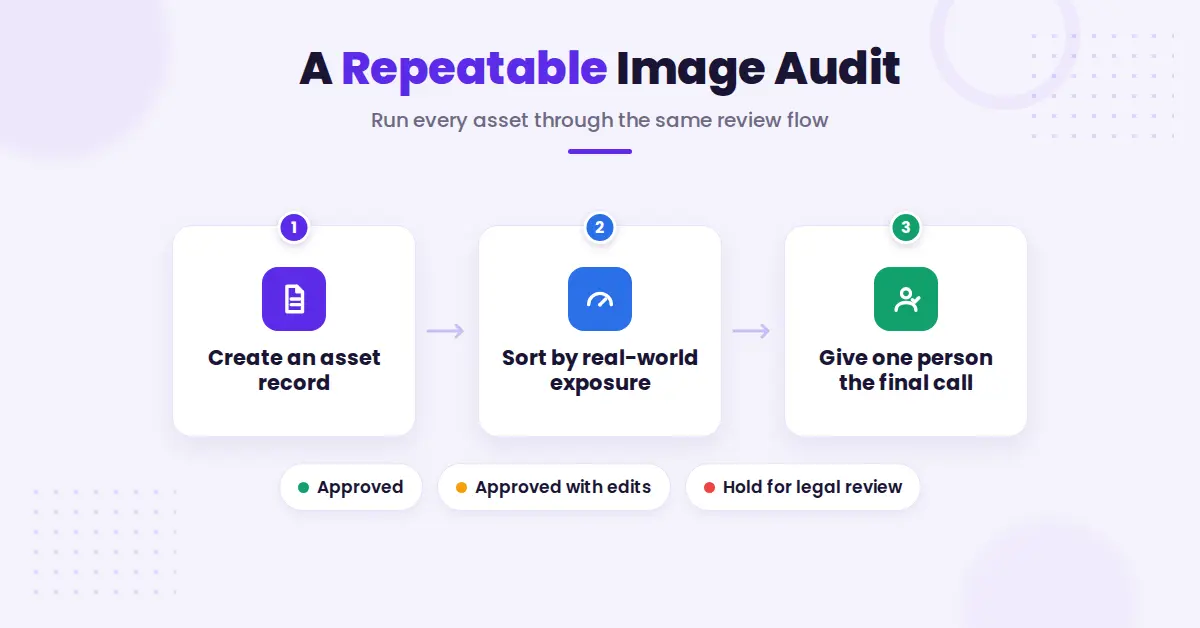
Give every image a unique ID and capture its intended use. Record its copyright status once, along with the campaign, channels, audience, geography, generator, model version, creation date, and any text-to-image models used, such as Stable Diffusion or DALL-E. Preserve its prompts, negative prompts, reference files, and other expressive inputs.
Also save the original output. Don’t keep only the edited version used in the ad.
Reference images need their own source record, and an image labeled public domain still needs source verification. If someone uploads a client photo, a competitor ad, a stock image, or an artist’s work, the audit has to show who supplied it and what rights the company has.
Sort Images by Real-World Exposure
A low-traffic blog illustration doesn’t need the same review as a paid campaign seen by millions. Set higher review levels for paid ads, product packaging, investor materials, healthcare content, children’s content, and high-profile partnerships. These uses can carry greater legal risks.
An asset that shows a generic desk scene may pass a quick review. An image featuring a recognizable person, luxury product, or stylized character needs more scrutiny.
Use three clear outcomes: approved, approved with edits, or hold for legal review. Looks fine to me isn’t an approval status.
Give One Person the Final Call
Marketing, design, and legal teams should all have input. Still, a named approver needs the authority to release or stop an image, reducing legal exposure through clear ownership.
That person doesn’t have to be a lawyer. They do need a written escalation rule. If an image resembles a known artist’s work, contains a potential trademark, or uses a realistic face, route it to legal or compliance before publication.
The goal isn’t to slow production. It’s to stop a risky image before it gets copied into 14 campaign variations.
Test the Risks Hidden in the Output
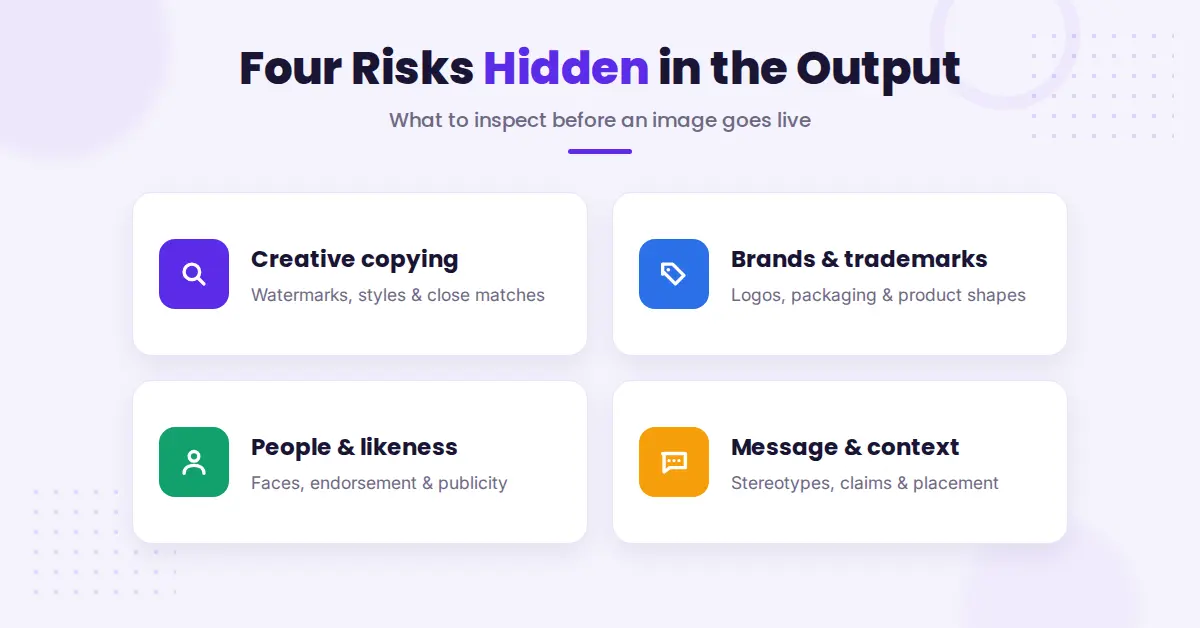
Your audit should look beyond obvious copying. The most expensive problems often sit in small details that no one noticed at first glance.
Look for Recognizable Creative Copying
Zoom in. Look for partial watermarks, familiar compositions, distinctive characters, a distinctive visual style associated with a known artist, and work unusually close to a known image.
If an output feels unusually familiar, revisit the prompt, reference files, and expressive inputs.
Run a reverse image search when something feels familiar, then compare it against your licensed asset library. It can flag a possible copyright infringement concern, but it’s a screening tool, not proof that an image is copied or clear.
Avoid prompts that ask for in the style of a living artist or demand a near-copy of a famous campaign. A vague result may be fine, but a heavily transformed or closely adapted output may still involve derivative works. The fair use doctrine isn’t automatic clearance for a commercial advertisement. A result that would make a creative director instantly name the source deserves escalation.
Inspect Brands, Products, and People
Trademark issues don’t always show up as a perfect logo. A cropped wordmark, distinctive package shape, sports jersey, product silhouette, or store sign can still create trademark violations.
Then check people. Does the face look like a celebrity, executive, customer, or public figure? Does the image imply that person endorses your product? A right of publicity or privacy rule can apply even when copyright doesn’t.
Don’t assume an altered logo or an AI-generated face makes the risk disappear. Ask a simpler question: could a reasonable viewer believe this brand or person is connected to your campaign?
A generated image doesn’t need to be an exact copy to create a brand problem. Familiarity can be enough to trigger a closer review.
Review the Message and Campaign Context
Brand safety includes more than intellectual property. An image may be legally clear and still be wrong for the message around it.
Check for stereotypes, unsafe product use, misleading before-and-after claims, political signals, or imagery that clashes with a sensitive topic. A visual for a medical campaign needs more care than a decorative blog header.
Review the final crop and placement, not only the original file. A harmless background detail can become the focal point in a vertical social ad.
Keep the Evidence That Explains Your Decision
If someone questions an image six months later, your team needs more than we generated it with AI. You need a short, usable evidence trail.
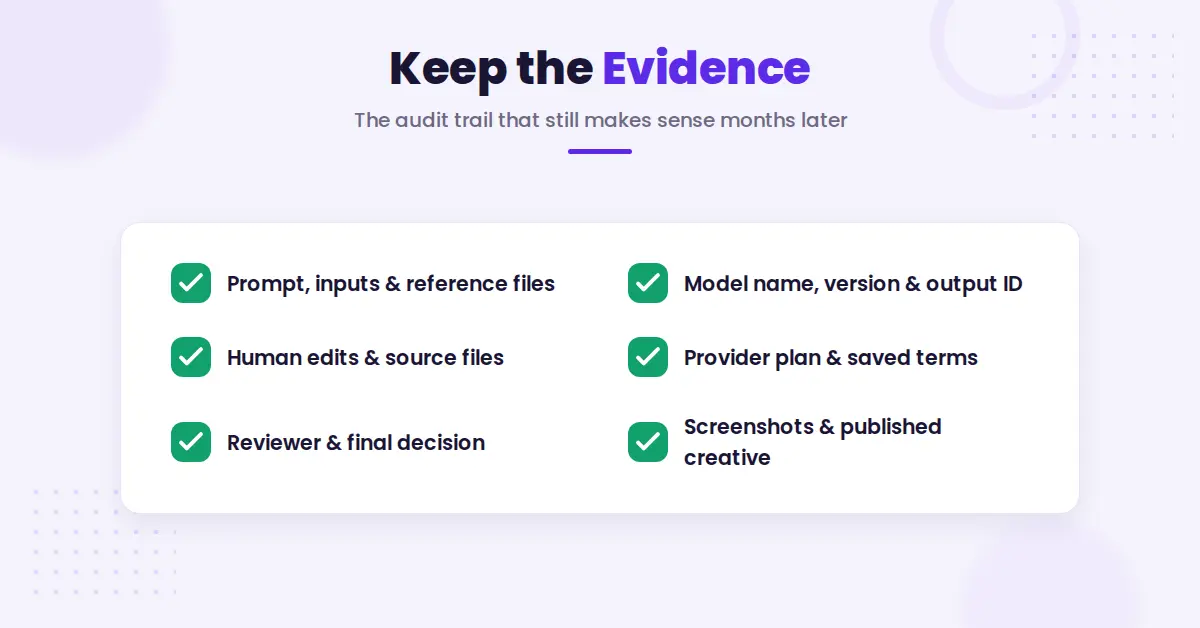
Save the Prompt, Inputs, and Human Edits
Keep the complete prompt, reference images, and other expressive inputs together. Record the model name, version, output ID, seed when available, and generation date. Save screenshots of the settings if the platform doesn’t give you a permanent record.
For every uploaded input, note its source and license. For every human edit, retain the editable source file and a short description of what changed. Those records can help support copyright protection for human-created portions, without suggesting the entire AI output is protected.
Content Credentials or other provenance metadata can help. They aren’t proof of ownership by themselves, and metadata can be removed. Treat them as supporting evidence, not a legal shield.
Archive the Provider Terms You Relied On
AI platform terms and related policies change. Save a PDF or dated screenshot of the terms, license agreements, and any provider policy or disclosure addressing web scraping, along with the plan your company used.
Adobe, for example, offers IP indemnification on eligible paid Firefly plans but not on its free tier, and the cover comes with conditions. That pattern is common, so pull the terms for the exact plan your team is on rather than relying on a sales-page summary.
OpenAI’s Terms of Use state that users retain rights in inputs and own outputs as between the user and OpenAI, where law permits. That allocation still isn’t a guarantee that an output is unique or safe against a third-party claim.
Set Brand Safety Rules Before Your Team Prompts
The easiest risky image to review is the one your team never generates. A short prompt policy reduces avoidable legal risks before review begins and gives creators room to work.
Write a Clear No-Go Prompt Policy
Ban prompts that request famous characters, competitor logos, editorial watermarks, a named living artist’s exact style, or a real person’s likeness without consent.
Add a rule for reference images, too. Team members can’t upload photos they found on Google, client social posts, or competitor campaign images just because the tool accepts them.
Give designers an approved brand kit instead. Include your own color system, icon rules, product photos, illustration direction, and examples of what on-brand means. That creates consistency without asking a model to imitate someone else’s work.
Match the Review to the Audience
A playful illustration for an internal deck has a different risk profile than an ad aimed at parents. The reviewer should know the audience, platform, offer, and claim before approving the asset.
Check accessibility once the image clears rights review. Write useful alt text that describes the image’s purpose, not a string of campaign keywords.
The same principle applies to AI writing, video, and graphics. Human oversight for responsible AI content catches problems that automated generation can’t judge on its own.
Treat Provider Claims and Lawsuits as Inputs, Not a Pass
A vendor’s commercial-use language matters. It should never be the last word in your review of tools using generative artificial intelligence.
Read Indemnity Terms Like a Contract
Indemnification may apply only to enterprise plans, certain features, or unmodified outputs. It may exclude claims tied to your prompts, reference files, campaign context, or changes made after generation.
Ask your vendor contact four direct questions:
- Which plan is covered?
- Which outputs are covered?
- What claims are excluded?
- What does the provider need from us if a claim arrives?
A promise of indemnity may reduce legal exposure. It doesn’t stop a complaint, a takedown, or a campaign pause. Your own audit record still matters.
Use Lawsuits to Spot Risk Categories
The Getty Images and Stability AI dispute is a reminder that generative image risk goes beyond a final file’s pixel-level similarity. It raises questions about web scraping, training data, intellectual property, and source attribution, but doesn’t prove every output is unlawful.
In the UK litigation, decided on 4 November 2025, Getty abandoned its primary copyright and database right claims before closing submissions, and the High Court then rejected the remaining secondary copyright claim, finding the model weights never stored copies of the works. It made only limited trademark findings tied to Getty watermarks appearing in early Stable Diffusion outputs, as set out in Latham & Watkins’ analysis of the judgment. That result isn’t a broad pass for every AI image.
Use major cases to improve your review questions about artificial intelligence models. Check for copied visual material, marks, false endorsement, and suspicious metadata. A class action lawsuit is a signal to update review questions, not a substitute for asset-by-asset judgment.
Account for Where and How You Publish
Copyright rules don’t stop at your company’s home country. A global campaign can face different standards based on where it runs, where customers see it, and where a dispute lands.
The UK Uses a Different Starting Point
The UK’s Copyright, Designs and Patents Act defines a computer-generated work as one made where there is no human author. Under section 9(3), the author of such a work is taken to be the person who undertook the arrangements necessary for its creation, which differs from the U.S. approach.
You can read the statutory definition of computer-generated works directly. Don’t assume that a UK rule gives you the same registration or enforcement result in the United States.
EU Rules Add Training-Data Questions
For EU-facing work, provider due diligence matters even more. Check how a provider documents training data and web scraping, including its data sources, rights reservations, and applicable compliance obligations.
The EU AI Act is the instrument to watch here: it puts copyright-policy and training-data summary obligations on providers of general-purpose AI models, which is why their documentation matters to you as a publisher. For a brand team, the practical move is simple: document the platform, terms, inputs, and approval path for every important commercial asset.
When a campaign crosses borders, use the stricter internal policy and bring local counsel into high-value or high-risk releases.
FAQs About AI Image Rights
Here are a few common questions to work through before you publish.
Can My Business Copyright a Fully AI-Generated Image?
In the United States, your business generally can’t claim copyright protection in image elements created entirely by AI. It may protect original human work added to the final asset, such as photography, illustration, or a creative arrangement.
Keep files showing those human contributions. They matter more than prompt history alone.
Are AI-Generated Images Safe for Commercial Use?
No image generator gives every output a universal green light. The copyright status of an output depends on the provider’s terms, your plan, supplied inputs, contents, and campaign context.
A commercial license is useful. It doesn’t clear trademarks, likeness rights, copyrights, or misleading advertising claims for you.
Does Provider Indemnification Remove Our Risk?
No. Indemnification can help cover certain claims under specific terms, but it often has exclusions and limits. It may not apply when your prompt, uploaded reference image, modification, or campaign use caused the problem.
Treat it as one layer of protection, not your whole approval process.
What’s the Minimum Record We Should Keep?
At minimum, keep the output file, prompt, model and version, generation date, reference-image sources, provider plan, saved terms, human edits, intended use, reviewer, and decision.
For major campaigns, add screenshots, approval comments, and a final copy of the published creative.
Final Thoughts on AI Image Copyright Audits
Fast production only helps when your team can publish with confidence. A disciplined rights review separates ownership from permission, catches visual issues early, and preserves an evidence trail that still makes sense months later.
The best workflow doesn’t treat legal review as a last-minute obstacle. It gives creators clear boundaries, gives reviewers the right evidence, and gives your brand fewer legal risks after launch.

RightBlogger Co-Founder Andy Feliciotti focuses on website development and shares his photography and travel adventures online.
Automated SEO Blog Posts for Your Site
Research, write, publish, and share from one account.
7-day free trial. Cancel anytime.




Leave a comment
You must be logged in to comment.
Loading comments...