How to Cross-Post on Medium and LinkedIn for SEO
Publish your site’s original first, canonicalize Medium, and turn LinkedIn into a shorter, feed-native take.

Cross-posting can grow reach fast, or quietly flatten it. If you publish the same article on Medium and LinkedIn without a plan, you can end up with two weak copies instead of one strong asset.
The fix sounds simple, but the details matter. Medium and LinkedIn do not play the same role, and Medium and LinkedIn SEO works best when each platform serves a different purpose.
Done right, it comes down to a few things: timing, a clean canonical signal, and rewrites that keep each version useful instead of recycled. Get those wrong and you split your own audience across copies that compete with each other.
Mastering this kind of content distribution is the key to maintaining momentum across both platforms. When done correctly, you can expand your reach while protecting the SEO value of your original content.
Key Takeaways for Medium and LinkedIn SEO
- Pick one original content source and treat the others as distribution channels. That one choice keeps your real SEO value tied to a clear URL.
- Use Medium as a republish or mirror with a canonical back to the original. That removes confusion, gives search engines a clean signal, and improves your overall online visibility.
- Make LinkedIn feel native. Short lines, a sharp hook, and one clear point beat a copied blog intro every time, especially when you are adapting long-form content for the feed.
- Change more than the title. If the opening, pacing, and call to action all stay the same, the post still feels copied, even if the words are technically different.
- To turn one strong draft into several good versions, AI content tools and AI repurposing can speed up the rewrite without flattening your voice.
Why Medium and LinkedIn Behave Differently in Search
Medium and LinkedIn look similar from far away. Both let you publish long-form ideas, both frequently appear in search engine results, and both can bring in new readers.
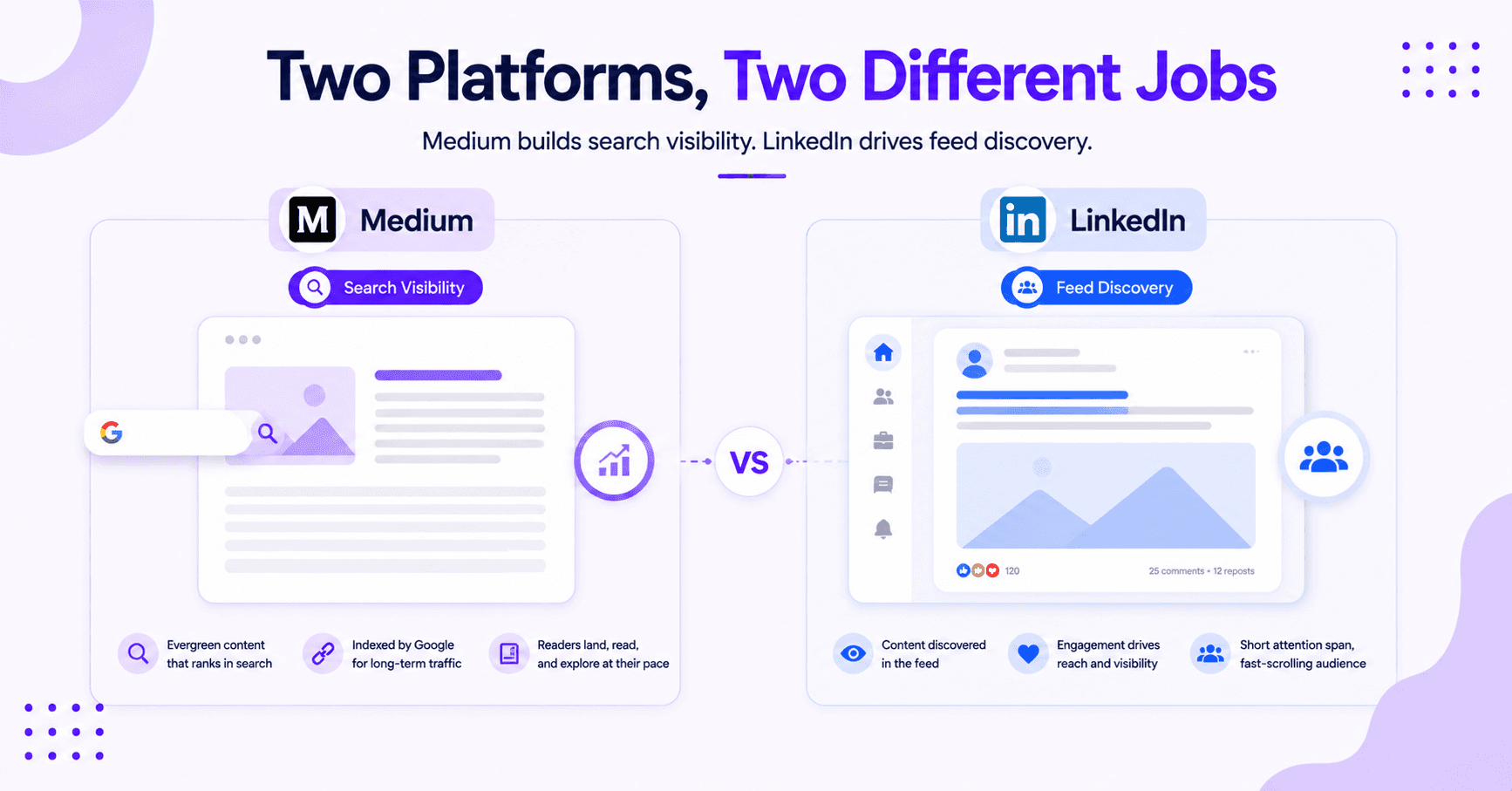
Up close, they work in different ways.
Medium behaves more like a publishing archive. People land on a piece, read at their own pace, and move on if the article holds up. That makes it a decent place for evergreen writing, especially when the piece is useful on its own and still boosts your online visibility by pointing back to a home base you control.
LinkedIn is a feed first. People scroll fast. They pause for a sentence that lands, a story that feels current, or a point that hits a nerve.
While search matters, the feed decides most of the reach for your target audience. If the post does not earn attention in the first few lines, the rest barely gets a chance.
That split matters because search engine optimization requirements and social engagement needs often pull in different directions. Search wants clarity, structure, and a clean source, while social wants momentum, immediacy, and a reason to react.
One article can serve both, but not if you publish the exact same version everywhere and hope for the best.
A solid breakdown of the platform split is in this Medium and LinkedIn SEO analysis. The key point still holds in 2026, the two channels help in different ways.
Build One Source Article First
The easiest mistake is treating the publishing platform as the source. It isn’t. The source is the version that owns the URL, the internal links, the conversion path, and the strongest SEO signals.
For most creators and brands, prioritizing your own site is a core content marketing strategy. That gives you room to add related links, track behavior, and keep the article inside your content system instead of handing the best version to someone else’s platform.
Once the original is live, Medium and LinkedIn become distribution layers. That shift sounds small, but it changes the whole workflow.
You stop asking, “Where should I post this?” and start asking, “Which version works best here?”
The original also gives you a home for your deeper intent. Maybe the main article explains a process, supports a product, or sits inside a larger content cluster.
This is where your internal linking provides the most value, as it helps readers keep moving through your site. That is where the real SEO value lives.
If the first draft needs a stronger shape, fix that before you adapt anything. A solid original gives you something worth remixing later, and automating the repetitive SEO work pays off only when the foundation is already strong.
The rule is simple, even if the work isn’t. Write one article that deserves to rank, then remix it for the places where people discover ideas.
How to Republish on Medium Without SEO Collisions
Medium can still play a useful role, but only if the Medium copy points back to your original with a canonical tag. There are two ways to do that, and plain copy-paste is not one of them.
That keeps search engines from guessing which copy matters most, so your original page holds onto its authority.
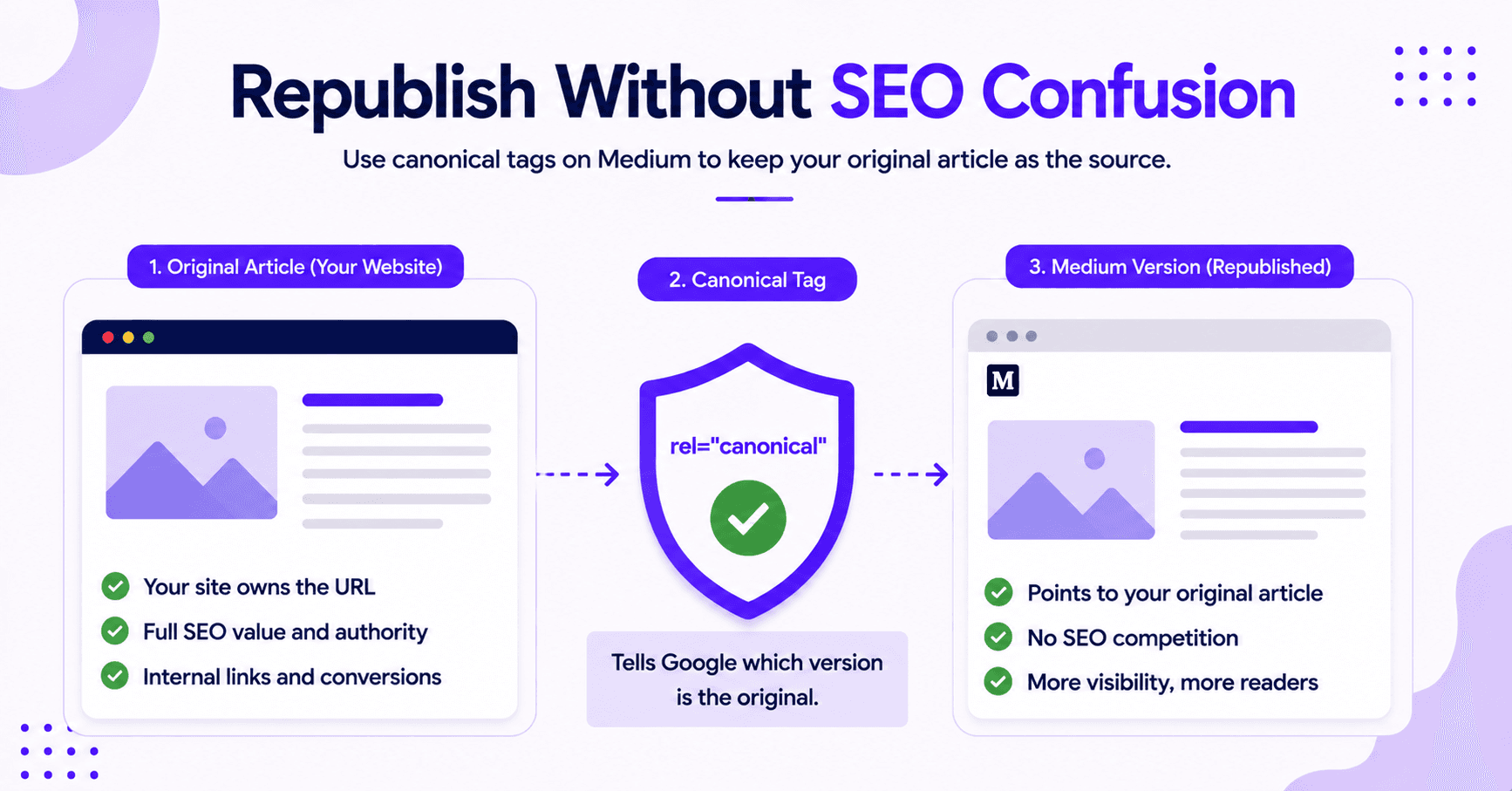
Use one of these:
- Medium’s “Import a story” tool (Stories > Import a story, then paste your URL). Medium automatically adds the canonical pointing to your original and backdates the post.
- The manual canonical field. In the editor, open the three-dot menu > More settings > Advanced settings, check “This story was originally published elsewhere,” paste your original URL, and save the canonical link.
Copy a story into a fresh Medium draft without doing one of those, and no canonical is set. At that point the Medium version competes with your original instead of supporting it.
Medium’s outbound links are nofollow, so they pass no PageRank to your site. The canonical is what tells Google your site is the original, which is exactly why it has to be set correctly.
The original article should own the search job. The republished versions should own the attention job.
The writing still needs care, though. Don’t send the exact same headline, intro, and subheads to Medium and call it strategy. That is the fastest path to a flat republish.
There is no duplicate content penalty, despite the myth, but a near-identical copy still wastes the opportunity and can muddy which version Google shows. So change more than the title. Consider updating:
- The lead
- The transitions
- Examples that only make sense on your primary site
If the original opens with a deep brand angle, the Medium version can open with a broader reader problem. If the source article uses a detailed framework, the republish can foreground the outcome first and the method second.
That is where the piece starts to feel alive again. It stands on its own and earns its place in a different setting.
A good Medium republish does not read like a clone. It reads like the same idea dressed for a different room.
Make LinkedIn Feel Native, Not Like a Blog Dump
There is also a hard SEO reason to adapt rather than dump. Unlike Medium, LinkedIn does not let you set a canonical tag, and Google does index LinkedIn articles. Paste your full post into a LinkedIn article and you create a duplicate with no way to point search engines back to your original. Keep the full version on your site, and use LinkedIn for a shorter, fresh take that links home.
LinkedIn needs a different rhythm. The first two lines do a lot of the work because they decide whether someone keeps reading or keeps scrolling.
Start with the point. If the article is about cross-posting SEO, say that fast. If it is about avoiding duplicate content problems, put that pressure up front.
By establishing a strong hook, you build thought leadership right from the start. Don’t spend four lines warming up to the actual message.
Short paragraphs help a lot here. So do line breaks that give the eye somewhere to land.
LinkedIn punishes density. It rewards clarity. A post with clean spacing feels easier to trust, and easier to finish.
The best LinkedIn versions usually pull one angle from the source article instead of the whole thing. For example:
- Canonical tags
- Why most republished posts sound dead
- The mistake of using the same intro on every platform
That is where repurposing content with AI can help, as long as the goal is to tailor the piece to your specific target audience rather than creating a bland copy.
The right tool saves time on structure. It does not decide the message for you.
LinkedIn also rewards a post that carries a real opinion. If you want discussion, end with one clean, on-topic question.
Keep it tied to the topic. “Would you publish the full article on LinkedIn, or keep it as a summary?” works. “Thoughts?” usually does not.
The goal is not to squeeze a blog post into the feed. The goal is to make the feed version worth reading on its own.
A Publishing Workflow That Holds Up in 2026
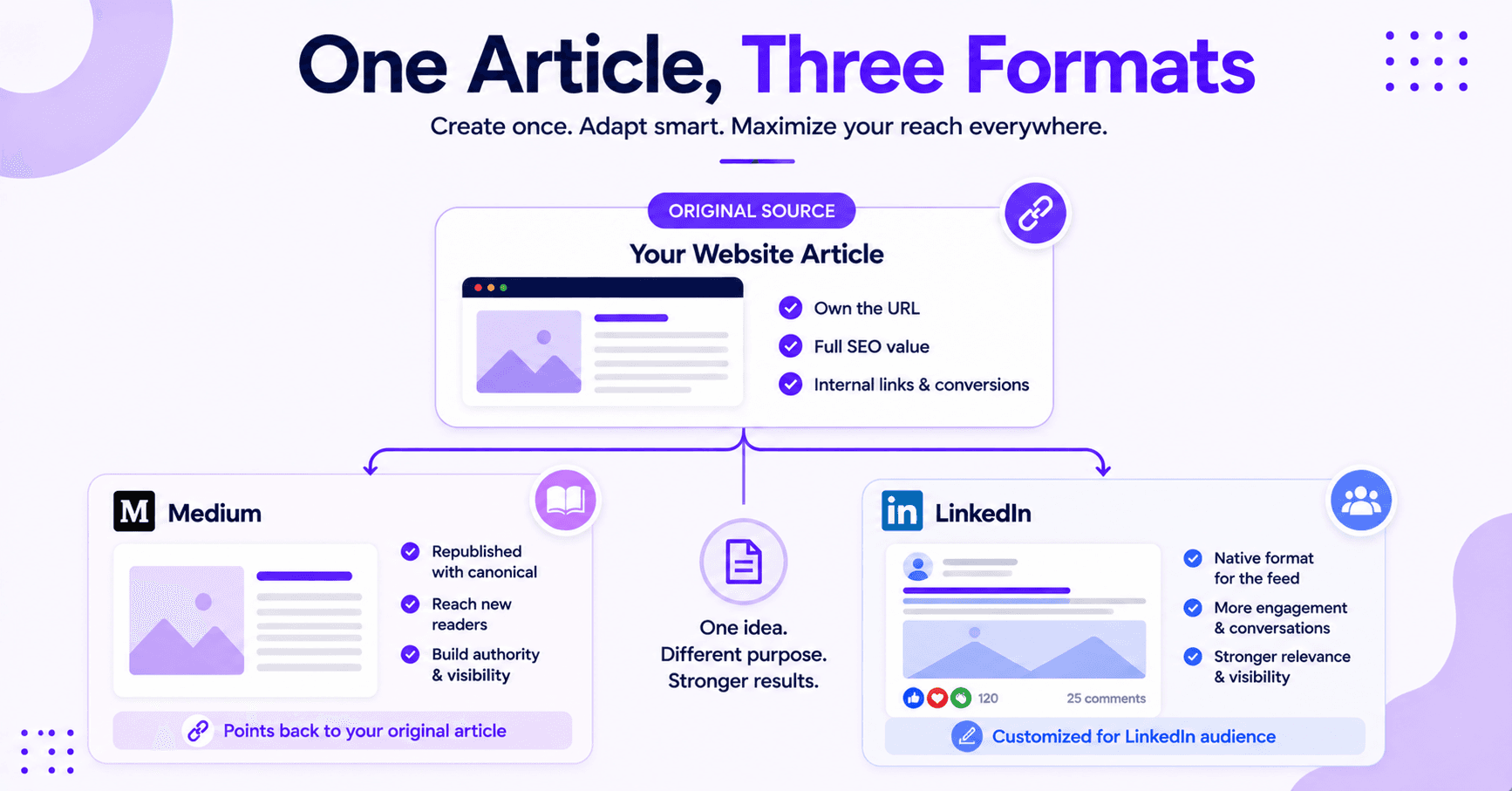
Start with the original on your own site. Give it the strongest title, the best structure, and the cleanest internal links you can manage.
That version should feel complete without leaning on Medium or LinkedIn to do the heavy lifting.
Then give the original time to get indexed before you syndicate. That head start lets Google attribute the content to your site first and makes the republished versions read as support for the original.
You don’t need a dramatic delay, but you do need a little separation.
Next, publish the Medium version as a form of content syndication, ensuring the canonical tag is set to the original. Keep the article useful, but make it less tied to your site’s exact structure.
If the original uses a product mention or a site-specific call to action, soften that part so the Medium reader still gets value without feeling like they landed on a sales page.
After that, write the LinkedIn version from scratch. Cut the length, sharpen the hook, and pull out one useful truth.
If the original article has three big ideas, choose one and build the post around it. The payoff here is reach and referral traffic. Medium and LinkedIn links are nofollow, so they do not pass authority directly. They can still earn you real backlinks indirectly, when readers find your work and cite the original elsewhere.
This is where automating SEO tasks makes life easier. Let tools handle the reminders, link checks, and update work.
Monitoring your organic traffic becomes much more efficient when you regularly check Google Search Console for your original site to ensure your primary content is indexed properly.
Keep the judgment calls, voice, and angle choices in human hands.
If you publish often, that split matters. The system should handle the repetition, while the writer should handle the thinking.
What to Measure After the Posts Go Live
Views can fool you. A post can look popular and still do very little for the business. Another can look modest and send the right people to the right place.
Track the source versions separately. Medium traffic should tell you whether the republish pulled readers toward the original.
LinkedIn should tell you whether the feed version earned attention, comments, profile visits, or clicks.
If you can, tag your links so the traffic is easy to separate. That gives you a clear read on which version actually moved people and how your cross-posting strategy impacts the search visibility of the source version.
Without that, the numbers blur together fast.
Watch the right mix of signals:
- On LinkedIn, comments and saves often matter more than raw impressions.
- On Medium, time on page and outbound clicks can matter more than the public reaction.
- On the original site, look for depth, next-page behavior, and any lift in branded search or returning visits.
Social signals are great for immediate awareness, but remember the cross-posted links themselves are nofollow. The lasting SEO value comes from your original page earning real, followed links as more people discover your work.
The clean question is simple. Did the cross-post help the main article do its job?
If it did, keep going. If it didn’t, the problem is usually one of three things:
The original article never gave the later versions enough to work with.
The hook was too weak.
The republish felt too close to the source.
Common Mistakes That Still Hurt Reach
Publishing your original and your syndicated version at the exact same moment often causes trouble. Before your original is indexed, Google may spot the copy first and treat your site as the duplicate. There is no penalty for this, but you can lose the attribution you wanted.
Copying a full article into LinkedIn is another common oversight. The feed is not designed for long-form blog dumps.
Users typically scan content first to decide if a post deserves their attention. If your writing opens like a formal archive entry, you will lose the reader immediately.
Using the same intro on Medium and LinkedIn is also a mistake that limits your engagement. Your opening sets the tone, and if both versions begin with identical sentences, the reader feels the repetition before the post has a chance to prove its value.
You can’t edit raw meta tags on Medium or LinkedIn, but both give you an SEO description field. Setting a distinct one is a nice touch, though Google often rewrites descriptions, so it is not worth much fuss.
Overloading your posts with too many links can also sink your reach. One clear path to your original source is usually enough.
Stuffing a Medium or LinkedIn post with links also backfires. If the reader needs more context, send them to your original or one highly relevant resource, rather than five different exits in the hope one works.
The final mistake is forgetting the specific purpose of each platform. Medium is ideal for a deeper reading experience and establishing a clear canonical trail. LinkedIn is built for discovery, professional discussion, and building quick trust.
When you ask both platforms to perform the exact same job, you often end up weakening the impact of both.
FAQs About Medium and LinkedIn SEO
A few questions that come up often:
Does republishing on Medium hurt my website’s SEO?
No, republishing content on Medium will not hurt your SEO as long as you use a canonical tag pointing back to the original article on your site. This tells search engines that your website is the primary source, ensuring your original page retains the authority and ranking power.
Can I just copy and paste my blog post to LinkedIn?
No, copying a full blog post to LinkedIn is rarely effective because the platform is designed for quick, skimmable insights rather than long-form reading. To maximize reach, adapt your content to include a sharp hook, shorter paragraphs, and a clear call to action that encourages professional engagement.
How long should I wait before syndicating my original article?
Wait until your original is actually indexed rather than counting hours. Check it with the URL Inspection tool in Google Search Console, and you can request indexing to speed it up. On a newer site that can take days, so a fixed 24-hour window is not reliable.
Final Thoughts on Medium and LinkedIn SEO
Cross-posting works when you stop treating Medium and LinkedIn like mirror copies. By creating high-quality articles tailored to the unique intent of each platform, you give the original version the primary search job, let Medium support the source, and shape LinkedIn content specifically for the feed.
That approach keeps your SEO clean and your writing sharper. It also gives each version a distinct reason to exist on its own, ensuring your content adds value regardless of where it is found.
The smartest Medium and LinkedIn SEO move in 2026 is still the simplest one: focus on one source, two real adaptations, and no dead copies. This strategy builds domain authority over time by signaling to search engines that your content is authoritative and valuable.
It is a different play than guest posting, but it compounds. When each platform does the one job it is good at, the whole system gets easier to run and keeps your original at the center.

RightBlogger Co-Founder, Andy Feliciotti focuses on website development, SEO, photography, and travel.

Automated SEO Blog Posts for Your Site
Research, write, publish, and share from one account.
7-day free trial. Cancel anytime.





Leave a comment
You must be logged in to comment.
Loading comments...