How to Turn Newsletter Archives Into SEO Blog Posts
Prioritize evergreen issues with proven engagement, then rebuild each for search intent, fuller answers, and related topic-cluster posts.


Some of the best blog ideas aren’t new ideas at all. They’re old newsletter issues, already written, already tested, and already proven to get a response.
That’s why newsletter archives are worth using for SEO work. The raw material is sitting there.
There’s no need to invent a topic from scratch. It just needs reshaping for search engine optimization so searchers can find it and strangers can understand it.
Key Takeaways for Newsletter Archives SEO
- A strong email issue that drives subscriber engagement with high open rates is a starting point that still needs reworking before it becomes a blog post.
- The best archive pieces are evergreen content that’s clear and still matches what people search for now.
- Each email gets rebuilt around search intent, better structure, and stronger context to boost performance metrics like traffic and rankings.
- One newsletter can become one main post, plus a few related supporting articles, forming the foundation of a modern content workflow.
Start With the Issues That Still Matter
Not every email is worth repurposing. Some newsletters are too timely, too personal, or built around a promo that expired six months ago. Those belong in the archive. Keep your search-facing pages for the emails that still hold up.
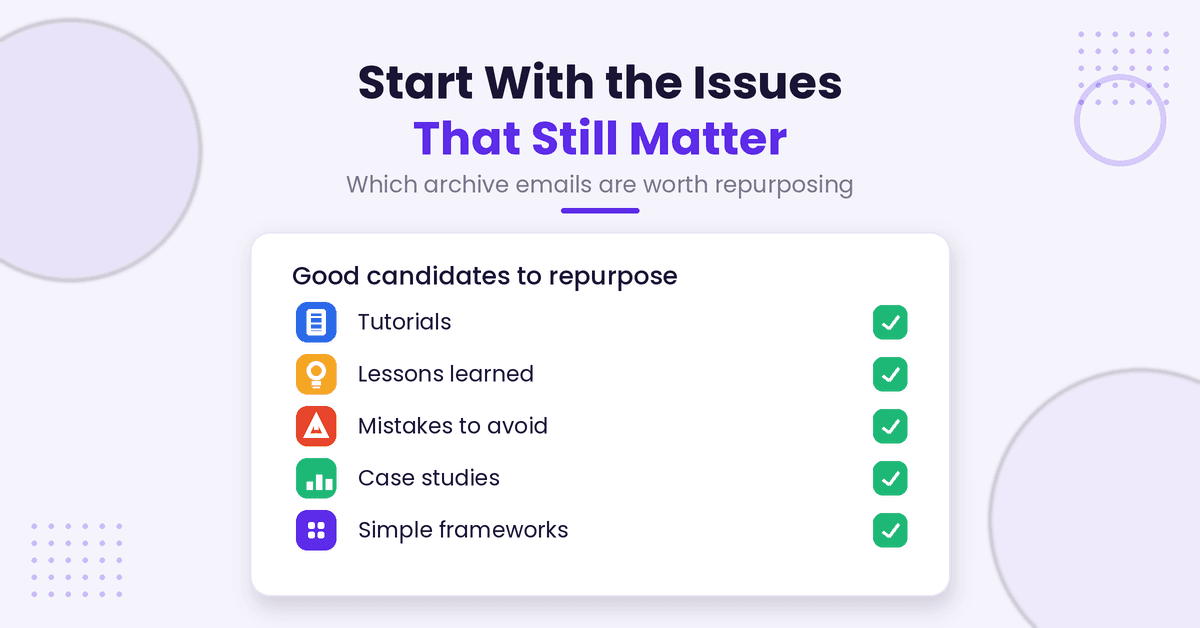
The best candidates are the ones that still answer a question today. Think tutorials, lessons learned, mistakes to avoid, case studies, and simple frameworks. If someone could Google the topic next week and still get value, it’s a good bet.
This is where a lot of creators go wrong. They treat the archive like a warehouse and assume all of it has value. It doesn’t.
The emails worth choosing already had a strong hook, solid replies, or high click-throughs. That’s a signal of strong user engagement and a topic that has legs.
A hosted archive helps subscribers find past issues, but it isn’t the same thing as a search-focused article.
Archived emails need stronger titles, clearer formatting, and more substance to rank. Copy-pasting an email into a blog is like hanging a sticky note on a billboard. The idea might be good, but the format is too small.
Once a winner turns up, the email-writer mindset has to go. What matters now is thinking like a searcher.
Rewrite for Search Intent, Not Inbox Context
Email readers already know the sender. Search readers usually don’t. That changes everything.
A newsletter can get away with inside jokes, loose structure, and lines like, “As I said last week…” A blog post can’t.

It needs context fast. It needs page titles people would search for. It needs headings that answer the next question in their head.
Turning an archive into a post usually follows this order:
- Pick the main search intent from long-tail search phrases that reveal the specific queries searchers use.
- Rewrite the headline for clarity.
- Add an intro for new readers.
- Expand thin spots with examples, stats, or screenshots.
- Cut the email-only clutter, like promos and subscriber-only references.
As of 2026, short paragraphs, direct answers, and question-style subheads are working well for both readers and AI search summaries. That’s one reason these posts aren’t written like essays anymore. They read like guided answers.
When nearly the same content lives in both places, duplication becomes a concern. There’s no duplicate content penalty, but Google will pick one version to show, and it might pick the archive. If your platform lets you set a canonical, point the archive at the blog post. Most hosted archives (Substack, Mailchimp) don’t offer that control, which makes the heavier rewrite the reliable fix.
That extra work matters. Fresh structure often beats fresh writing. After publishing, Google Search Console confirms how these new posts are being discovered by searchers.
Build a Blog Post, Not an Archive Page
This is the step that makes the whole thing rank better. The email isn’t just “cleaned up.” It becomes a proper article built for search engine optimization.

That means a stronger H1, clearer H2s, structured data, and a short answer near the top. The scope widens a bit, and the URLs switch to descriptive ones.
Email is often narrow and punchy. Search content needs a fuller answer.
The next move is finding places to connect the post to the rest of the site through internal linking. That’s where archive repurposing starts to compound.
One post links to another. A loose pile of emails turns into a usable library that builds real topical authority.
Building that system on purpose pairs well with a broader SEO content strategy for 2026. It helps tie search traffic back to an owned audience, which is the whole point.
And to speed up the draft without flattening a distinct voice, AI content repurposing methods help. The draft gets faster. The thinking still has to come from the writer.
Turn One Newsletter Into a Small Topic Cluster
One archive email doesn’t have to become one blog post. Sometimes it should become three.

A newsletter called “Why Your Blog Posts Don’t Get Clicks” might become one main article on low click-through rates, then spin off smaller posts on headline writing, meta descriptions, and search intent. Keyword research guides the main post and spin-offs that align with specific searcher needs. Same source, different angles.
This works because newsletters often bundle ideas together. Search doesn’t. Searchers want one clean answer per page.
It also builds a small topic cluster, which boosts SEO efficiency.
Updating old material is often quicker than starting cold. That’s in line with this content refresh strategy example.
There’s no digging for a new idea. It’s about improving something that already proved it could hold attention, and focused, specific posts tend to earn links more easily than catch-all emails ever did.
That’s the real win with newsletter archives SEO: one already-proven email turns into multiple ways to get found.
This isn’t about squeezing extra life out of old content. It’s about uncovering content that was useful all along.
FAQs About Newsletter Archives SEO
A few questions that come up often:
Can a Newsletter Archive Be Published As-Is?
Not as-is. A straight repost from an email service provider usually lacks search intent, structure, and context for search visibility.
An email is written for people who already subscribed, so an archive page reads like an email: a different format, with different expectations, than a search result.
Which Newsletter Should Be Repurposed First?
The best first pick is an evergreen issue that drove strong subscriber engagement. If readers replied, clicked, or shared it, that’s a clue the topic deserves a larger home on the blog.
Will Duplicate Content Cause Problems?
It won’t get you penalized, but if the archive page and blog post are almost identical, Google may choose to show one and filter the other. Rewrite the blog version heavily, remove email-only sections, and set a canonical where your platform allows it.
Final Thoughts on Newsletter Archives SEO
A good newsletter archive is more than a record of what was sent. It’s a backlog of tested ideas, proven angles, and half-finished blog posts.
When those emails are treated like raw material instead of final assets, search traffic gets a lot easier to build. The work isn’t starting over. It’s shaping what already works into something people can find.
Done consistently, this turns the newsletter into a steady source of search traffic instead of a one-day inbox hit.

Article by
RightBlogger Co-Founder Andy Feliciotti focuses on website development and shares his photography and travel adventures on YouTube and his blog.



Automated SEO Blog Posts for Your Site
Research, write, publish, and share from one account.
7-day free trial. Cancel anytime.





Leave a comment
You must be logged in to comment.
Loading comments...