How to Find Zero-Volume Keywords That Still Drive Signups
Mine customer questions, Search Console impressions, and niche communities, then validate intent and offer fit before building pages.

Some of the best signup pages start from terms that keyword tools show as having zero search volume. Sounds crazy? Here’s why it works and how this approach fits seamlessly into a modern search engine optimization strategy.
A low search volume in a tool (or even a 0) doesn’t mean there’s no traffic for that keyword term at all, just that it’s too low to be accurately measured.
These extreme long-tail keywords have high buying intent. If someone searches a painfully exact phrase and lands on the right page, that visitor is often far closer to signing up or making a purchase than the person who typed a broad, high-volume term. It’s the difference between searching for “best running shoes for overweight men with flat feet” versus “running shoes”.
In 2026, these highly specific, very low-volume keywords are more important than ever. AI Overviews now appear on roughly one in five Google searches per Pew Research, so high search volume can look impressive while the clicks disappear.
You don’t want vanity traffic. You want signups, and zero-volume keywords often reveal the clearest buying intent.
Key Takeaways from Zero-Volume Keywords
- Treat zero-volume keywords like hidden buyer language of your target audience, even when your tool reports a flat zero.
- Map them to the user intent of the signup journey, all the way through to the offer.
- Mine first-party data first, because your audience tells you what tools miss.
- Validate with intent, impressions, and offer fit, then build related content around winners.
Why Zero-Volume Keywords Often Beat Bigger Terms
Keyword research isn’t a popularity contest. While high search volume terms can bring attention, long-tail keywords drive signups and action.
Most search demand lives in tiny, fragmented phrases that tools barely capture. Ahrefs’ analysis of its own keyword database found that 94.74% of keywords get 10 or fewer monthly searches, and Google has long said that 15% of the searches it sees each day have never been searched before. The demand is real; the dashboards just cannot see it at that grain.
At the same time, Ahrefs’ view on when to target zero-volume keywords is the right caution. Not every zero-volume term deserves a page.
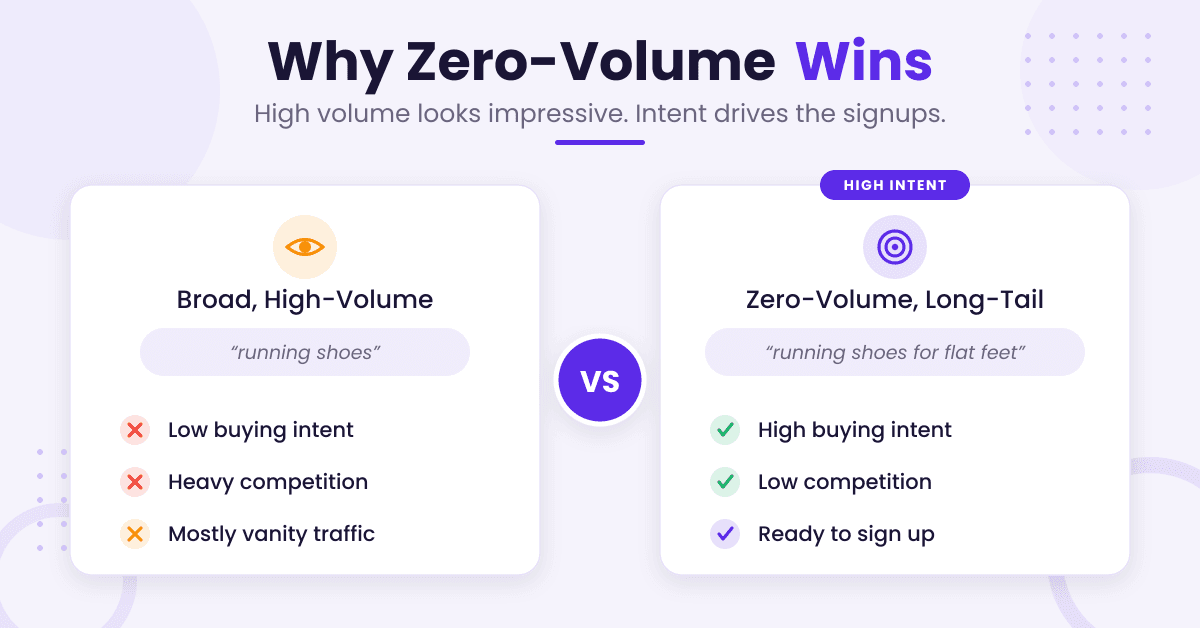
So what makes one worth chasing? Intent.
If you write for informational keywords like “best email marketing software,” you compete with giant sites, and you get readers who aren’t necessarily ready to buy.
If you instead write a post targeted at the phrase “email welcome sequence for paid newsletter signup,” which shows transactional intent, there might be much less traffic, but each reader you get will have a problem, a use case, and a reason to act.
Zero-volume keywords work best inside a broader content system where each page feeds the next. A good topical authority map helps you connect those small pages so they build trust together.
Map Your Signup Flow Before You Research
Before you open any tool, map the path to signup. This ensures you reach the right target audience and saves you from creating clever content that never converts.
Start with four moments: the problem, the comparison, the proof, and the signup. Then, ask yourself what your ideal customer would type at each stage.
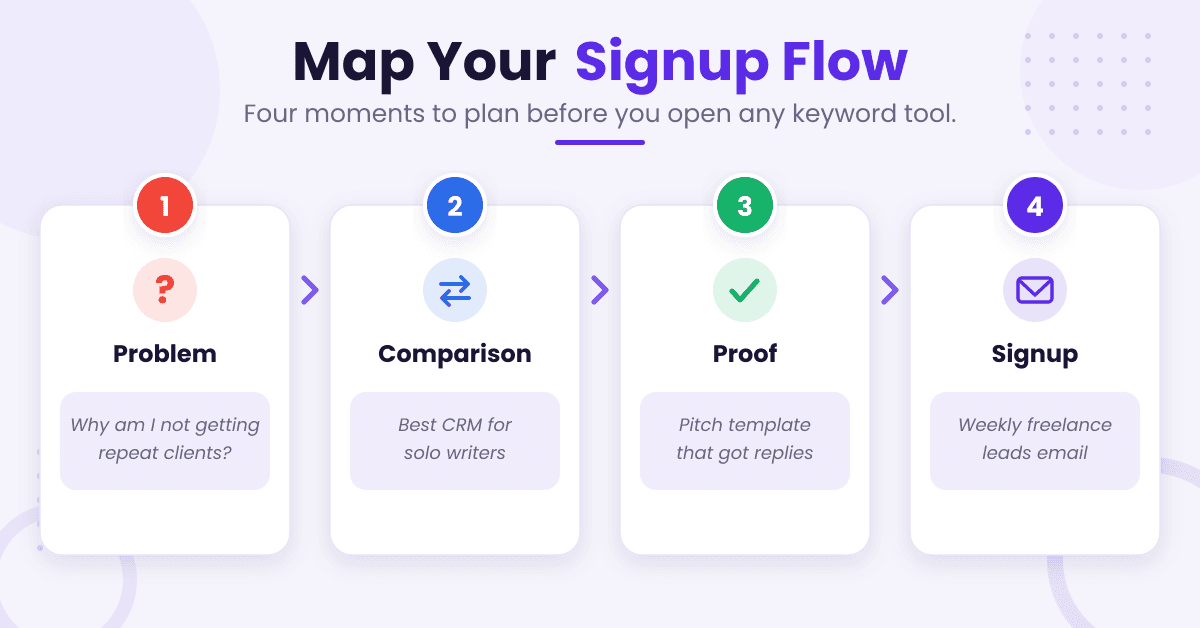
For example, if you’re growing a newsletter for freelance writers, look out for those four specific moments:
- Problem language sounds like, “why am I not getting repeat clients?”
- Comparison language sounds like, “best CRM for solo writers.”
- Proof language sounds like, “freelance pitch template that got replies.”
- Buying keywords for signup sound like, “weekly freelance leads email.”
Those phrases rarely look impressive in keyword research tools, but they often match real buying motion.
You can pull this language from support emails, onboarding forms, DMs, blog comments, canceled subscription notes, and sales calls. If five people describe the same pain in slightly different ways, you already have a cluster.
From there, you can turn that into content with RightBlogger’s free keyword cluster generator to create keywords that group related intents and keep related pages tied to the same offer.
Where to Find Zero-Volume Keywords
Plenty of the best ideas come from places marketers ignore because they don’t look like research.
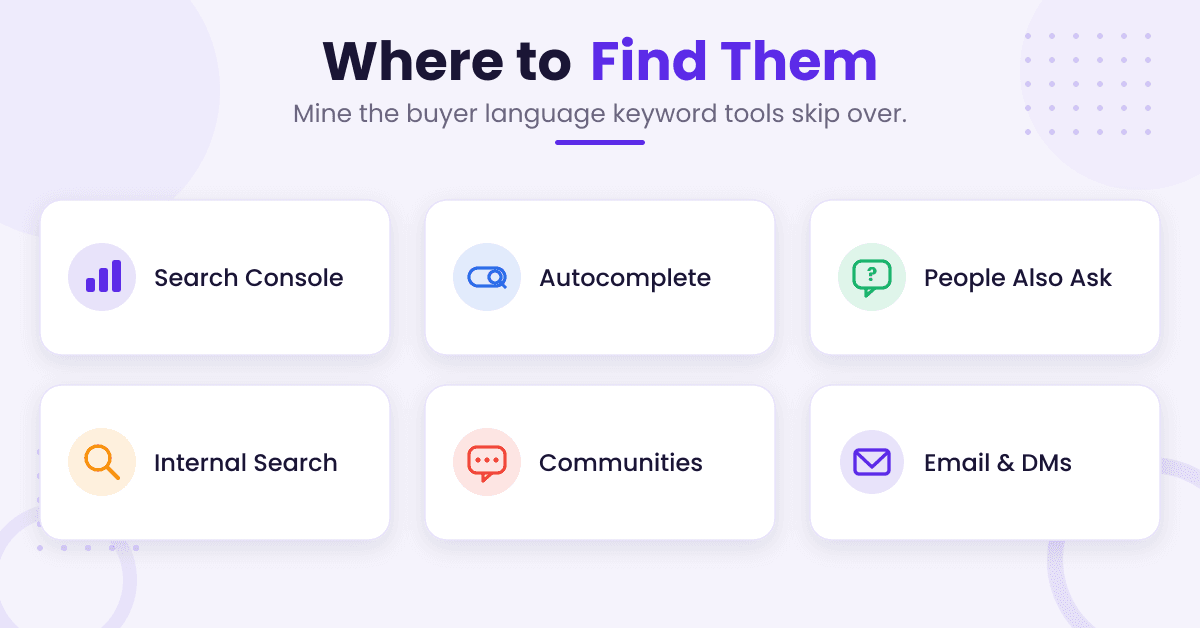
First, check your own audience data. Google Search Console impressions are gold here. Open Performance > Search results, switch to the Queries tab, stretch the date range to several months, sort by impressions, and watch for long-tail queries earning impressions with few clicks and no dedicated page. Internal search helps too. So do YouTube comments, niche communities, and email replies.
Next, use Google itself. Google Autocomplete, People Also Ask, and related searches often surface the exact wording that tools skip, since keyword databases are built from Keyword Planner data (which lumps close variants together) plus sampled clickstream panels, so rare phrasings never make it in. You don’t need a giant list. You need phrases that sound like real people.
Then, expand on those ideas with a free keyword research tool. Don’t use it to disqualify terms that have low volume. Instead, use it to find patterns, modifiers, and nearby phrases that you can group together.
It’s also a good idea to watch competitors, but don’t copy them blindly.
If a competitor has a page for an ultra-niche pain point, a use-case landing page, or a feature comparison page you hadn’t considered, that’s a signal. The real clue isn’t that they ranked. It’s that they thought the page was worth making.
How to Validate Zero-Volume Keywords Before You Publish
You don’t need volume proof. You need business proof.
- First, check whether the keyword fits your offer. Skip informational keywords where the searcher wouldn’t logically join your list, book your service, or try your product.
- Second, look at the results page. Are the top results blog posts, landing pages, templates, or videos? That tells you what format the searcher wants.
- Third, decide whether you can answer the query clearly in one strong section, ideally with a direct 40 to 60 word answer near the top. That’s smart for readers, it’s the format featured snippets pull from, and it’s the window AI answers like Google’s AI Overviews tend to quote.
- Finally, judge these posts on conversion rate. If a tiny post brings 20 visits and 4 signups, you want more of that! Build adjacent pages around it, using topic clusters and a solid content strategy to let these small pages do the heavy lifting.
FAQs About Zero-Volume Keywords
A few questions that come up often:
Are Zero-Volume Keywords Good for New Blogs?
Yes, often better than broad terms. New blogs need easier wins, and narrow intent usually means low competition and stronger fit.
How Many Zero-Volume Keywords Should I Target?
Generally, you don’t want to target zero-volume keywords one by one. Instead, group them around one problem or offer. That aggregates search volume for a stronger page and a clearer internal linking path.
Can Zero-Volume Keywords Drive Newsletter or SaaS Signups?
Absolutely. They work best when the query matches a sharp pain point, a use case, or a comparison close to signup.
Final Thoughts on Zero-Volume Keyword Opportunities
Keyword tools are helpful, but they aren’t the market. Your readers are.
When you want signups, look for zero-volume keywords that sound small in a dashboard and huge in real life. These specific queries can also catch emerging trends months before keyword tools report any volume at all.
Start with the search queries your audience already uses, validate by intent, and build around the winners. You might not see much increase in traffic, but you’ll likely get far more signups.

Article by
RightBlogger Co-Founder, Ryan Robinson teaches 500,000 monthly readers how to grow online businesses and writes about SEO and blogging.




Automated SEO Blog Posts That Work
Try RightBlogger for free, we know you'll love it.
7-day free trial. Cancel anytime.





Leave a comment
You must be logged in to comment.
Loading comments...