Outrank Alternatives That Actually Fit a Creator’s Workflow (2026)
Compare six autoblogging options by price, article caps, editorial control, and backlink exchanges to find the right fit.

If you’re shopping for Outrank alternatives, you probably want to publish a lot of search-optimized content without article limits, rigid workflows, or “autopilot” drafts that still need a heavy edit before they’re publishable.
Outrank (Outrank.so) is a solid SEO-focused AI writer, but it’s not the only one, and it’s not the right fit for every workflow. The best tool is the one you’ll actually use week after week. This guide covers what to look for in an alternative, then compares the six autoblogging tools that compete with Outrank most directly, including how RightBlogger fits into the mix, plus three writing and optimization tools if you’d rather skip autopilot.
Key takeaways
- The best Outrank alternative depends on what’s slowing you down: cost, article limits, editing time, or publishing friction.
- Prioritize tools that keep you in control of structure and voice. SEO automation that forces a “one-size” outline is usually a net negative.
- Look for a workflow that supports both Google and AI discovery (citations, helpfulness, clarity), not just keyword scoring.
- If you publish at scale, the tool’s article limits and credit model matter more than its feature list.
- Four autoblogging tools here run a built-in backlink exchange like Outrank’s: RightBlogger, Arvow (on its Business plan), RankYak, and BabyLoveGrowth. RightBlogger is the only one with no article cap on any plan, at $49/month. (It’s our tool, so weigh that accordingly.)
- A 30-minute trial run beats reading 10 reviews. Test each tool’s full draft-to-publish flow before committing.
Outrank alternatives at a glance
This table compares the main autoblogging alternatives with Outrank. Prices are entry plans, checked on each tool’s own pricing page in October 2026.
| Tool | Best for | Automation | CMS publishing | Starting price |
|---|---|---|---|---|
| Outrank (baseline) | The tool you’re replacing | Full autopilot, 30 articles/mo | WordPress, Webflow, Shopify, Wix, Ghost, and more | $99/mo ($999/yr) |
| RightBlogger | Bloggers who want the whole workflow without caps | Autoblogging on your schedule, unlimited articles | WordPress, Webflow, Shopify, Wix, Ghost, Framer, and more | $49/mo billed yearly ($59 monthly) |
| Arvow | An Outrank-style loop at a lower price | Autoblogging on 1,000 credits/mo | WordPress, Shopify, Webflow, Wix, Ghost, and more | $39/mo billed yearly ($69 monthly) |
| RankYak | Hands-off daily publishing, one site at a time | Full autopilot, 1 article a day | WordPress, Shopify, Wix, Webflow, Ghost, Duda | $82.50/mo billed yearly ($99 monthly) |
| KoalaWriter (Koala AI) | Cheap, fast drafts with optional autopilot | Bulk writing; autopilot on the $99 Boost plan | WordPress, Shopify, Webflow, Ghost | $20/mo billed yearly ($25 monthly) |
| BabyLoveGrowth | Articles, backlinks, and AI tracking in one plan | Full autopilot, 30 articles/mo | WordPress, Shopify, and 8 more | $49/mo billed yearly ($99 monthly) |
| Byword | High-volume programmatic SEO | Bulk articles from keyword lists | WordPress, Webflow, Shopify, Ghost, and more | $99/mo (25 articles) |
Every tool here except Byword undercuts Outrank’s $99 entry price on yearly billing. The bigger difference is output: RightBlogger has no article cap, Outrank, RankYak, and BabyLoveGrowth publish about 30 posts a month per site, Arvow and Koala meter credits or words, and Byword sells article bundles. Work out how many posts you actually publish each month before you compare prices.
Why you might need an Outrank alternative

Outrank’s pitch is clean: keyword research, SERP-based guidance, AI writing, and autoblogging publishing in a single loop. If it’s working for you and your content is ranking, great. The reasons most people start looking elsewhere usually fall into three buckets.
Cost. Outrank’s lowest paid plan is around $99/month, and you’ll pay more if you want to generate more than 30 articles a month. That’s fine if you’re shipping exactly 30 finished posts, but most blogs burn 2-3 drafts for every keeper. Article-cap pricing penalizes iteration.
Autopilot quality. Outrank leans hard on “set it and forget it” autoblogging. That only works if every generated draft is on-target for search intent, optimized for the right keyword, and sounds like you. If you’re doing heavy edits before publishing, you’re not really getting the benefit of autoblogging.
Workflow fit. Outrank is purpose-built for one thing: SEO articles that publish straight to your CMS. If you also need keyword clustering, content repurposing, social posts, or a flexible editor for hand-shaped pieces, you’ll outgrow it fast.
Trial terms. A small practical one: Outrank bills automatically once its short trial ends, so set a reminder to decide before it renews and check the cancellation steps in advance. That’s just good housekeeping with any auto-renewing tool.
What to look for in an Outrank alternative
When you’re comparing alternatives, don’t start with feature lists. Start with friction. Where does your current workflow stall? These six criteria are the ones that actually matter.
1. Article limits and credit model
If you want to build topical authority, you need freedom to iterate. You’ll often draft three or four versions of a post before one is publishable. Tools with hard article caps or per-credit pricing punish that kind of experimentation.
Look for either unlimited generation (some platforms include this on lower tiers) or generous credit allocations that don’t reset to zero on free regenerations. Outrank’s article cap is the single most common reason people switch.
2. Outline quality and editorial control
A tool that gives you a strong, customizable outline saves more time than a tool that churns out a finished draft you have to restructure. Outline quality controls everything downstream: heading flow, search intent fit, internal linking opportunities, and how much editing the draft needs.
The best tools let you tweak the outline before drafting (move sections, swap H2s, add bullet points). The weaker ones generate the full article in one pass and force you to fix structural issues after the fact.
3. On-page SEO that doesn’t sound robotic
You want your post to rank, but not at the cost of readability. Tools that optimize purely for keyword density or term coverage tend to produce content that feels stuffed. Tools that score against top-ranking pages (Surfer-style) are better but can still over-optimize if you chase the score blindly.
Don’t forget GEO (generative engine optimization). Optimizing for AI citation now matters as much as ranking on Google for many topics, and the two playbooks aren’t identical.
4. Keyword research and cluster planning
Most bloggers don’t need more content. They need the right content. A tool that helps you spot missing subtopics, group keywords into clusters, and plan a content map ahead of writing is worth more than one that just speeds up drafting random posts.
5. Publishing integrations
Whatever alternative you pick, make sure its integrations actually work with your CMS. WordPress is the safest bet (almost every tool integrates), but if you’re on Shopify, Webflow, Ghost, or Squarespace, the integration list shrinks fast. Verify before you commit.
6. Built-in link building (backlink exchange)
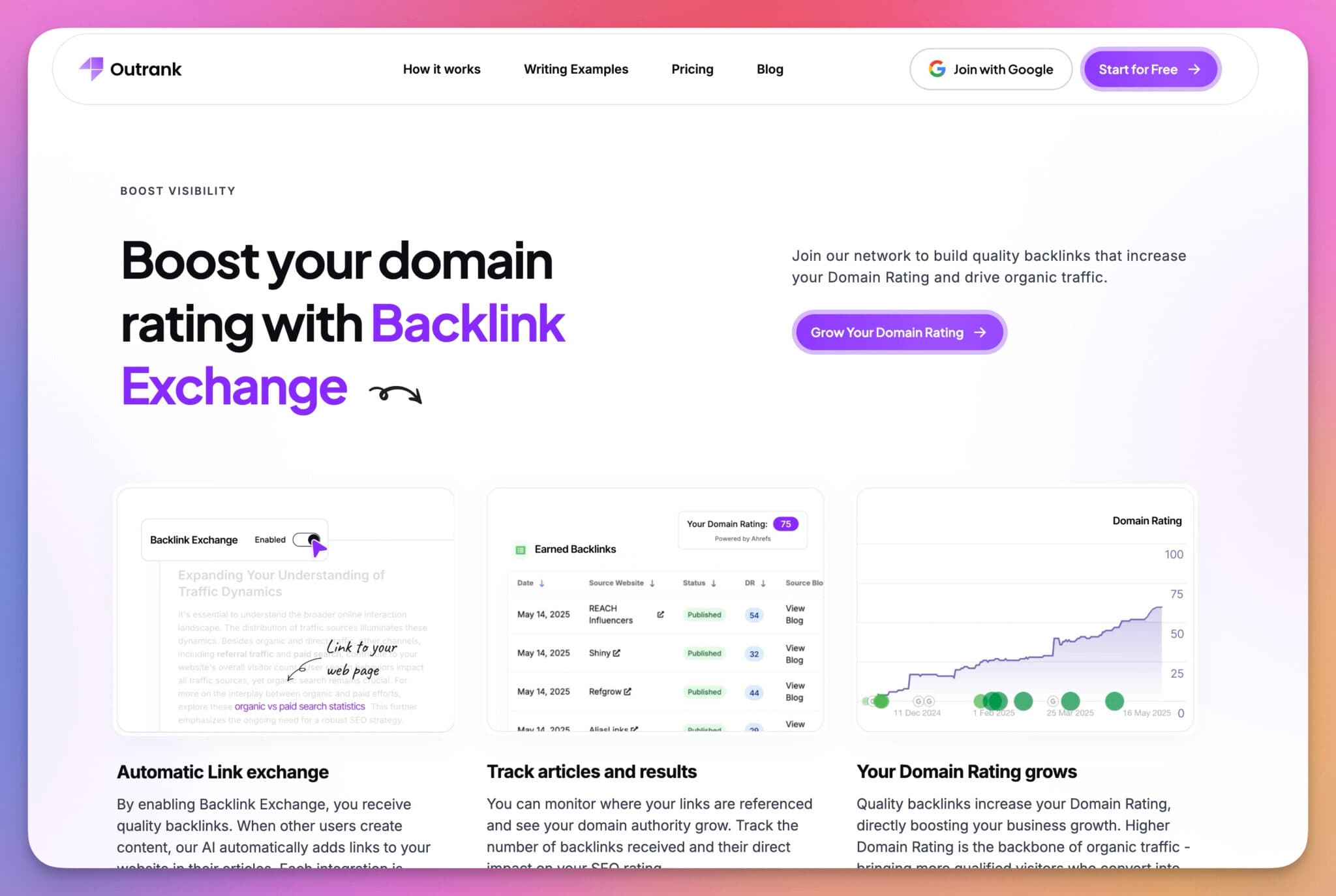
One factor that’s easy to miss: Outrank’s Backlink Exchange is one of its biggest draws. It’s a network where verified member sites earn in-content links from each other automatically as they publish, with no outreach, and it’s the feature reviewers single out most. Some report Domain Rating climbing from the low 20s into the 40s over a few months.
One catch worth knowing: on Outrank’s entry plan you can’t set a minimum Domain Rating for the sites that link to you, so some links land from lower-authority pages. Still, if that link network is a big part of why you’re eyeing Outrank, you’ll want an alternative that has one too, not just a writer.
It’s rarer than it sounds. Most AI writing tools stop at the draft. On this list, RightBlogger, Arvow, RankYak, and BabyLoveGrowth run a backlink exchange of their own; Koala, Byword, Surfer, Frase, and Jasper don’t.
If you do use one, make sure it gates members on real quality (verified domains, a domain-rating floor, strict topical relevance) so the links actually help instead of leaving a spammy footprint. And set expectations on speed: these networks tend to add a few links a week, so Domain Rating gains compound over months rather than overnight.
The 6 best Outrank alternatives for autoblogging in 2026
These six tools do what Outrank does, turning keywords into published articles with little or no manual work, but each one makes different tradeoffs on price, volume, and control. None of them is the right answer for everyone.
1. RightBlogger

RightBlogger is built specifically for bloggers, bundling an AI article writer, keyword research, content gap analysis, an SEO editor, autoblogging, social posts and repurposing, and CMS publishing. Plans start at $49/month with unlimited articles on every tier, about half Outrank’s $99 entry price. Disclosure: this is our tool, so weigh accordingly.
RightBlogger also includes a Site Agent for the post-publish loop. It scans your connected site on a recurring schedule (WordPress, Ghost, Webflow, Wix, Shopify, and Framer today). Pulling from your Search Console data, it surfaces internal-link adds and low-CTR meta-description rewrites, catches stale year references, and keeps every change reversible with a 30-day one-click undo. None of the other tools on this list ship a recurring post-improvement agent like it.
It also runs its own Backlink Exchange, a direct answer to Outrank’s. As you write with links turned on, it matches you to a relevant page on another verified member’s site, they link back to you, and there’s no outreach. A few things keep it editorial rather than spammy:
- Gated membership, with Google Search Console verification and a Domain Rank 15+ floor
- In-content links with varied anchors and long cooldowns between any two sites
- Included at no extra cost on eligible plans
Best for: bloggers who want one tool for the whole publishing workflow without article caps. Our Outrank vs RightBlogger comparison covers the practical differences.
Skip if: you want a single-purpose SEO editor like Surfer or a marketing-team tool like Jasper.
2. Arvow

Arvow is the closest direct workflow match to Outrank. It bundles automated keyword research, SERP analysis, AI article generation, and CMS publishing into a single autoblogging-style workflow, with a clean interface and solid SEO scoring.
It has also launched its own automated backlink exchange (on its Business tier), so it matches Outrank on built-in link building, and it sells a separate done-for-you niche-edit service on top.
Best for: people who liked Outrank’s general workflow but want a different price point or interface. Arvow’s Solo plan is $69/month at its current limited-time price, or $39/month billed yearly. Its credit model (1,000 credits, roughly 100 articles) is looser than Outrank’s 30-article cap.
Skip if: you need anything beyond article writing. Arvow doesn’t do social posts, content repurposing, or a flexible editor for hand-shaped pieces. See our full Arvow comparison for more.
3. RankYak
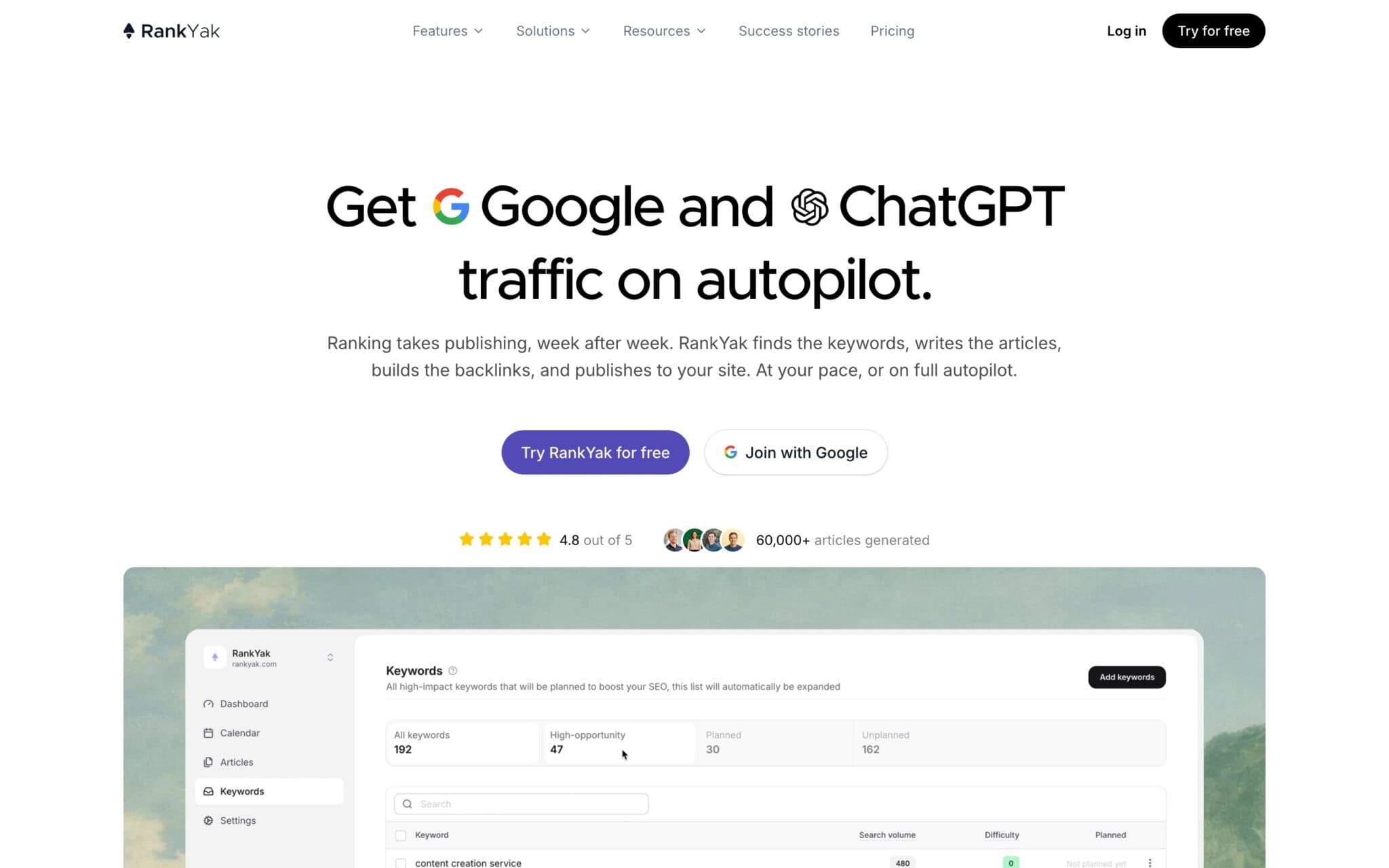
RankYak is the most hands-off alternative here, and it works a lot like Outrank. It plans your keywords, writes an article for each publishing day you pick, publishes it to your site, and swaps backlinks with other RankYak sites through its own exchange. It publishes natively to WordPress, WordPress.com, Shopify, Wix, Webflow, Ghost, and Duda, with an API and webhooks for everything else.
Pricing is per site: $99/month, or $82.50/month billed yearly, for up to 30 articles a month (one per day), with a 3-day free trial. Its Site Guard add-on, another $99/month, checks your existing pages against your search data and drafts fixes you apply in one click.
Best for: site owners who want Outrank’s done-for-you loop, with a calendar that lets them choose which days to publish.
Skip if: you publish more than one post a day or run several sites on a tight budget. Pricing scales per site, unused publishing days don’t roll over, and fixing your existing pages costs as much again as the base plan. See our full RankYak comparison for more.
4. KoalaWriter (Koala AI)
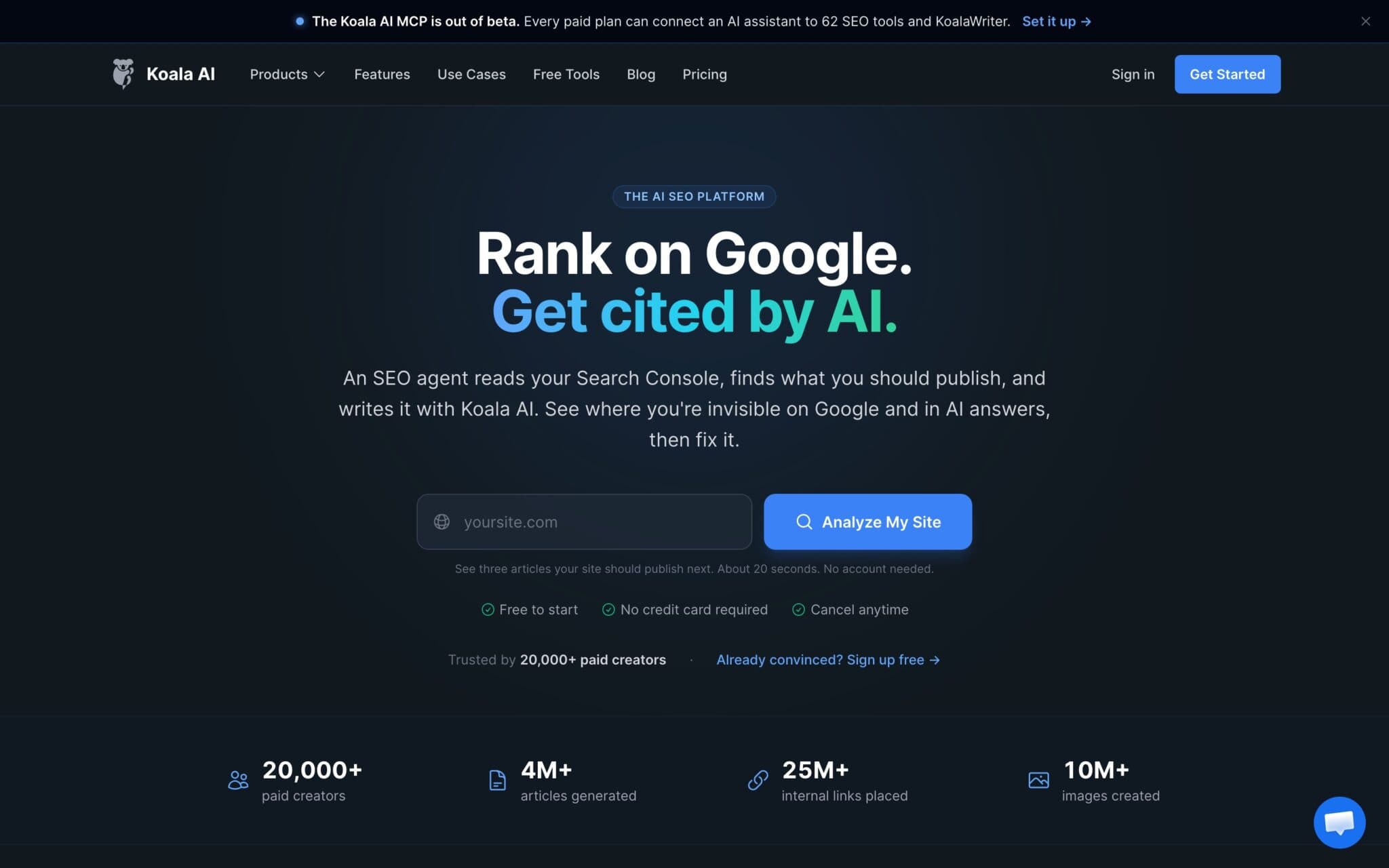
Koala AI, still best known for its KoalaWriter article writer, started as a fast, one-click AI writer for SEOs and has grown into an AI SEO platform. It writes long-form articles from a keyword, can pull live Amazon data into affiliate articles, adds internal links across your site with KoalaLinks, and publishes to WordPress, Shopify, Webflow, and Ghost, or anywhere else through webhooks.
The catch for Outrank shoppers is where autopilot lives. Plans start at $25/month ($20 billed yearly) for 45,000 words, but Content Calendar Autopilot, the feature that plans and publishes on a schedule the way Outrank does, starts on the Boost plan at $99/month ($79 billed yearly). Every plan is capped by words rather than articles, and Koala doesn’t run a backlink exchange.
Best for: bloggers and niche-site builders who want cheap, fast drafts they’ll edit and publish themselves, with autopilot available when they’re ready.
Skip if: you want Outrank-style autopilot at the lowest price. By the time you reach the plan with autopilot, you’re paying what Outrank costs, with a word budget instead of an article count. See our full Koala comparison for more.
5. BabyLoveGrowth
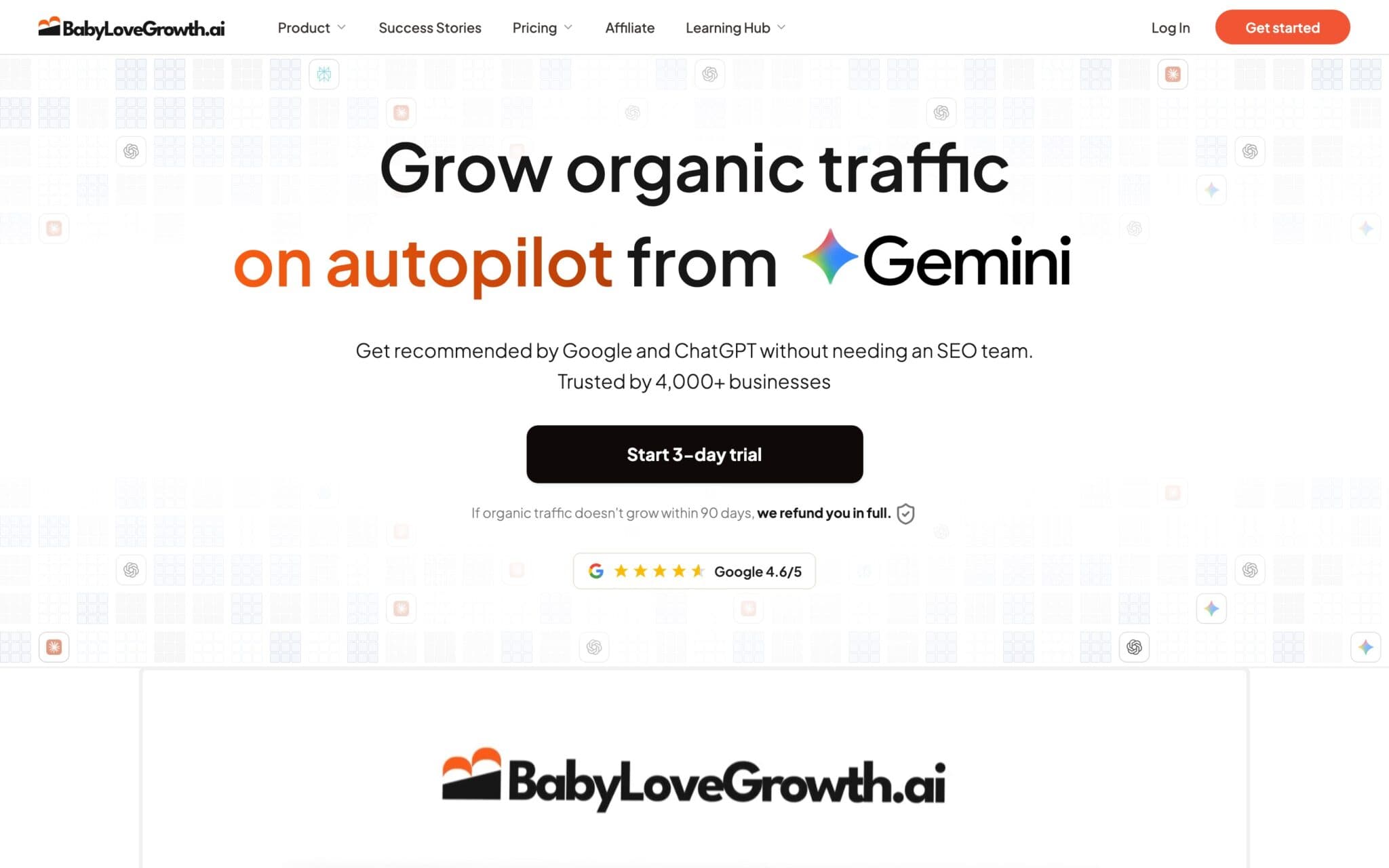
BabyLoveGrowth packs the most into one autopilot subscription. Its Grow plan publishes 30 articles a month to WordPress, Shopify, and eight other platforms, adds backlinks through an exchange it says spans more than 4,000 partner sites, tracks 10 prompts across ChatGPT, Claude, and Gemini, and includes Reddit and Quora agents plus a weekly Instagram and Facebook post made from your articles.
Grow costs $49/month billed yearly or $99 month to month, with a 3-day free trial and a 90-day money-back guarantee tied to traffic growth (read the conditions before you count on it). The Scale plan ($199/month billed yearly) raises that to 120 articles in four languages.
Best for: small businesses and Shopify stores that want articles, links, and AI-visibility tracking handled by one subscription.
Skip if: you want tight control over your link profile. On top of the exchange, its Backlink Marketplace pays outside bloggers $1 per Domain Rating point for each article it publishes on their sites, and Google’s spam policies count paying for posts that contain links as a link scheme. Look closely at how those links are handled before you rely on them.
6. Byword
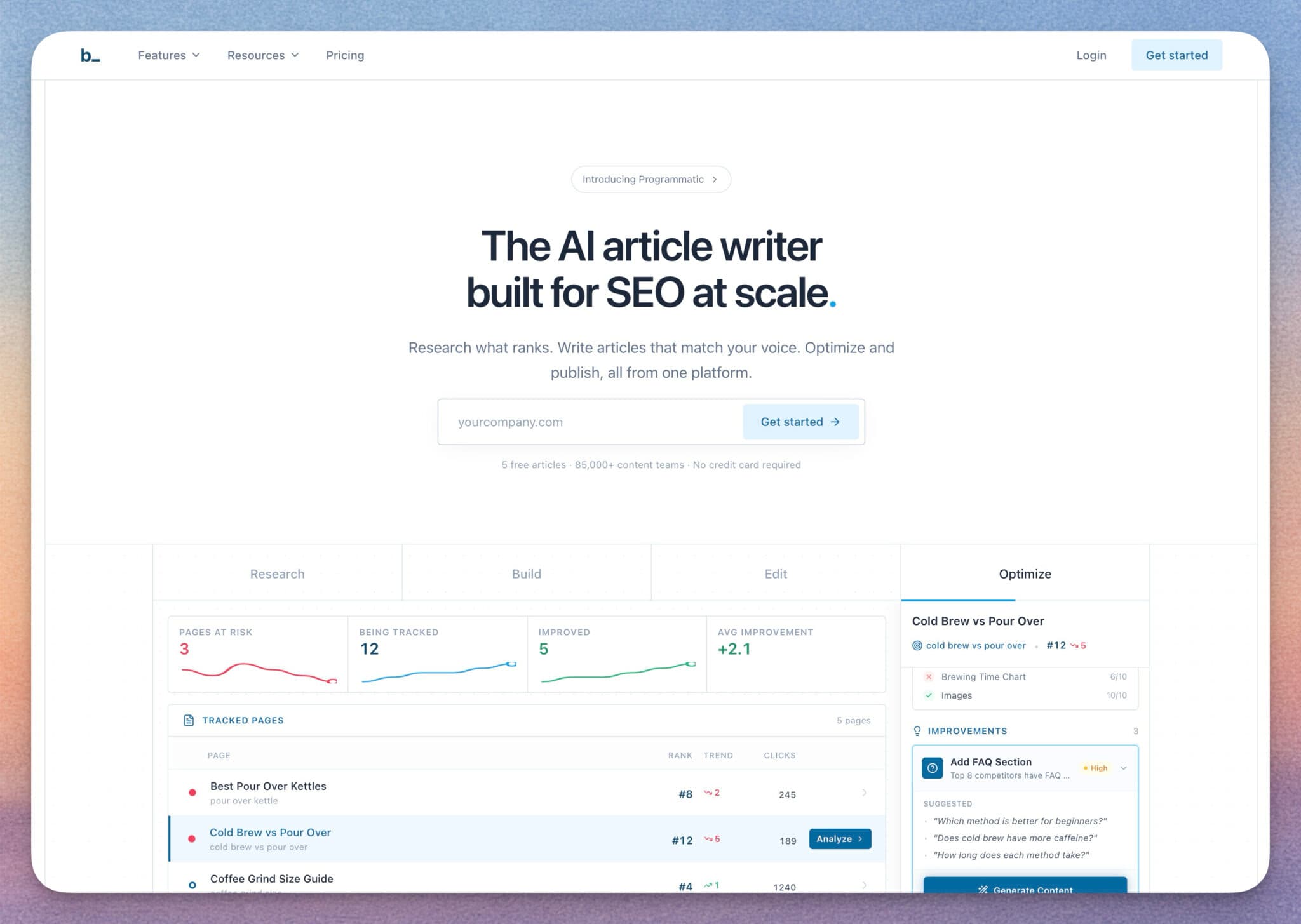
Byword is the volume play. You feed it a keyword (or a list of keywords), and it generates a full article per keyword, with direct publishing to WordPress, Webflow, Shopify, Ghost, and more. The output is decent for a first draft. Pricing now runs on monthly subscription tiers (from $99/month for 25 articles), rather than the older pay-per-article model.
Best for: publishers running programmatic SEO plays or large-scale niche sites where the priority is throughput, not perfectionism.
Skip if: you care about hand-shaped editorial work. Byword’s 2026 rebuild added a voice-matching system, but it’s still built for throughput over careful editing, and reviewers note the drafts create real cleanup work before they’re publish-ready.
If you want optimization instead of autopilot
Some people shopping for Outrank alternatives don’t actually want autopilot. They want help writing or optimizing posts they publish themselves. If that’s you, these three are worth a look instead.
Surfer SEO
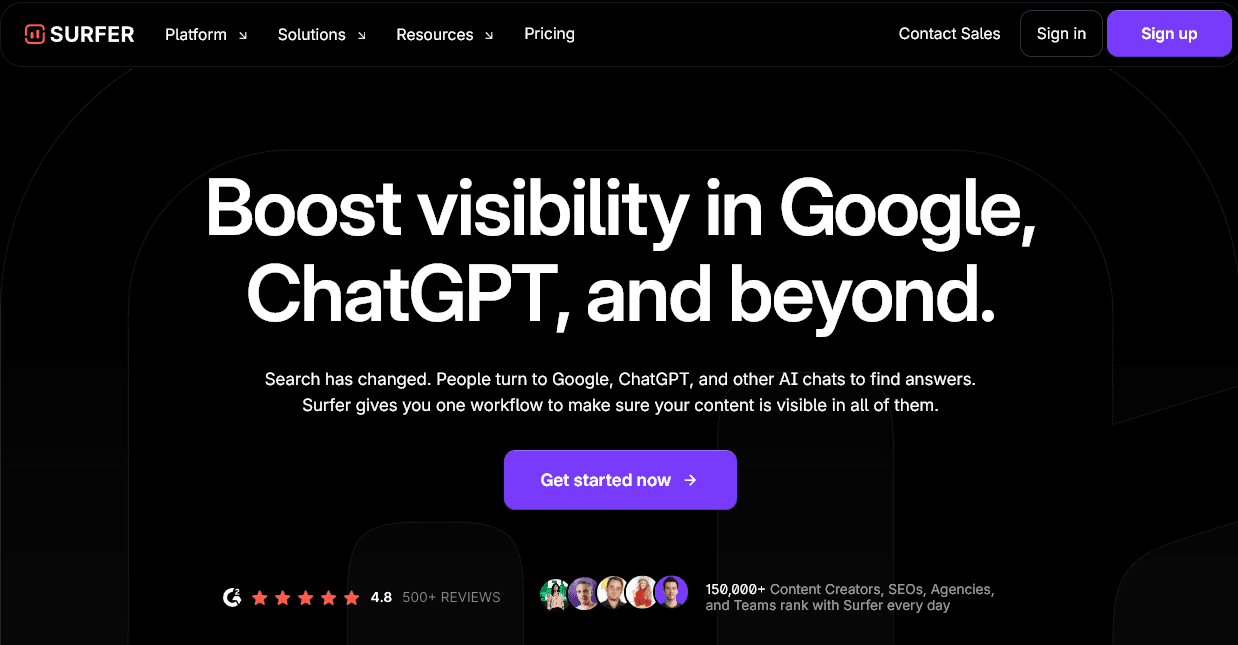
Surfer is the on-page optimization tool of the bunch. Paste a draft, pick a target keyword, and Surfer scores your content against the top-ranking pages and tells you exactly what to add, remove, or adjust. The Content Editor is excellent for tightening drafts that already exist, and in 2026 Surfer has leaned hard into AI-search visibility tracking alongside its classic SEO scoring.
Best for: people who already have a writing workflow they like and just want a heavyweight optimization layer. Pairs naturally with a separate AI writer or with hand-written content.
Skip if: you want one tool for the full draft-to-publish workflow. Surfer’s entry Discovery plan now starts around $49/month (the old $99 plan is mid-tier), it doesn’t generate full articles end-to-end, and it works best as an editor on top of another writer.
Frase
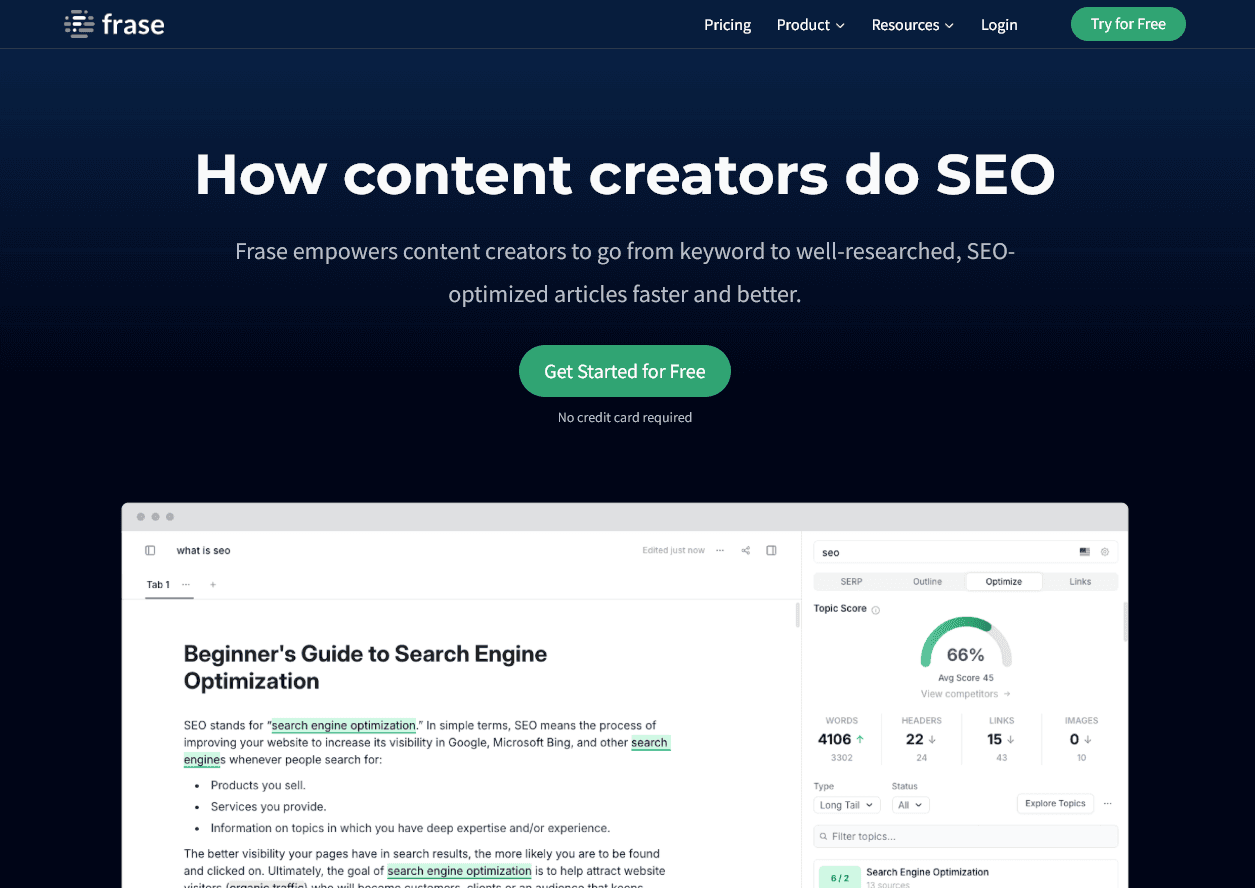
Frase sits between Surfer and a full AI writer. It does content research, outline building, and AI drafting, with strong SERP analysis built in. Frase pulls data from top-ranking pages to help you structure your articles around what Google already rewards.
Best for: middle-of-the-road buyers who want SERP-driven outlines plus AI drafting. After a 2026 repricing, plans now start at $49/month ($39 billed yearly), up from the old $15 tier, with unlimited AI writing as a paid add-on.
Skip if: you want polished AI writing out of the box. Frase’s AI drafting is functional but typically needs more editing than dedicated AI writers.
Jasper AI

Jasper is one of the most established AI writing tools. It’s built for marketing teams and handles everything from blog posts to ad copy to social. Jasper’s strengths are its template library, Brand Voice features, and team collaboration.
Best for: in-house marketing teams that need one writing tool across blog, ads, email, and social, with proper brand-voice controls.
Skip if: you’re a solo blogger. Jasper retired its budget Creator tier, so entry is now the Pro plan at $69/month per seat ($59/month billed annually), there’s no free plan, and it lacks the blogging-specific workflow features (autoblogging, content gap analysis, CMS publishing) that more focused tools include.
Outrank alternatives FAQ
Is Outrank worth it for bloggers?
It can be, if you’ll use the full feature set and you’re happy publishing about 30 posts a month. If you need room to experiment with multiple drafts per topic or you publish at higher volume, the article cap and $99/month entry point start to bite. Most people who switch cite cost or article limits, not feature gaps.
What’s the best Outrank alternative for unlimited content?
RightBlogger offers genuinely unlimited article generation on all plans, starting at $49/month. Byword handles high volume too, but its standard plans now cap monthly output (25 to 300 articles by tier), with true unlimited reserved for its enterprise plan. RankYak and BabyLoveGrowth cap their standard plans at about 30 articles a month per site, and Koala meters words instead of articles. The right pick depends on whether you want a full editorial workflow (RightBlogger) or pure programmatic throughput (Byword).
Do I need an “autopilot” publisher to grow traffic?
No. Most bloggers grow faster with a human-reviewed workflow than with full autopilot. Autoblogging tools (Outrank, RightBlogger, Arvow, RankYak, BabyLoveGrowth, Byword) can save real time, but I’d recommend at least a quick human edit before publishing. Pure autopilot only works when your prompts, templates, and brand voice are dialed in to the point where the drafts come out clean every time.
Which alternative is cheapest?
Entry prices shifted again when these tools repriced in 2026. Koala AI is the cheapest way in at $20/month billed yearly ($25 monthly), though its autopilot starts on the Boost plan at $79/month billed yearly ($99 monthly). Arvow’s Solo plan is $39/month billed yearly ($69 at its current monthly price), BabyLoveGrowth’s Grow plan is $49/month billed yearly ($99 monthly), and RankYak is $82.50/month billed yearly ($99 monthly). Byword starts at $99/month for 25 articles. On the optimization side, Frase starts at $49/month ($39 billed yearly, 10 articles) and Jasper’s Pro plan is $69/month ($59 yearly). For unlimited output, RightBlogger at $49/month is the only option here without an article cap.
Which Outrank alternatives include a backlink exchange?
Among the tools here, RightBlogger, Arvow (on its Business plan), RankYak, and BabyLoveGrowth do. Each runs an automated, in-content link exchange similar to Outrank’s, where member sites earn links from each other as they publish. Koala, Byword, Surfer, Frase, and Jasper don’t include a link network. If links are a big reason you’re considering Outrank, check how each network screens its members and keep any paid placements separate from the exchange. RightBlogger’s is included at no extra cost, with domain-quality and relevance gating built in.
Do any of these tools auto-improve posts after publishing?
Most of them stop at publish. RankYak’s Site Guard add-on ($99/month) checks your existing pages against your search data and drafts fixes you apply in one click, and Koala’s KoalaLinks adds internal links across your site. RightBlogger’s Site Agent is included on every paid plan. It runs recurring scans on connected sites (WordPress, Ghost, Webflow, Wix, Shopify, and Framer), queuing internal-link adds, meta-description rewrites for low-CTR pages, year-in-title freshness fixes, and broken outbound-link cleanups.
You choose how aggressive it is per project (Ask Approval, Smart, or Fully Automatic), and every edit gets a 30-day undo. Most of the other autoblogging tools here focus on getting new drafts out the door.
Picking your Outrank alternative
Don’t pick on feature-list length. Pick on the workflow friction you’re trying to eliminate:
- Article caps? RightBlogger is the only tool here with unlimited articles on every plan.
- Optimization rigor? Surfer.
- Pure volume? Byword.
- Hands-off daily publishing for one site? RankYak.
- The cheapest way in, with autopilot when you’re ready? Koala AI.
- Articles, links, and AI-visibility tracking in one plan? BabyLoveGrowth.
- A marketing team’s brand voice? Jasper.
- An Outrank-style end-to-end loop? RightBlogger, Arvow, RankYak, and BabyLoveGrowth all cover it. Arvow is the closest interface match; RightBlogger is the only one without an article cap, and it adds social posts and repurposing at $49/month.
The fastest way to decide is to draft one real post, end-to-end, in two of these tools. The friction shows up in 30 minutes, not 30 reviews. Most of these offer free trials or low-commitment entry tiers, so test before you commit.

RightBlogger Co-Founder Ryan Robinson teaches 500,000 monthly readers how to grow an online business and is a recovering side project addict.




Automated SEO Blog Posts for Your Site
Research, write, publish, and share from one account.
7-day free trial. Cancel anytime.





Leave a comment