Byword vs RightBlogger: Which AI Blogging Platform Is Better in 2026?
Choose Byword if you want
- Bulk or programmatic content at agency scale
- Per-article credits and team seats
- Unlimited domains on higher plans
Choose RightBlogger if you want
- Unlimited articles on one flat plan
- Upkeep of posts that are already live
- Social sharing and AI brand monitoring included
$0 due today. 30-day money-back guarantee on paid plans.
Table of contents
Key takeaways
- Byword starts at $99 monthly for 25 articles, while RightBlogger starts at $59 monthly with unlimited generation.
- Both offer free plans; Byword allows five free articles monthly, while RightBlogger also offers a seven-day paid-plan trial and a 30-day money-back guarantee.
- Both can publish automatically, but only RightBlogger runs recurring audits and maintenance fixes on live pages, with approval controls available.
- Byword is the better fit for defined bulk projects and template-driven programmatic campaigns, especially when built-in indexing submission matters.
- RightBlogger better suits bloggers, teams, and agencies wanting ongoing blog management, with unlimited generation, site maintenance, social distribution, and client reporting in one platform.
Byword and RightBlogger can both generate SEO-focused articles, automate publishing, add links, and support content production at scale. The key difference is the scope of the workflow each platform covers.
Byword focuses on bulk and programmatic content generation, with credit-based pricing and built-in indexing submission. RightBlogger offers a broader all-in-one blogging system, combining unlimited content generation with SEO research, optimization, publishing, ongoing site maintenance, social distribution, and backlink building.
Choosing between them comes down to what you want to automate. Do you need a focused tool for producing batches of articles, or a platform that can help manage the full content cycle?
Quick verdict: Byword is a practical option for bulk projects, defined content runs, and users who prefer usage-based pricing. RightBlogger is the stronger overall choice for bloggers, niche site owners, teams, and agencies that want unlimited generation and a wider set of SEO, publishing, maintenance, and distribution tools.
Byword vs RightBlogger Feature Comparison
The full comparison below shows the capabilities of each platform. After the table, we’ll look at the differences that matter most in day-to-day use.
| Feature |   | Byword |
|---|---|---|
Free Plan | ||
Starts At | $49 | $83 |
Unlimited Use | ||
Pay Per Article | ||
Autoblogging | ||
Site Agent | ||
AI Brand Monitoring | ||
Social Automation | ||
Backlink Exchange | ||
WordPress Integration | ||
Webflow Integration | ||
Shopify Integration | ||
Wix Integration | ||
Duda Integration | ||
Webhook Integration | ||
Ghost Integration | ||
Zapier Integration | ||
Keyword Research Tool | ||
AI Chat | ||
Article Generator | ||
Automatic In-Article Images | ||
Automatic In-Article Videos | ||
Automatic Internal Linking | ||
Automatic External Linking | ||
Video to Blog | ||
Create Embedded Lead Magnets | ||
Mass Publishing | ||
Languages Supported | 139 | 47 |
Article Indexing Service | ||
Create Presets | ||
Change Voice Tonality | ||
Change Writer Point of View | ||
Sub User Accounts | ||
Educational Resources | ||
Priority Support | ||
SEO Reports | ||
Auto Optimize | ||
White Label Client Reports |
Content Generation: Both Cover the Basics
Both platforms include the core features needed to generate long-form blog content.
Byword and RightBlogger also support presets, voice tonality controls, automatic images, internal linking, external linking, and mass publishing.
That makes either platform capable of supporting a structured content production workflow. The gap becomes clearer when you move beyond basic article generation.
RightBlogger Offers More Ways to Create and Repurpose Content
RightBlogger includes several content tools that Byword doesn’t offer:
- AI Chat for working through ideas and content questions
- Writer point-of-view controls
- Automatic YouTube video embeds
- Embedded AI lead magnets
The RightBlogger AI Article Writer supports long-form content creation with control over voice and perspective.
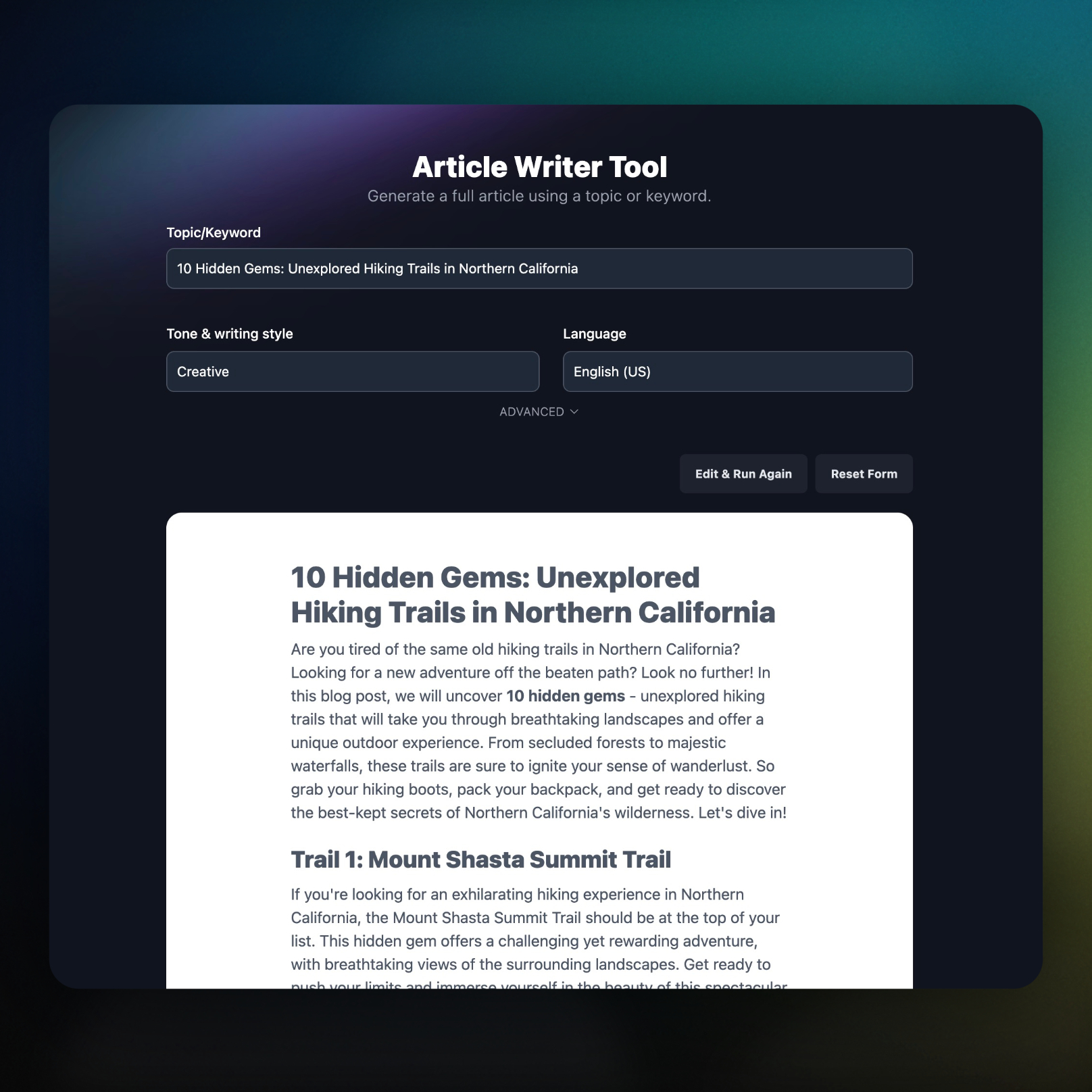
The point-of-view setting can be useful when switching between first-person creator content, second-person tutorials, and more neutral third-person articles. Both tools let you change tonality, but only RightBlogger includes writer perspective as a separate control.
RightBlogger also has a Video to Blog tool for turning existing video content into written posts. This gives YouTubers and content teams another way to expand their publishing output without starting every article from scratch.
Byword Keeps Its Content Workflow More Focused
Byword includes article generation, automatic images, presets, and automated links. That covers the main needs of a bulk SEO campaign.
Its January 2026 v2 relaunch centers on programmatic SEO templates, multi-model generation, and live SEO scoring. Templates help teams structure repeatable content runs, while video-to-blog conversion lets them turn YouTube videos into articles.
It doesn’t include AI Chat, automatic video embeds, embedded lead magnets, or point-of-view controls. If you don’t need those extras, Byword’s focused approach may be enough.
SEO and Content Optimization
Both platforms provide keyword research, article generation, SEO reports, and automatic content optimization. They can also add internal and external links automatically, which can save time during editing and publishing.
The difference is how far their SEO toolsets extend after the initial article is created.
RightBlogger Combines Research, Writing, and Optimization
RightBlogger includes a Keyword Research Tool, along with several features designed to improve articles before and after publication:
- SEO Reports that analyze search results and show what an article may need to compete
- Auto Optimize for adding relevant terms used by top-ranking pages
- Automatic internal and external linking
- Site Agent for maintaining published content
- Backlink Exchange for off-page SEO
- White-label client reports based on Google Search Console data
Its SEO Reports help turn keyword research into a more direct content brief. Rather than stopping at a keyword suggestion, the platform can analyze competing search results and identify terms and topics to cover.

The Auto Optimize feature extends that workflow by updating articles with terms found across high-ranking content. This gives bloggers and teams a built-in path from keyword selection to article generation and on-page optimization.
Byword’s SEO Strength Is Indexing Submission
Byword’s Research and Optimize tools cover keyword exploration, SEO reports, and content optimization for articles generated inside the platform. It also supports automatic internal links, external links, and an indexing dashboard that submits to Google and IndexNow.
RightBlogger does not include an article indexing service, so this is a clear Byword advantage. Byword handles indexing submission alongside publishing, so you don’t need a separate submission step.
However, Byword does not provide a recurring maintenance agent or white-label Google Search Console reports.
Choose Byword if direct indexing submission is central to your workflow. Choose RightBlogger if you want SEO tools that extend into site maintenance, off-page growth, and client reporting.
RightBlogger Tracks Your Brand in AI Answers
RightBlogger’s AI Brand Monitor tracks how often ChatGPT, Claude, Gemini, and Perplexity mention your brand when people ask about your category. It also measures your share of voice against competitors, the sentiment of those answers, and the sources they cite.
AI Brand Monitor is included on every paid plan, with one monitor per connected site. It runs your prompts on a schedule and shows the per-prompt detail behind each number.
For marketing teams, this adds a way to assess brand visibility beyond traditional search performance. You can see whether AI assistants mention your business and how those answers describe it, rather than checking each assistant manually.
This is monitoring inside a publishing platform, not a standalone AI visibility suite. Tools built primarily for AI visibility track more platforms and more prompts, so RightBlogger’s scope is narrower than a dedicated monitoring product.
Byword does not include AI brand monitoring. If tracking those answers is part of your content strategy, you’ll need a separate tool alongside Byword.
Site Agent: Maintaining Content After Publication
Publishing an article doesn’t finish the work. Site owners still need to revisit old content, fix broken links, improve weak metadata, and refresh outdated titles.
RightBlogger’s Site Agent is a major difference in this comparison. It scans connected WordPress, Ghost, Webflow, Wix, and Shopify sites on a recurring schedule. Audit frequency depends on your plan. It can maintain any page on a connected site, not only content generated by RightBlogger.
The recurring audits look for high-impact updates, including:
- Adding missing internal links
- Cleaning up broken outbound links
- Improving weak meta descriptions on pages with low click-through rates
- Refreshing stale year references in titles
Site Agent offers three levels of control:
- Ask Approval queues every proposed edit for review.
- Smart automatically applies low-risk fixes.
- Fully Automatic applies all eligible fixes.
Every change includes one-click undo for 30 days. RightBlogger also keeps two independent backups, which adds protection if you want to reverse an automated update.
Byword does not have an equivalent site maintenance agent. It can create, optimize, publish, and submit new content for indexing, but it does not run recurring audits or apply maintenance fixes to pages that are already live.
For established sites with a growing content library, maintaining old pages can matter as much as publishing new ones. RightBlogger’s broad page coverage, review modes, backups, and undo window make Site Agent useful as the site grows.
Autoblogging, Scheduling, and Bulk Publishing
Both Byword and RightBlogger support autoblogging and mass publishing. Each platform can help you generate content in batches and send it to a connected publishing system.
RightBlogger’s autoblogging workflow combines content planning, generation, scheduling, and publishing. Its paid plans include different numbers of planner automations:
- Solo: 1 planner automation
- Pro: 3 planner automations
- Agency: 10 planner automations

RightBlogger also provides unlimited article generation on its paid subscriptions. Byword’s Starter, Standard, and Scale plans use article allowances and charge for extra articles. Its separate Unlimited tier removes the article cap but bills generation through your own AI provider keys.
That creates two different approaches to scale:
- Byword’s credit-based plans cover a defined amount of content, which may suit fixed-size bulk projects. Its Unlimited tier separates the platform fee from generation costs.
- RightBlogger uses a subscription with unlimited article generation, which becomes more attractive as publishing volume rises.
Both can handle bulk production. RightBlogger stands out when you want to run recurring content plans without tracking the cost of each new article.
For a wider look at this category, see our guide to the best autoblogging tools for bloggers and marketing teams in 2026. You can also compare RightBlogger with another automation-focused platform in our Autoblogging AI vs RightBlogger comparison.
Social Automation and Content Distribution
Publishing a blog post is only one part of content marketing. Each new article still needs to reach readers through search, social media, newsletters, or other channels.
RightBlogger’s Social Media Automation can automatically share every new blog post to:
- X
- Threads
The platform writes an AI caption for each supported social network rather than reusing one generic caption everywhere.
Plan coverage varies. Solo includes LinkedIn integration, while Pro and Agency also cover X, Facebook, Threads, and Pinterest.
Byword does not include built-in social sharing automation. You can publish articles through its supported integrations, but social distribution requires a separate workflow.
For creators and marketing teams, this moves RightBlogger beyond article production. The same workflow can generate the post, publish it, and share it on social media.
Backlink Exchange and Off-Page SEO
RightBlogger also includes a Backlink Exchange that automatically matches users with real, verified sites in relevant niches. In-content backlinks are matched and placed automatically as members publish, so they build gradually without manual outreach or link farms.
Byword does not include a backlink exchange.
This distinction matters when your content plan includes earning links, not just publishing pages. RightBlogger can also support off-page SEO, giving it a broader role in the growth process.
The Backlink Exchange won’t replace every link-building method, but it gives users a built-in way to pursue relevant backlinks while producing content.
Integration Capabilities
Both platforms work with WordPress, Webflow, Shopify, Ghost, and webhooks. After that, their publishing options differ.
| Integration | RightBlogger | Byword |
|---|---|---|
| WordPress | Yes | Yes |
| Webflow | Yes | Yes |
| Ghost | Yes | Yes |
| Shopify | Yes | Yes |
| Wix | Yes | No |
| Duda | Yes | No |
| Webhooks | Yes | Yes |
| Blogger | No | No |
| Zapier | No | Yes |
RightBlogger has an advantage for direct publishing to Wix and Duda. Those integrations give users a way to automate content on either platform without building a custom connection.
Byword also supports publishing and exports to HubSpot, Medium, Airtable, Notion, Google Docs, and Google Sheets. That mix can be useful for teams that move content through documents, databases, and editorial workspaces before it goes live.
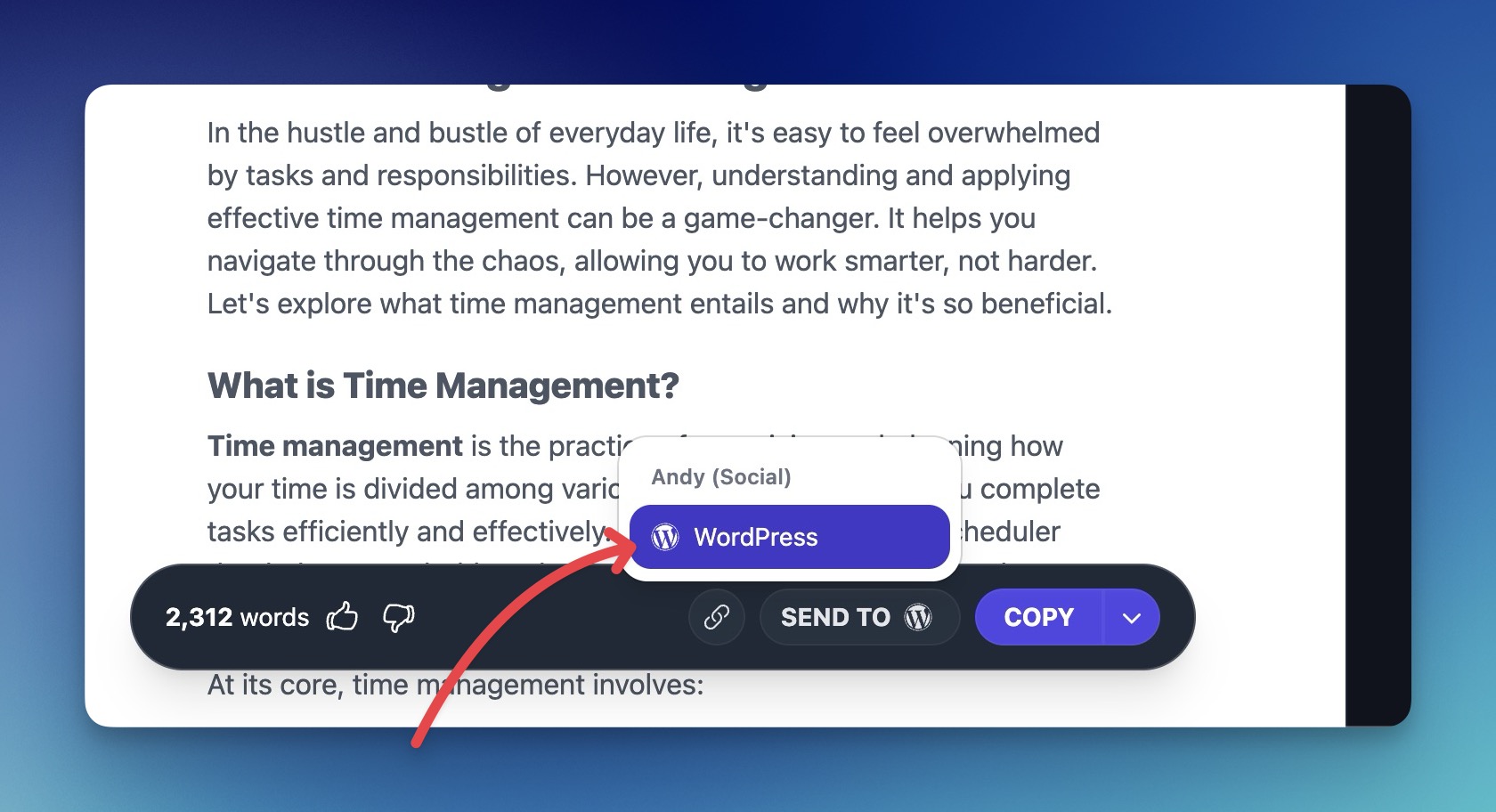
The best fit depends on your publishing stack:
- Pick RightBlogger for direct Wix or Duda publishing.
- Pick Byword for destinations such as HubSpot, Medium, Airtable, Notion, Google Docs, or Google Sheets.
- Either can work for WordPress, Webflow, Shopify, Ghost, or webhook-based publishing.
Byword includes Zapier and Make connections, plus a REST API and remote MCP server for custom workflows. RightBlogger does not include a Zapier integration, though both platforms support webhooks.
Customization and Editorial Control
Both tools include presets and voice tonality settings. These features let you reuse preferred article settings instead of configuring every post from the beginning.
RightBlogger adds writer point-of-view controls and AI Chat, giving users more ways to guide the content. Its plans also include saved custom writing styles:
- Solo: 5 custom writing styles
- Pro: 15 custom writing styles
- Agency: 50 custom writing styles
These saved styles can help creators and teams keep content consistent across multiple topics or sites. An agency, for example, can save different styles for clients rather than rewriting the same instructions for each article.
Byword includes presets and tonality controls, so it isn’t short on basic customization. However, it does not include writer point-of-view controls or AI Chat.
RightBlogger provides more editorial control, while Byword covers the most common repeatable settings.
Multimedia and Lead Generation Features
Both platforms can place images in articles automatically and turn videos into blog posts. RightBlogger goes further by adding automatic YouTube video embeds.
It also includes the ability to build embedded AI tools that can serve as interactive lead magnets.
The RightBlogger Tool Studio for embedded lead magnets gives publishers a way to turn informational content into something readers can use. Paid plans include different tool limits:
- Solo: 5 embedded tools
- Pro: 15 embedded tools
- Agency: 50 embedded tools
Byword does not include automatic video embeds or embedded lead magnets.
If your main goal is text-based SEO publishing, that may not matter. If you want articles to include video embeds and interactive lead-generation tools, RightBlogger gives you more options.
Language Support
Language coverage is one of the clearest differences between these platforms.
- RightBlogger supports 139 languages
- Byword supports 47 languages
Byword covers a solid range for international content projects, but RightBlogger supports nearly three times as many languages.
RightBlogger is better suited to multilingual blogs, international marketing teams, and agencies with clients in different regions. Its broader language support can also make it easier to test localized content without moving to another writing platform.
Team Collaboration and Scalability
Both RightBlogger and Byword support sub-user accounts and mass publishing. Byword opens team seats and API access on its Standard plan, while RightBlogger includes added team seats on Pro and Agency.
RightBlogger provides clear limits for sites, seats, reports, and recurring automations:
| RightBlogger Plan | Connected Sites | Team Seats | Planner Automations | SEO Reports per Month |
|---|---|---|---|---|
| Solo | 1 | No added seats | 1 | 30 |
| Pro | 3 | 3 | 3 | 90 |
| Agency | 10 | 5 | 10 | 300 |
The Pro plan fits small content teams managing several sites. The Agency plan raises the limits for connected sites, team members, automations, saved writing styles, embedded tools, and SEO reports.
Byword’s Standard plan is the starting point for teams and API-based workflows. This makes it a capable option for companies building programmatic content systems or passing generated articles into a custom publishing process.
For teams, RightBlogger’s main advantage is that content production, SEO reports, planner automations, publishing, and client reporting can live within the same platform. Its white-label Google Search Console reports are useful for agencies that need to show clients branded performance dashboards on their own domain.

User Experience and Interface
The biggest user experience difference is the number of content tasks each platform tries to handle.
Byword offers a focused production workflow. A team can generate and optimize a batch of articles, add images and links, publish the content, and submit it for indexing. This is a direct path for bulk or programmatic campaigns.
RightBlogger covers more stages inside one account. A user can research keywords, generate articles, optimize them, schedule publication, maintain live pages, share new posts to social media, build backlinks, and prepare client reports.
A narrower workflow may suit teams that already have separate SEO, social, and maintenance tools. RightBlogger can reduce app switching for users who want one central system for ongoing blog management.
Byword reviewers on Trustpilot praise the founders’ SEO knowledge, and one credits its keyword-driven articles in the 2,000 to 3,000 word range with ranking gains on their own site. As of September 2026, Byword sits at 2.8 out of 5 across 7 reviews. Negative reviews describe WordPress publishing blocked by some common hosts without a fix or warning before purchase, plus login verification codes that never arrive. With only 7 reviews, the newest from June 2025, treat this as a signal rather than a verdict on its January 2026 relaunch.
As of September 2026, RightBlogger sits at 4.8 out of 5 across 46 reviews. Reviewers praise the breadth of tools under one subscription and output that reads like the person who requested it. The profile has no review below 5 stars and no complaints at that snapshot, but that isn’t proof of perfection. Solo still limits you to one connected site and LinkedIn-only social sharing, and RightBlogger does not submit articles for indexing.
The better interface for you will depend on whether you prefer a focused bulk generator or a broader workspace for managing a content operation.
Customer Support and Learning Resources
Both platforms include educational resources and priority support, but plan access differs.
RightBlogger’s support and training features include:
- Educational resources
- RightBlogger courses
- Priority support
- Strategy calls
RightBlogger reviewers on Trustpilot describe support answered personally by the founders, often within minutes. They also praise feature requests that ship quickly.
Byword includes educational resources, while priority support is reserved for its Scale plan. It does not include strategy calls.
Byword reviewers on Trustpilot report difficulty finding a reachable support contact. For a team that relies on automated publishing, access to help matters when a connection fails or a production run stalls.
RightBlogger offers more direct guidance across its product, especially for agencies and teams that need help setting up content systems. Byword’s Scale customers still get priority support, which may be enough for high-volume programmatic projects.
Byword vs RightBlogger Pricing
Both platforms have a free plan, but their paid pricing models are very different.
Byword maintains a permanent free tier capped at five articles per month across three domains. RightBlogger also offers a free plan, giving users a way to try the platform before moving to an unlimited paid subscription.
RightBlogger’s paid plans start with a 7-day free trial and $0 due today. You can evaluate the paid workflow before any card is charged, and you keep every article you write during the trial. Every paid plan is also covered by a 30-day money-back guarantee.
That gives buyers two ways to evaluate RightBlogger: use the free plan or test a paid plan during the trial. Byword’s free article allowance lets you test its content production before paying for more output.
RightBlogger’s cancellation is self-serve from the account page through the Stripe billing portal. Cancelling takes a click, and access runs to the end of the paid period.
In Trustpilot reviews published before its January 2026 relaunch, Byword users report refund requests that went unanswered. Before committing to a paid plan, use the free articles to test both the output and your publishing connection.
| Pricing Factor | RightBlogger | Byword |
|---|---|---|
| Free plan | Yes | Yes, up to 5 articles per month |
| Starting paid price | $59 monthly or $49 monthly equivalent with annual billing | $99 monthly or $83 monthly equivalent with annual billing |
| Entry-plan article volume | Unlimited | 25 articles |
| Pay per extra article | No | Yes |
| Best pricing fit | Recurring and high-volume publishing | Defined bulk and programmatic runs |
RightBlogger’s Solo plan costs $59 when billed monthly or $588 per year, which works out to $49 per month. It includes unlimited words, one connected site, one planner automation, five custom writing styles, five embedded tools, and 30 SEO reports per month.
The higher plans expand those limits:
- Pro: $89 monthly or $828 yearly, equal to $69 per month with annual billing
- Agency: $299 monthly or $2,388 yearly, equal to $199 per month with annual billing
Unlimited generation does not mean unlimited sites, team seats, or SEO reports. Those still follow your plan’s limits.
Byword uses credit-based plans tied to a set number of articles:
- Starter: $99 monthly, or $83 per month with annual billing, for 25 articles
- Standard: $299 monthly, or $249 per month with annual billing, for 80 articles
- Scale: $999 monthly, or $833 per month with annual billing, for 300 articles
- Extra articles: $2.50 to $3.50 each, depending on the plan
Byword also supports pay-per-article purchasing, while RightBlogger uses subscriptions rather than per-article purchases.
This model gives Byword users a clear allowance for each production cycle. On its credit-based plans, costs rise when you publish beyond the included volume.
Byword also offers an Unlimited tier with a $1,999 monthly platform fee. It removes the article cap, but generation is billed separately through your own AI provider keys at roughly $0.10 per article. That means uncapped article volume, not all-inclusive generation.
Which Pricing Model Gives You Better Value?
Byword may offer the better fit when you know how many articles a project requires. A programmatic campaign with a fixed page count can be easier to budget around a set article allowance.
RightBlogger becomes more attractive for a steady publishing schedule. Once you’re producing articles each week, the unlimited-use model gives you more room to test topics, regenerate drafts, and expand content without paying for every additional article.
The subscription also covers more than generation. RightBlogger includes tools for keyword research, SEO optimization, publishing, site maintenance, social distribution, lead magnets, and backlink building.
Replace-the-Stack Cost Estimate
A content team could assemble a similar workflow using several separate subscriptions. For a conservative planning estimate, assume the following entry-level monthly budgets:
| Separate Tool Category | Simple Monthly Estimate |
|---|---|
| AI article writer | $20 |
| SEO content optimization | $30 |
| Keyword research | $20 |
| Scheduling and publishing | $10 |
| Estimated total | $80 per month |
These are round planning estimates, not quotes from named vendors. Higher limits, added users, or more advanced tools could raise the total.
Against that basic $80 estimate:
- RightBlogger Solo at $59 monthly could save about $21 per month.
- RightBlogger Solo at the $49 annual equivalent could save about $31 per month.
- The basic separate stack would total about $960 per year.
- RightBlogger Solo billed annually costs $588 per year, a difference of about $372.
Byword Starter costs $99 monthly or $83 per month with annual billing, which is close to the estimated cost of the separate stack. It combines writing, keyword research, optimization, links, publishing, and indexing submission, but remains capped at 25 articles.
These categories overlap with Byword’s own tools, so the $80 estimate is not an extra charge to add to its subscription.
The estimate also assigns no separate price to site maintenance, social automation, backlink matching, AI Chat, video repurposing, or embedded lead magnets. Paying for dedicated tools for those jobs would increase the cost of a separate stack.
Which Blog Automation Tool Is Best for You?
The best choice depends on your publishing volume, CMS, budget, and how much of the workflow you want one platform to handle.
For Solo Bloggers
RightBlogger is the better overall choice for most active solo bloggers.
The Solo plan provides unlimited generation, keyword research, SEO reports, site maintenance, planner automation, and direct publishing. You can also save custom writing styles and build embedded lead magnets.
Byword may be the better fit if you publish no more than a few articles per month and can stay within its free tier. Its paid Starter plan makes more sense when you want a defined 25-article allowance and built-in indexing submission.
For Niche Site Owners
Choose RightBlogger if you’re building a niche site on an ongoing basis.
Unlimited generation, autoblogging, automatic links, SEO reports, Auto Optimize, social sharing, and Site Agent support both new and existing content. The Backlink Exchange also adds an off-page SEO workflow that Byword does not provide.
Choose Byword when you want to run a fixed bulk project and direct indexing submission is a high priority.
For Agencies
RightBlogger is the stronger agency platform.
Its Agency plan includes:
- 10 connected sites
- 5 team seats
- 10 planner automations
- 300 monthly SEO reports
- 50 saved writing styles
- 50 embedded tools
Byword supports team seats from Standard, API access from Standard, and priority support on Scale. It can work well for an agency that needs a focused bulk generator or wants to build a custom programmatic workflow.
RightBlogger is the better fit when the agency also needs recurring planning, site maintenance, social distribution, backlink building, and branded client reports.
For Marketing Teams
RightBlogger is better for teams that want one system for content planning, production, optimization, publishing, and distribution.
Pro includes three team seats, three connected sites, three planner automations, and 90 SEO reports per month. It also includes social sharing to X, LinkedIn, Facebook, Threads, and Pinterest.
Byword is worth considering when a team already uses separate social, maintenance, and reporting tools. Its API access and range of publishing destinations can also help teams move bulk content through an existing editorial system.
For Programmatic SEO Projects
This is the closest decision.
Byword is built for bulk and programmatic content production. Its templates, API access, automated links, images, indexing submission, and wide range of publishing destinations suit repeatable production runs. Its Unlimited tier also gives large projects a way to move beyond fixed article allowances.
RightBlogger also supports mass publishing and autoblogging, but adds unlimited generation within its subscription, broader language support, recurring site maintenance, social distribution, backlinks, and direct Wix and Duda integrations.
Choose based on the project:
- Byword: Template-driven campaigns, indexing submission, API access, or a workflow built around documents and editorial databases
- RightBlogger: Recurring programmatic publishing, multiple sites, team planning, and broader SEO automation
Byword Pros and Cons
Byword Pros
Byword fits teams that want content production to stay focused.
- Handles large, defined production runs with clear article allowances
- Moves content into the documents and editorial workspaces teams already use
- Handles indexing submission without a separate handoff
- Lets teams feed articles into custom systems through its API
- One reviewer credits its long-form SEO articles with ranking gains
Byword Cons
The tradeoffs show up when you need to manage content after launch.
- Credit-based plans require tracking article allowances
- Published posts still need a separate maintenance process
- Social promotion and backlink acquisition remain outside the workflow
RightBlogger Pros and Cons
RightBlogger Pros
RightBlogger’s strengths are clearest when publishing is an ongoing process.
- Publishes and maintains posts without repeated CMS cleanup
- Unlimited generation suits steady schedules and content testing
- Keeps routine social promotion tied to publishing
- Brings client content production and reporting into one workspace
RightBlogger Cons
The broader workflow still has limits you should plan around.
- Indexing submission still needs a separate process
- Solo can’t run a multi-site or multi-user operation
- Zapier-based workflows need a different integration route
- SEO reports and planner automations still have plan limits
Final Verdict: Is Byword or RightBlogger Better?
Byword is a strong choice for bulk and programmatic content projects. Its templates, API access, indexing submission, and broad publishing options work well for defined campaigns and custom production systems.
RightBlogger is the better choice for most bloggers, niche site owners, marketing teams, and agencies. Its unlimited generation, Site Agent, social automation, Backlink Exchange, broader language support, and client reporting cover more of the work required to grow and maintain a blog. Compare the plans and annual savings on the RightBlogger Pricing page.