How to Build Author Archive Pages That Actually Rank
Multi-author archives benefit from indexing; single-author sites may need noindex, with bios, credentials, and curated posts adding unique value.

Most author archive pages are treated like neglected leftovers, but that is a significant oversight. When you consider how these pages function within the WordPress template hierarchy, it becomes clear that they are essential components for site structure and search engine visibility.
When built effectively, these pages do more than just list recent posts. They establish the expertise of the writer, explain why that person matters, and help readers understand the authority behind the content. By optimizing your author archive pages, you provide search engines with cleaner signals while giving your audience a compelling reason to engage further with your site.
If your current author pages feel thin, vague, or disconnected from the rest of your website, they are likely not performing to their full potential. The good news is that a high-ranking page does not need to be flashy. To succeed, your author archive pages simply need to be useful, specific, and easy for both users and search crawlers to navigate.
Key Takeaways from Author Archive Pages
- A high-quality author page is more than just a name and a list of links. It should prove that a real person stands behind the content. This makes it easier for readers to connect with the expert behind the work.
- Author archive pages should also help readers and search engines clearly understand the writer’s specific focus.
- If the author covers topics like SEO, blogging, or finance, that expertise should be immediately obvious. It should show through the bio, a curated list of posts, and other supporting details.
- Consistency is also a critical factor that many site owners overlook. If these signals conflict with one another, the page will quickly lose its ability to rank and effectively demonstrate authority.
Why Author Archive Pages Matter More Than You Think
Search engines do not look at a page in a vacuum. Instead, they analyze patterns to understand site structure and credibility. Author archive pages help search engines connect the dots between a specific contributor and the content they publish. This creates a clear map of your site expertise.
A strong, well-indexed archive page also benefits your visibility when someone searches for a writer by name. When these author archive pages are built correctly, they can rank as individual results in search engines. This increases your site total surface area in search results. That is a significant advantage for your overall digital footprint.
If the page only lists posts, it feels like a file cabinet. If it shows who wrote them and why that person matters, it starts doing real work.
This is also where trust comes into play. Readers want to know whether the person behind a post has genuine experience in the topic. Providing this transparency on your author archive pages is especially important for websites covering serious subjects like health, finance, or law. On those sites, accuracy and accountability are essential for building lasting authority.
What a Ranking Author Page Needs
A strong author page feels complete without feeling crowded. It gives people enough detail to trust the writer, then gets out of the way.
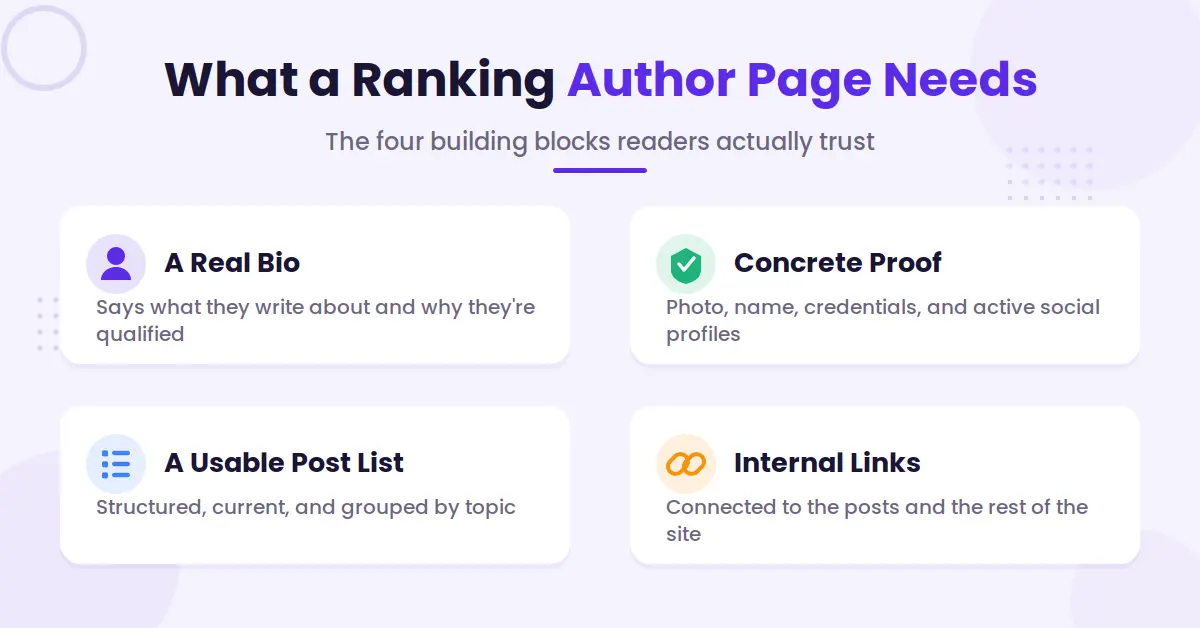
This matters because these pages act as a central hub. They group everything a contributor has written in one convenient location. This improves user experience. It gives readers a quick path to find more content from a writer whose voice or expertise they enjoy. As Search Engine Journal notes in their breakdown of author page best practices, the goal is to provide readers with proof of expertise rather than fluff.
Start with a Bio That Says Something Real
The author bio should do more than repeat a job title. It should tell readers what the person writes about, why they are qualified, and what kind of topics they cover most often.
A vague summary like “writer and editor” will not carry much weight. A better one provides concrete proof. Maybe the author has years of hands-on experience, a niche focus, a background in publishing, or a set of topics they return to again and again.
Keep it short enough to scan. Two or three tight paragraphs are usually enough. If the author has awards, certifications, or bylines in known publications, include those as well, provided they remain relevant to the topics covered. For a field-by-field checklist and a written bio example, see our guide to author pages that support E-E-A-T.
Add Proof That Feels Concrete
A good author archive page should not ask readers to take a leap of faith. It should show the work and establish authority.
That means including a professional photo, a clear name, and essential author meta like current job titles and relevant social profiles. These links help establish trust, provided they are active and updated. You should also highlight published books, speaking gigs, or specific industry experience.
If you want a live example of a professional profile page, take a look at Ryan Robinson’s author bio. It gives readers a clear sense of who wrote the work and why that person has something to say. The goal is to remove doubt; readers should leave the page thinking that this person truly knows the topic.
Make the Content List Easy to Use
The post list is the part most people see first, so it needs structure. If you are using a modern site builder like Elementor or a similar theme builder, you can create a custom query loop to display posts dynamically. This ensures your most recent or important work stays at the top.
If the author covers more than one topic, separate those sections so the page remains organized.
Do not bury your best work under a wall of old posts. A page full of stale links can look abandoned, even if the author is active. Keep the archive current and remove dead weight when it no longer serves the reader.
It also helps to write a short intro above the list. One or two sentences can explain the author’s focus. That turns a raw feed into a useful, polished landing page.
Keep the Page Linked to the Rest of the Site
An author page should not sit alone. Every post should link back to the author, and the author page should link to the best posts.
That back and forth matters because it helps search engines understand the relationship between the person and the content. It also makes it easier for readers to keep exploring once they land on the page. A decent archive can become a small content hub if you treat it that way.
If you are building out the structure behind that page, structured data for author archive pages can help reinforce the connection in a cleaner, more technical way.
Schema and Technical Setup That Support the Page
Good content still needs clean signals. If the page is strong but the technical setup is sloppy, you leave value on the table.
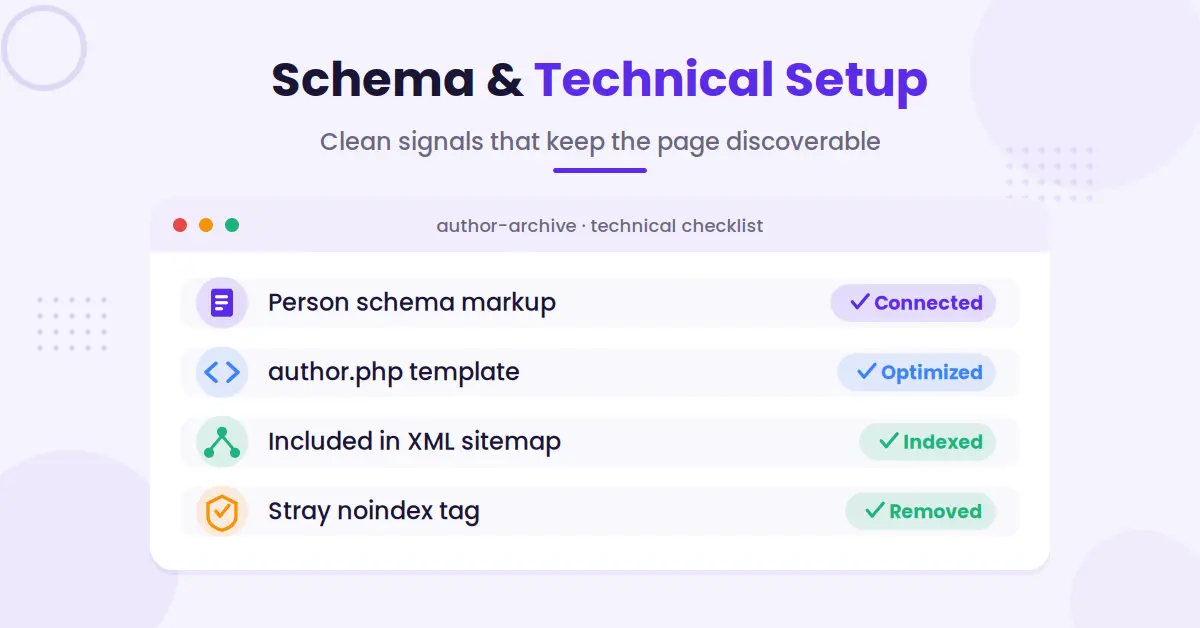
The most helpful markup for an author archive page is usually tied to the author as a real person rather than just a list of posts. On RightBlogger, the author schema markup guide walks through how to connect that person entity to the page and to the posts they wrote. Using author meta well helps search engines connect the individual behind the content to the archive itself.
Google also documents a dedicated type for exactly this kind of page: ProfilePage structured data, with a Person as the mainEntity. Supported since late 2023, Google’s own valid examples include author pages, and it feeds the creator and profile appearances you see in Search. If your author archives stay indexed, it is worth adding.
From a structural perspective, it helps to know how your theme handles the WordPress template hierarchy. Author archives render from an author.php template when your theme includes one; otherwise WordPress falls back to archive.php and finally index.php, and block themes follow the same order with .html templates.
If you are not using a visual builder, you can modify your archive template using PHP snippets to add custom branding, author bios, or specialized content blocks. This gives you full control over the user experience. It ensures the page feels like a high-quality destination.
The technical side should also be easy to crawl. If you want the page indexed, make sure it is in your XML sitemap and not blocked by a stray noindex tag. If your site uses WordPress, a clean sitemap setup helps keep author pages discoverable. This WordPress XML sitemaps guide is a handy companion read for that part of the job.
Yoast SEO also provides a straightforward note on author archive settings. The advice is worth reading if your site only has one writer. In that case, a duplicate-looking author archive may not add much value. It is often better to keep it out of the way than to let it compete with the homepage or the main blog page for search visibility.
The same principle applies to page speed and index clutter. Do not let archive pages turn into endless scroll traps, tag mashups, or thin pages packed with nothing but dates. Keep the crawl path clean, ensure your templates are optimized, and make the purpose of the page obvious to both users and crawlers.
When to Index Author Archives and When to Hold Back
Deciding whether to index author archive pages can be tricky. Not every site benefits from making these pages visible to search engines. Your strategy should depend largely on your site architecture and the number of contributors you have.
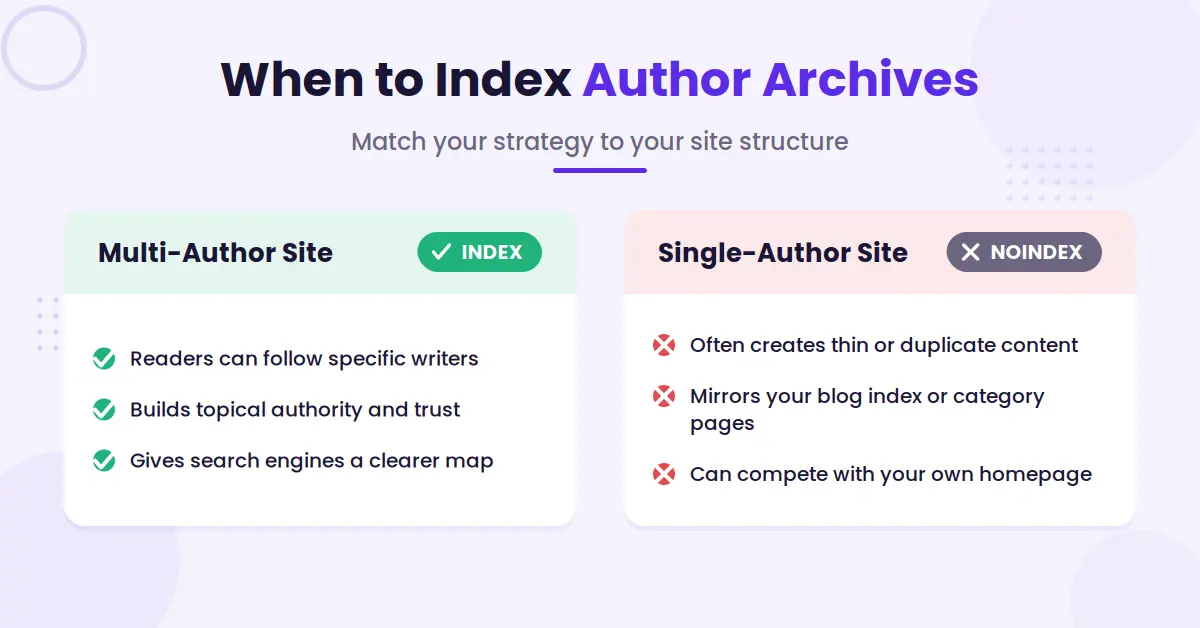
If you operate a multi-author site, especially one featuring recognizable industry experts, indexing the author page is almost always the right move. These pages allow readers to follow specific writers. They also provide search engines with a clearer, more organized map of your site’s content network. When these pages are populated with a solid bio, a professional photo, and a collection of recent articles, they serve a functional purpose. They build topical authority and trust.
In contrast, the situation for a single author site is quite different. On a one-person blog, an archive page often creates thin or duplicate content that serves little purpose for the user.
The author archive often mirrors the content already present on your blog index or category pages. As a result, it can inadvertently compete with your own site for ranking space. In these scenarios, it is often better to use a noindex tag via Yoast SEO to tell search engines to skip the page.
If you find that your author page adds no unique value at all, you can go further and disable author archives entirely in Yoast (Settings > Advanced > Author archives). That toggle automatically 301-redirects the archive URLs to your homepage and removes the author sitemap, so nothing is left orphaned and there is nothing extra to configure.
Ultimately, your author archives should exist for a reason. If the page helps users navigate your content and highlights your subject matter expertise, keep it indexed. If it simply acts as a redundant mirror of your homepage or blog index, it is time to rethink your technical approach.
Common Mistakes That Keep Author Pages Buried
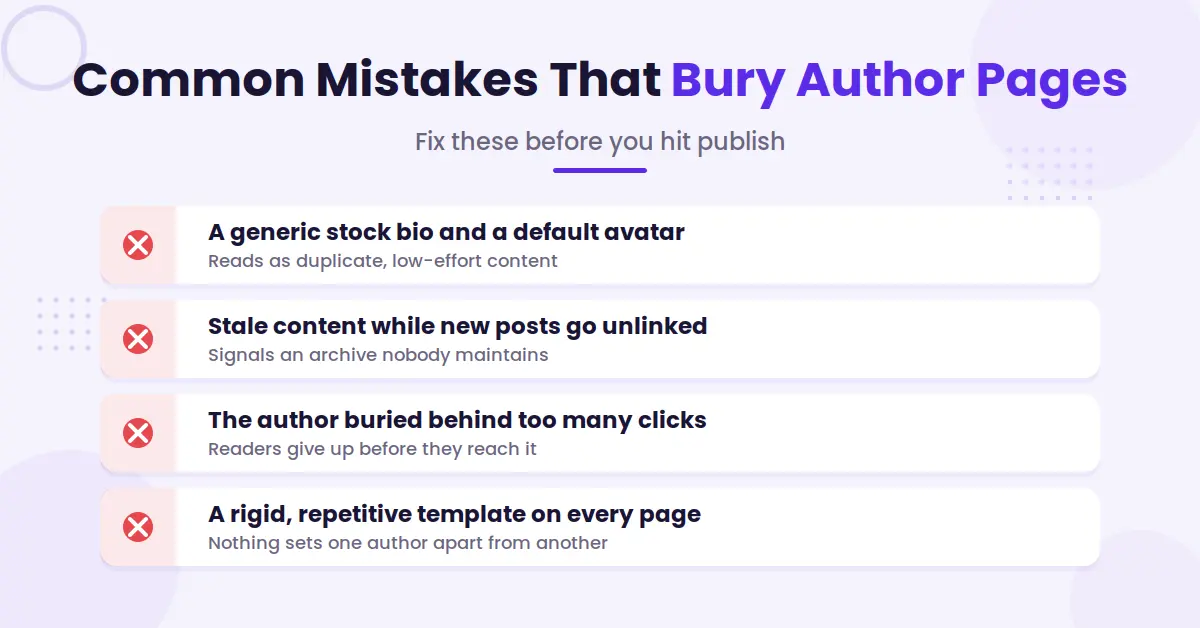
The fastest way to sink your author archive pages is to make them feel generic. A stock bio, a default avatar, and a few random links provide little value to readers or search engines. To be clear, there is no duplicate content penalty at play here: when your archives are carbon copies of your main feed, Google simply filters them out or shows another version of that content instead, so the page never ranks on its own.
That makes it nearly impossible for these pages to compete in search results.
Another common problem is stale content. If the author page highlights outdated work while the writer has published a new batch of strong, relevant posts, the page sends the wrong signal. Keep the bio, credentials, and featured posts current: the archive stays naturally fresh as new posts publish, and an outdated page mostly costs you reader trust rather than some freshness score.
A third mistake is hiding the author behind too many clicks. Readers should be able to reach the page without hunting. If they have to dig through complex menus or obscure footer links to learn more about the expert behind the post, your author archive pages lose a significant portion of their authority.
Many sites also make the mistake of using a rigid, repetitive layout. When every author page features the same bland bio and identical template text, it becomes much harder for each page to stand out as a unique entity. That lack of individual character signals a lack of investment.
If you want your author archive pages to rank effectively, you must give them a clear point of view. Let the author’s specific topic focus shine through. Ensure the page reflects the depth of the writer’s work rather than acting as a generic placeholder generated by your CMS.
FAQs About Author Archive Pages
A few questions that come up often:
Do author archive pages help with SEO?
Yes, when they are built with a clear strategy. These pages help organize content, connect the author to their published work, and make it obvious who is responsible for the content, which is exactly what Google’s E-E-A-T guidance encourages. Worth calibrating: E-E-A-T is not a direct ranking factor or score, but clear authorship feeds the trust signals Google’s systems do try to reward, and it gives readers a reason to believe the byline.
Should every site index author archive pages?
Not necessarily. Multi-author sites typically see the most benefit from these pages, while single-author sites may find them redundant. If an author archive page lacks depth or essentially duplicates your blog roll, applying a noindex tag is often the better technical move to avoid content quality issues.
What should I put on an author page?
Start with a professional bio, a high-quality photo, links to the author’s best posts, and any credentials or proof that support their experience. If the page still feels empty after including those elements, it likely needs more depth to provide value to your readers.
Does schema matter for author archive pages?
It helps, but it is not required. Author pages can rank without markup; schema is simply a low-effort way to connect the author profile to their content in a format search engines can parse. Person markup with sameAs links to active profiles helps most with entity disambiguation, especially when the author shares a name with someone else. It will not fix a weak page, but it makes authorship signals clearer.
How often should I update an author archive page?
You should update these pages whenever the author publishes meaningful new work or when their professional credentials change. Regularly refreshing these pages ensures they do not feel stale and shows search engines that the author remains an active, contributing expert on your site.
Final Thoughts on Author Archive Pages
Author archive pages rank successfully when they perform a meaningful job for your readers. They need to showcase exactly who wrote the content, explain why that person is an authority in their field, and provide a clear path so readers can navigate through your site with confidence.
The best author archive pages feel simple, but they are never empty. They pair a professional bio and clear proof of expertise with a useful list of recent posts and solid technical signals. That combination is what turns a basic, automated list into a destination worth indexing.
If your current author archive pages feel like dead ends, start by upgrading the bios, then tighten your internal links, and finally check your technical structure. A high-ranking page is never loud. Instead, it is defined by its clarity and the value it provides to your audience.

Article by
RightBlogger Co-Founder Ryan Robinson teaches 500,000 monthly readers how to grow an online business and writes about blogging, content, and SEO.


Automated SEO Blog Posts That Work
Try RightBlogger for free, we know you'll love it.
7-day free trial. Cancel anytime.





Leave a comment
You must be logged in to comment.
Loading comments...