Writesonic vs RightBlogger: Which AI Blogging Platform Is Better in 2026?
Choose Writesonic if you want
- Visibility-first monitoring as the core product
- Deeper prompt and platform coverage to track
- Site audits with an action centre
Choose RightBlogger if you want
- Articles actually published on a schedule
- Unlimited articles, not 15 a month
- Maintenance with one-click undo
$0 due today. 30-day money-back guarantee on paid plans.
Table of contents
Key takeaways
- With annual billing, RightBlogger starts at $49 per month with unlimited articles, while Writesonic starts at $79 with monthly limits of 15 to 50 articles.
- Both offer seven-day trials, but RightBlogger also has an ongoing free plan and charges $0 upfront for its paid-plan trial.
- RightBlogger suits bloggers and agencies wanting automatic generation, scheduling, and publishing, while Writesonic requires individual CMS exports and offers no scheduled publishing.
- RightBlogger maintains published pages with approval controls, backups, and undo, while Writesonic offers audits with AI fixes but reserves full Action Center access for Enterprise.
- Writesonic is the better fit for teams prioritizing AI search visibility, especially Google AI Overviews tracking, over automated blogging.
Writesonic and RightBlogger can both generate search-focused articles, research keywords, optimize content, and connect with popular content management systems. Yet they’re built around different goals.
Writesonic now focuses heavily on AI search visibility, including tracking brand citations across tools such as ChatGPT, Gemini, and Google AI Overviews. It also provides article generation, SEO tools, and site audits.
RightBlogger is designed as a broader blogging, SEO, and content automation platform. It can take you from keyword research and article creation through scheduled publishing, ongoing site maintenance, social promotion, and backlink building.
Both platforms include AI brand monitoring. Choosing between them comes down to one main question: Do you mainly need an AI visibility platform, or do you want that monitoring alongside an automated blogging workflow?
Quick Verdict: RightBlogger Is Better for End-to-End Blog Automation
RightBlogger is the stronger overall choice for bloggers, niche site owners, agencies, and marketing teams that want to automate content production and growth.
Its main blogging advantages include:
- Unlimited article generation on paid plans
- Scheduled autoblogging and mass publishing
- Automatic social sharing and a built-in backlink exchange
- Video-to-blog conversion, automatic video embeds, and embedded lead magnets
- Broader language and CMS coverage
- A free plan, plus a seven-day paid-plan trial with $0 due today
Writesonic has its own strengths. Its AI search visibility tools can help brands track how they appear across major AI answer platforms. It also has a multi-step article research process, site audits, keyword research, SEO reports, and content optimization.
The biggest difference is what happens after an article has been generated. Writesonic requires you to export finished articles to your CMS one at a time. RightBlogger can generate, schedule, and publish content automatically.
Writesonic vs RightBlogger at a Glance
RightBlogger
RightBlogger combines content planning, keyword research, long-form writing, SEO optimization, publishing, and site maintenance in one platform.
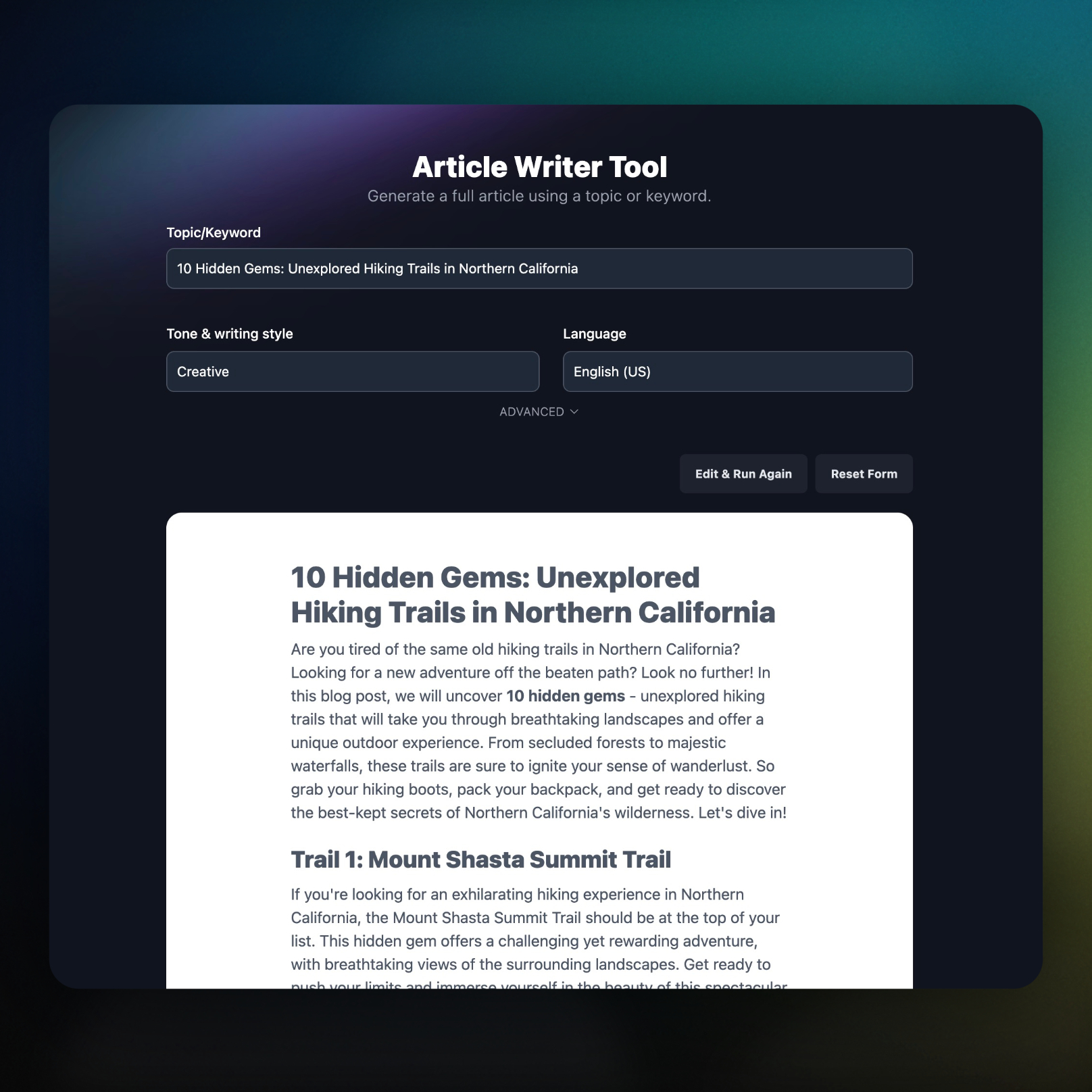
You can use the RightBlogger AI Article Writer to generate long-form articles. Articles can include stock images, YouTube videos, internal links, and external links.
RightBlogger can then schedule and publish those articles through its autoblogging system. After publication, Site Agent continues maintaining the site by finding missing internal links, broken outbound links, weak meta descriptions, and stale years in page titles.
AI Brand Monitor adds another layer: tracking how AI assistants mention your brand, describe it, and cite sources when answering questions about your category.
Writesonic
Writesonic combines AI search visibility monitoring with article generation, keyword research, SEO reports, optimization, and site audits.
Its article workflow uses a multi-step research pipeline. It can also add images, internal links, and external links.
However, Writesonic doesn’t provide scheduled or recurring publishing. Finished articles must be exported to a CMS one at a time, which limits its usefulness for unattended autoblogging.
Writesonic vs RightBlogger Feature Comparison
| Feature |   | Writesonic |
|---|---|---|
Free Plan | ||
Starts At | $49 | $79 |
Unlimited Use | ||
Autoblogging | ||
Site Agent | ||
AI Brand Monitoring | ||
Social Automation | ||
Backlink Exchange | ||
WordPress Integration | ||
Webflow Integration | ||
Shopify Integration | ||
Wix Integration | ||
Duda Integration | ||
Webhook Integration | ||
Ghost Integration | ||
Keyword Research Tool | ||
AI Chat | ||
Article Generator | ||
Automatic In-Article Images | ||
Automatic In-Article Videos | ||
Automatic Internal Linking | ||
Automatic External Linking | ||
Video to Blog | ||
Create Embedded Lead Magnets | ||
Mass Publishing | ||
Languages Supported | 139 | 25+ |
Create Presets | ||
Change Voice Tonality | ||
Change Writer Point of View | ||
Sub User Accounts | ||
Educational Resources | ||
Priority Support | ||
SEO Reports | ||
Auto Optimize | ||
White Label Client Reports |
Content Generation
Both platforms cover the core features you’d expect from an AI article generator.
Both platforms also provide AI chat, presets, voice controls, automatic images, internal links, and external links. This makes either option useful for producing search-focused long-form content.
The differences become clearer when you look beyond a single article.
RightBlogger Offers More Ways to Create and Repurpose Content
RightBlogger supports unlimited article generation on its paid plans. Writesonic limits customers to between 15 and 50 articles per month, depending on the plan.
That distinction matters if you manage several sites or publish at a high rate. A 15-article allowance may work for one small company blog, but it can become restrictive for an agency or niche site portfolio.
RightBlogger also includes two content formats that Writesonic doesn’t offer:
- Video-to-blog conversion
- AI tools that can be embedded into articles as lead magnets
Embedded tools can make a blog post more interactive while helping you capture leads. You can learn more about building these assets with RightBlogger Tool Studio.
Writesonic Has a Structured Research Pipeline
Writesonic’s article generator uses a multi-step research workflow. That can appeal to writers who want to generate and review articles individually before sending them to a site.
The tradeoff is volume and automation. Writesonic caps the number of monthly articles and requires manual CMS exports. RightBlogger is better suited to a continuous publishing workflow.
SEO and Content Optimization
Both products provide a solid base for keyword-focused content creation. They combine keyword research, SERP-based SEO reports, automatic optimization, and internal and external linking.
RightBlogger’s Keyword Research Tool helps users find article ideas before they begin writing. Its SEO reports then analyze competing pages to show what an article may need to cover.
The Auto Optimize feature can update an article with relevant terms used by top-ranking content. This reduces the need to move drafts between a writer and a separate optimization tool.

Writesonic also offers keyword research, SEO reports, and automatic optimization. Businesses focused on monitoring brand citations in ChatGPT, Gemini, and Google AI Overviews may find its visibility-first approach appealing.
RightBlogger is the better fit when the goal is to connect SEO research directly to planning, unlimited writing, publishing, and ongoing maintenance.
Neither platform includes an article indexing service, so publishing through either tool doesn’t guarantee search engine indexing.
AI Brand Monitoring
AI visibility tracking is part of both platforms, not a reason to rule out RightBlogger.
RightBlogger’s AI Brand Monitor tracks brand mentions across ChatGPT, Claude, Gemini, and Perplexity. It measures share of voice against competitors, answer sentiment, and cited sources. Solo, Pro, and Agency all include it.
Each connected site gets one monitor. It runs your prompts on a schedule and shows the per-prompt detail behind the results, so you can see which questions lead to brand mentions and which don’t.
For a content team, that means you can track how AI assistants describe your brand without adding a separate monitoring subscription to your blogging setup.
Writesonic makes AI visibility its central focus, with core tracking across ChatGPT, Gemini, and Google AI Overviews. Access to all 10 of its supported platforms requires Enterprise. The buying decision is about which platforms you need to monitor and what work you want to automate around that monitoring.
Writesonic goes deeper on platform coverage and prompt volume. RightBlogger’s monitor sits inside a publishing platform rather than a standalone visibility suite, making it the better fit when monitoring supports your blogging work instead of being the main job.
Published Content Maintenance and Site Audits
Both RightBlogger and Writesonic provide some form of published-content maintenance. This isn’t a simple tie, since their scope and controls differ.
How RightBlogger Site Agent Works
RightBlogger’s Site Agent scans connected WordPress, Ghost, Webflow, Wix, and Shopify sites on a recurring schedule.
It looks for high-impact issues such as:
- Missing internal links
- Broken outbound links
- Weak meta descriptions on low-click-through pages
- Stale years in page titles
Site Agent can work on any page on the connected site, including content that wasn’t originally written with RightBlogger.
Users can choose from three control modes:
- Ask Approval: Every proposed edit waits for review.
- Smart: Low-risk fixes are applied automatically.
- Fully Automatic: All eligible fixes are applied without manual review.
Each change has a one-click undo option for 30 days, along with two independent backups. That gives publishers room to automate routine work without giving up control.
How Writesonic Site Audits Compare
Writesonic’s site audits run between 10 and 50 times per month, depending on the plan, and cover between 100 and 2,500 pages. The audits include automatic AI fixes.
However, the Action Center that carries out on-page and technical work is limited to Enterprise plans. Growth users receive a five-action-per-month trial.
The practical difference is access to ongoing fixes and control over them. RightBlogger’s approval modes, 30-day undo window, backups, and support for pages it didn’t create make Site Agent well suited to active blogs. Writesonic buyers need to account for the Action Center’s plan restrictions when deciding how much maintenance they can automate.
Automation, Scheduling, and Bulk Publishing
This is where the two platforms differ most.
Writesonic doesn’t include scheduled or recurring publishing. Articles must be exported to a CMS one at a time. It also doesn’t support mass publishing.
RightBlogger includes full autoblogging and scheduled publishing. You can plan keyword-based articles, generate them, and publish them on a schedule without handling each post manually.
The number of planner automations depends on the RightBlogger plan:
- Solo: 1 planner automation
- Pro: 3 planner automations
- Agency: 10 planner automations
RightBlogger also supports mass publishing when you need to send several finished posts live at once.

Automation doesn’t remove the need for editorial review. Review your content for accuracy, usefulness, and brand fit before relying on an unattended publishing workflow.
If scheduled publishing is a top priority, compare more options in this guide to the best autoblogging tools for bloggers and marketing teams in 2026.
Social Distribution and Backlink Building
Writing and publishing are only part of growing a blog. Content also needs distribution and authority.
RightBlogger extends the workflow with built-in social automation and backlink matching. Writesonic doesn’t include either capability in its main platform.
Automatic Social Sharing
RightBlogger’s social media automation can share each new blog post to:
- X
- Threads
The Solo plan includes LinkedIn automation, while Pro and Agency include all five networks. RightBlogger writes a separate AI caption for each connected platform instead of copying the same message everywhere.
Writesonic’s main platform doesn’t include automatic blog-to-social sharing. Social posting is offered through Socialsonic, which is a separate product.
Backlink Exchange
RightBlogger’s Backlink Exchange matches users with real, verified sites in related niches. It matches and places relevant in-content backlinks automatically as members publish, so links build gradually.
The system is designed to avoid manual outreach and link farms. Writesonic doesn’t offer a comparable backlink exchange.
These tools move RightBlogger beyond article creation. It covers content production, on-site SEO, distribution, and part of the off-page SEO process.
Multimedia Features
Both tools can automatically include stock images inside articles.
RightBlogger goes further with automatic YouTube video embeds, video-to-blog conversion, and embedded AI lead magnets. Writesonic doesn’t offer automatic in-article videos, video-to-blog conversion, or embedded lead magnet creation.
These extra formats are useful for creators who already publish videos or want their articles to offer more than text and stock images.
Language Support
RightBlogger supports 139 languages, while Writesonic supports 25 or more languages.
Writesonic’s coverage may be enough for businesses working in a small set of major markets. RightBlogger is a better fit for multilingual publishers, international agencies, and companies producing localized content across many regions.
Language support doesn’t guarantee identical output quality in every language. You should still review translated or localized content with a native speaker before publication.
Integrations
Both tools connect with several popular CMS platforms, but RightBlogger supports more publishing environments.
| Integration | RightBlogger | Writesonic |
|---|---|---|
| WordPress | Yes | Yes |
| Webflow | Yes | Yes |
| Ghost | Yes | Yes |
| Shopify | Yes | No |
| Wix | Yes | No |
| Duda | Yes | No |
| Webhooks | Yes | Yes |
| Blogger | No | No |
| Zapier | No | No |
RightBlogger has the advantage for Shopify, Wix, and Duda users. Both products support WordPress, Webflow, Ghost, and webhooks.
Neither platform supports a direct Blogger or Zapier integration.
RightBlogger’s broader set of CMS and publishing integrations is valuable for agencies because clients don’t always use the same website platform.
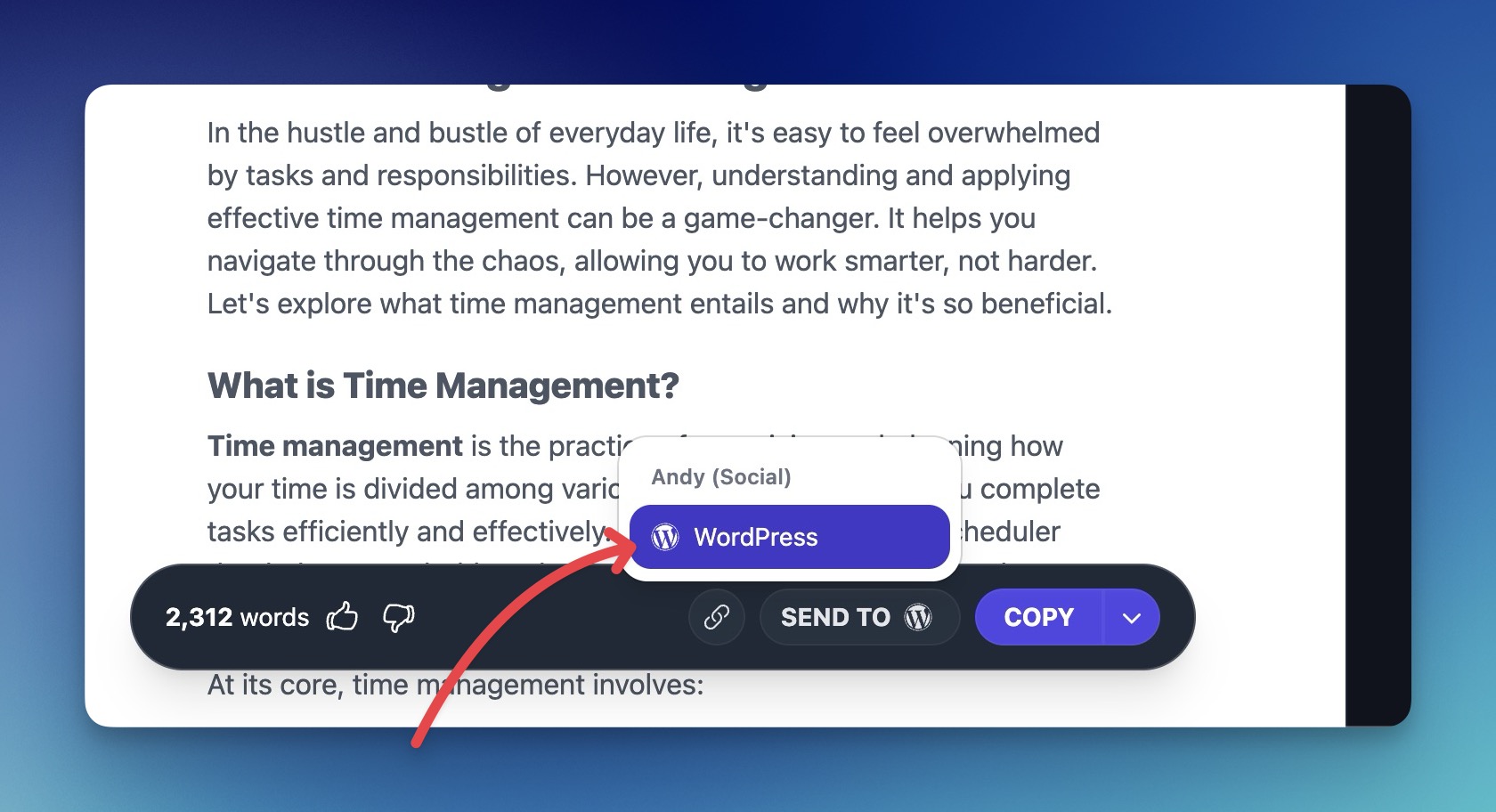
The distinction isn’t just where articles can go. Writesonic’s CMS connections still require individual exports, while RightBlogger connects its integrations to scheduled and bulk publishing.
Customization and Editorial Control
Both products let users create presets and change voice tonality.
RightBlogger adds writer point-of-view control, while Writesonic doesn’t include this option. Point-of-view control helps publishers keep each article consistent with the perspective defined in their editorial guidelines.
RightBlogger plans also let users save custom writing styles. The limits are:
- 5 custom styles on Solo
- 15 custom styles on Pro
- 50 custom styles on Agency
Presets and saved styles can reduce repetitive setup when you write for different sites, brands, or clients.
Team and Agency Collaboration
Both RightBlogger and Writesonic support sub-user accounts, so neither platform is limited to individual creators.
RightBlogger gives clear team limits within its pricing structure:
- Solo: Built for one creator
- Pro: 3 team seats and 3 connected sites
- Agency: 5 team seats and 10 connected sites
The Pro plan includes 90 monthly SEO reports, while Agency includes 300. Both platforms also offer white-label client reports with branded Google Search Console dashboards on your own domain.
RightBlogger doesn’t require every team member to build a separate set of tools for research, optimization, writing, and publishing. Teams can work within the same broader content system.
Writesonic can make sense for teams that place AI search visibility and brand citation tracking above scheduled blog production.
For another comparison focused on a well-known AI writing platform, see Jasper vs RightBlogger.
User Experience and Interface
The better user experience depends on the job you need to complete.
Writesonic’s workflow suits teams that want to monitor AI search visibility, research individual articles, optimize them, and manually export each finished draft.
RightBlogger is organized around the full blogging cycle:
- Find keywords.
- Plan article topics.
- Generate long-form content.
- Optimize each article.
- Add images, videos, and links.
- Schedule or publish to a connected CMS.
- Share new posts on social media.
- Maintain published pages with Site Agent.
- Build links through Backlink Exchange.
Keeping these steps in one platform reduces tool switching. That can make the process easier for bloggers who don’t want to manage separate dashboards and subscriptions.
Writesonic offers the more focused workflow for AI visibility analysis. RightBlogger requires fewer manual handoffs when the goal is to take a post from an idea to a live page, promote it, and maintain it over time.
Writesonic sits at 4.6 out of 5 across 5,763 reviews on Trustpilot as of September 2026. Reviewers praise content quality, brand voice, and SEO scoring, with several rating its results above dedicated optimization tools they previously paid for. Long-time subscribers also describe features and existing projects moving behind higher tiers after they had already paid.
RightBlogger sits at 4.8 out of 5 across 46 reviews on Trustpilot as of September 2026. Reviewers praise the breadth of tools under one subscription and output that sounds like their own writing. The profile has no review below 5 stars at that point, but that isn’t proof of a perfect product. Its practical drawbacks include Solo’s one-site limit and less monitoring depth than a visibility-first platform.
Pricing and Plans
Pricing is another major difference between Writesonic and RightBlogger.
| Pricing Detail | RightBlogger | Writesonic |
|---|---|---|
| Free plan | Yes | No |
| Starting paid price with annual billing | $49/month | $79/month |
| Paid-plan article allowance | Unlimited generation | 15 to 50 articles/month |
| Pay per article | No | No |
| Trial option | 7-day paid-plan trial, $0 due today | 7-day trial |
RightBlogger’s main paid plans are:
- Solo: $59 monthly or $588 annually, equal to $49 per month
- Pro: $89 monthly or $828 annually, equal to $69 per month
- Agency: $299 monthly or $2,388 annually, equal to $199 per month
Writesonic starts at $79 per month when billed annually. Its plans cap article production at between 15 and 50 articles per month.
Neither platform offers pay-per-article billing. For bulk production, RightBlogger keeps article generation unlimited across its paid plans. Higher tiers expand site, team, planner automation, and SEO report allowances rather than charging for each article.
RightBlogger gives buyers two ways to try the product: an ongoing free plan and a seven-day trial of a paid plan with $0 due today. Every paid plan also carries a 30-day money-back guarantee, and you keep every article you write during the trial.
Cancellation is self-serve from RightBlogger’s account page. It opens the Stripe billing portal, where you can cancel with a click, and access continues until the end of the paid period.
Writesonic offers a seven-day trial but no ongoing free plan. For either product, use the trial to test the workflow you’ll actually rely on, from researching a topic to getting a finished article onto your site.
For buyers considering an annual commitment, some Writesonic reviewers on Trustpilot report renewal charges after cancellation and refund requests being declined once those charges landed. Those are reviewers’ accounts, but they’re relevant when weighing the risk of a longer subscription.
Replace-the-Stack Cost Comparison
Many bloggers build their workflow from several separate subscriptions. A conservative estimate might look like this:
| Separate Tool Category | Typical Monthly Budget, Estimated |
|---|---|
| AI writing tool | $20 to $50 |
| SEO content optimizer | $30 to $80 |
| Keyword research tool | $20 to $50 |
| Scheduling and publishing tool | $10 to $30 |
| Estimated total | $80 to $210 |
These are rough budgeting ranges, not quotes from named vendors. Your actual cost will depend on usage limits, site count, and team size. Free tools and subscriptions with overlapping features can also lower the total.
A RightBlogger Solo subscription costs $59 month to month or $49 per month with annual billing. Against this estimated stack, that works out to $21 to $151 less per month on monthly billing, or $31 to $161 less per month on annual billing.
The comparison still isn’t perfectly equal. Separate specialist tools may offer deeper functions in one area. RightBlogger’s advantage is that the main workflow lives in one subscription, and the estimate above doesn’t assign extra costs to its social automation, Site Agent, embedded tools, Backlink Exchange, or AI Brand Monitor.
Writesonic also replaces parts of this stack. It combines writing, keyword research, SEO optimization, site audits, and AI visibility tracking. Its higher starting price and lack of unattended publishing make it less complete as an autoblogging replacement.
Customer Support and Learning Resources
Both platforms offer priority support, educational resources, and strategy calls. Those options give users help beyond standard product documentation.
RightBlogger offers blogging and SEO courses, tutorials, guides, and strategy support. Solo includes basic courses, while Pro and Agency include premium courses.
RightBlogger reviewers on Trustpilot describe personal replies from the founders, often within minutes, and praise feature requests that turn into product updates quickly. That kind of access matters when a publishing setup or site connection needs attention.
Writesonic reviewers also praise fast support replies and quick bug fixes. Other reviewers describe slow resolution of credit bugs, so the positive accounts don’t mean every type of issue gets resolved at the same pace.
Support access alone doesn’t tell you how well a team will solve your problem. During the trial, ask a real setup question about your CMS, publishing workflow, or site maintenance needs rather than assuming one provider will respond faster.
For RightBlogger users, the learning resources sit alongside the tools they’ll use for research, writing, publishing, and ongoing SEO work.
Which Blog Automation Tool Is Best for You?
The right choice depends on what you publish, how often you publish it, and how much manual work you want to keep.
Solo Bloggers
Choose RightBlogger if you want keyword research, unlimited articles, SEO optimization, scheduling, publishing, and site maintenance in one subscription.
The free plan also gives new bloggers a lower-risk way to test the platform. When you’re ready to scale, Solo supports one connected site and one planner automation.
Choose Writesonic if you publish fewer articles and care more about an AI visibility-focused workflow, including Google AI Overviews tracking, than automating a posting schedule.
Niche Site Owners
RightBlogger is the stronger choice for niche sites.
Unlimited article generation, autoblogging, mass publishing, internal linking, Site Agent, and Backlink Exchange address several common niche site needs. Automatic social sharing can also distribute each new post without adding another manual task.
Writesonic’s 15-to-50 article caps and manual CMS exports make it harder to run a high-volume publishing model.
Agencies
RightBlogger Agency is the better fit for content and SEO agencies running recurring publishing across a portfolio of client sites.
Agency supports 10 connected sites and five team seats, with 10 planner automations and 300 monthly SEO reports. For a smaller agency managing up to three sites, Pro offers a more compact setup.
Agencies can also work with WordPress, Webflow, Ghost, Shopify, Wix, and Duda clients.
Writesonic may be the better choice for an agency selling AI search visibility monitoring as a core service. Access to all 10 supported AI search platforms requires Enterprise, so agencies should account for that when comparing plans.
Marketing Teams
Choose RightBlogger if your team is responsible for planning, producing, publishing, promoting, and maintaining blog content.
Its Pro plan includes three team seats, three connected sites, three planner automations, all five social integrations, and 90 monthly SEO reports.
Choose Writesonic if your team already has a publishing and distribution workflow and wants AI visibility, including Google AI Overviews tracking, to be the main focus.
RightBlogger Pros and Cons
Pros
The biggest benefits show up in the routine work around each article.
- Takes posts from keyword research to publication without repeated CMS work
- Maintains older content with approval modes, backups, and 30-day undo
- Supports high-volume publishing without rationing article generation
- Reduces post-publication work through social sharing and backlink matching
- Keeps AI brand monitoring alongside the content workflow
Cons
Unlimited writing doesn’t remove every plan limit or replace every specialist tool.
- Solo users can outgrow one connected site and one planner automation
- Social sharing beyond LinkedIn requires Pro or Agency
- SEO report and automation allowances still need to match your workload
- AI visibility specialists get less platform coverage and prompt depth
Writesonic Pros and Cons
Pros
Writesonic’s strengths suit teams that put AI visibility at the center of their work.
- Gives visibility-focused teams deeper platform coverage and prompt tracking
- Gives editorial teams a structured workflow for researching individual articles
- Earns reviewer praise for strong non-English content
- Keeps writing and SEO optimization together for teams that already handle publishing
Cons
When blogging is the main job, its visibility-first focus leaves some work elsewhere.
- Every finished article still needs a one-at-a-time CMS export
- Article caps can restrict high-volume publishing
- Full Action Center access requires Enterprise after the Growth trial
- Blog distribution still needs a separate workflow
Final Recommendation: Should You Choose Writesonic or RightBlogger?
Writesonic deserves consideration when AI search visibility is your main service or reporting priority, especially if Google AI Overviews coverage matters. Its structured article research and site audits complement that focus.
For most bloggers, content teams, niche site owners, and agencies, RightBlogger is the better all-around choice. It combines the blogging workflow with AI brand monitoring in one subscription, backed by a free plan, a seven-day paid-plan trial, and a 30-day money-back guarantee. Compare the current options on the RightBlogger Pricing page.