Entity-First SEO Writing: How to Build Outlines That Google Understands (Even Before You Add Keywords)
Map 8 to 15 related entities into question-led sections, add proof, then polish with keywords.

If you’ve ever spent an hour picking the “perfect” keyword, then stared at a blank outline anyway, you’re not alone. I used to do the same thing, and it always felt backwards. Like choosing a book title before I even knew what it was going to be about.
Entity-first SEO writing flips that around. Instead of starting with a keyword phrase, I start with the “things” the page is truly about, then I build a structure that makes those things easy to understand at a glance.
Key Takeaways (Quick Version)
Want to “get” this process straight away? Here’s how it works:
- You build outlines around entities and relationships: the specific things a topic is made of, and how they connect.
- Your entity-first outline makes it obvious what to include, and what to skip.
- You optimize around a keyword last, after the structure already makes sense and you know what sections you’re going to be including.
And here’s the why behind it. Google’s Knowledge Graph is a huge database of facts about real-world entities (people, places, things, and so on) that help Google to “get” the context of a search query. These are the types of things that appear in knowledge panels and AI overviews when you search. The same entity signals also drive citations in AI-generated answers (GEO vs SEO).
If you want Google’s algorithms to rank your content highly, you need to keep entities in mind right from the start.
What “Entity-First” Really Means (In Plain English)
“Entity-first” might sound a bit confusing or technical, but it’s a straightforward, intuitive process.
An entity is a real, specific “thing” that can be clearly identified. It can be a person, brand name, product, place, concept, event, or method.
Here are some examples of entities:
- New York (place)
- Nike (brand)
- RightBlogger (product)
- Ryan Robinson (person … hi!)
- Artificial Intelligence (concept)
- Super Bowl (event)
So if my post is about sourdough bread, the entities aren’t “easy bread recipe” and “bread tips.” The entities are things like starter, hydration, fermentation, Dutch oven, scoring, and crumb. Those are the pieces readers expect to see, and they’re the pieces search engines can connect.
The trick is that entities don’t live alone. They travel in groups. If I mention “sourdough starter,” a reader expects to see feeding schedules, ratios, temperature, and timelines. That set of relationships is what makes content feel complete.
Let’s dig a bit deeper into this SEO strategy.
Why You Can Build the Outline Before You Touch Keywords
If you’re taking a keyword-first approach to outlining, it’s easy to end up writing for the phrase. That can lead to fluff, awkward headings, and sections that exist just to “fit” a particular keyword in … not the type of content that’s going to rise up search engine rankings.
By outlining entity-first, you’ll create an article that covers its topic in a much more natural and comprehensive way.
You’ll see the difference:
- Your sections get tighter. Each section earns its spot because it explains an entity, a property (attributes), or a relationship.
- Your examples become easier. Entities are concrete, so it’s easy to bring examples to mind.
- Your content matches reader expectations. The outline mirrors how people actually think about the subject.
Stuck on how to actually outline? Check out our tips on creating a compelling blog post structure.
Your Entity-First Outline Framework
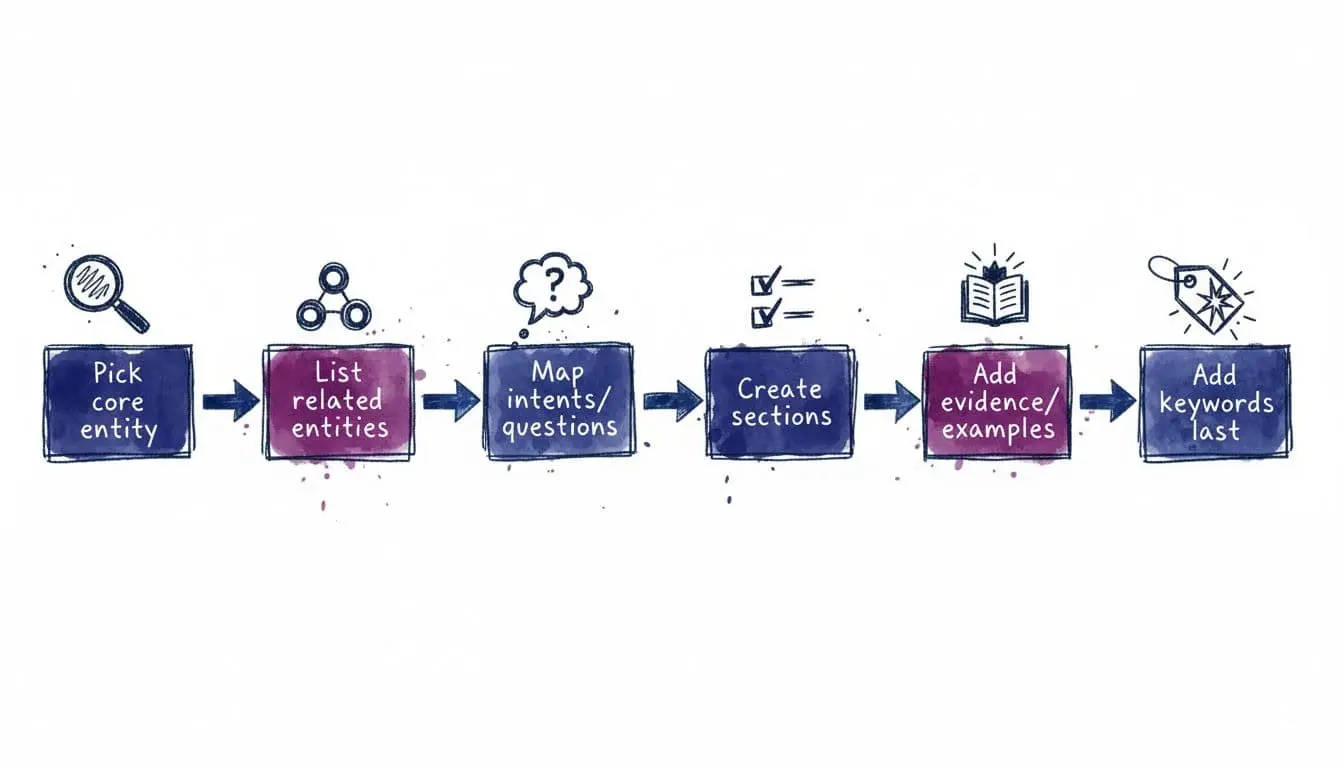
When you’re writing an entity-first outline, you want a simple, repeatable process for this stage of your content marketing. That’s what we’re going to run through now.
Step 1: Pick One Core Entity (Not a Vague Topic)
Start by naming the main thing the page is about in one phrase or sentence.
- Good: “Topical authority”
- Better: “Topical authority for niche blogs”
- Best: “Topical authority (how it works, how to build it, how to measure it)”
That last version helps you start to think about the structure of your article and the sections you’ll need within it.
Step 2: List the Related Entities Readers Expect
Don’t take a long time over listing related entities: 5 minutes is enough. Just get down all the obvious ones.
For instance, if I’m taking an entity-first writing approach to “topical authority”, my list might include: internal links, content clusters, knowledge graph, expert sources, consistent publishing, updating old posts, and search intent.
If you can’t find at least 10 related entities, you might want to rethink the topic.
Step 3: Understand What Intent or Questions Each Entity Answers
Once you’ve got your list of entities, think about the role each one is playing in your article. For instance:
- Definition entities: What is it?
- Mechanism entities: How does it work?
- Decision entities: When should I use it vs not?
- Process entities: How do I do it step-by-step?
- Proof entities: What evidence, data, examples, or sources support it?
This step keeps you from writing five sections that all say the same thing. Here, you’re starting to break down these entities into topic clusters, so that you can group things together where appropriate.
Step 4: Turn Relationships Into Section Headings
Relationships create the best headings because they answer real questions.
Instead of: “Topical Authority Explained”, I’ll write: “How Internal Links Support Topical Authority” or “What Content Clusters Actually Do to Build Authority”
This turns your outline into a chain of connected ideas, which helps you structure content that readers can easily follow.
Step 5: Add Evidence and Examples Inside the Outline
Before you start drafting, I recommend that you add one short note under key sections of the outline to explain how you’re going to offer proof to the reader that what you’re saying is valid and useful.
That could be any of these:
- Example you’ll use
- Tool or method you’ll mention
- Source you’ll cite
- Mistake you’ll warn about
These hooks can help you write stronger paragraphs that grab your readers.
Step 6: Add Keywords Last (As a Final Polish)
Once the outline is strong, you can look at tweaking the wording to optimize around specific keywords. Remember, you want to use natural language: the sorts of terms that your audience use.
What if you’ve already got a keyword in mind before starting your outline? First, make sure it’s got enough volume (and not too hard a difficulty rating) using the Keyword Research Tool.
Then, make sure you’re still looking for those entity relationships, and that your outline covers the topic in depth. Think about the meaning, context, and user intent of your primary keyword (this is called “semantic SEO”). If you typed that keyword into Google search, what piece of content would you be looking for?
How I Know the Outline “Makes Sense” Before Writing
Not sure if your outline is quite there yet? Run a quick gut-check. From my perspective, if I can read only the headings and still understand the article, the outline is ready.
I also ask myself one blunt question: Would a beginner trust this outline?
If the outline skips basic entities, beginners are going to just bounce straight back and try a different search result. But if it includes only the absolute basics, more advanced readers will give up straight away. For a really high-quality pillar page or article, you want your entity optimization to include a pretty comprehensive range of material.
Common Mistakes With Entity-First Outlines
Not sure if you’re doing entity-first outlining right? Here are some common mistakes to avoid as you get to grips with this content strategy.
Mistake 1: Using “entity” as just a different term for “keyword.”
An entity is the thing: something you can point to or define: coffee shop, New York, and Valentine’s Day are all entities.
A keyword is a search term that you’re optimizing for. Romantic coffee shops in New York is a keyword.
Mistake 2: Listing entities without explaining relationships.
Writing an article about 30 different named things that aren’t connected won’t do much for your SEO.
Mistake 3: Skipping proof.
If you make a claim, pair it with an example, a source, or a clear reason. Ideally, get this in place during your outline, to speed up the writing (whether you’re drafting yourself or using AI tools like the Article Writer).
Entity-First Outline FAQs
Do I need schema markup for entity-first writing to work?
No. Schema markup (structured data) can help boost your SEO, but the outline and the on-page clarity come first. If the page cleanly explains the entities and relationships, you’re already ahead of a lot of your competition! When you’re ready to add schema, the easiest place to start is author schema markup since it directly supports the author entity Google uses to score E-E-A-T.
How many entities should I include in one post?
Aim for enough to make the topic feel complete … but remember, you’re not writing an encyclopedia. For most blog posts, that’s usually 8 to 15 meaningful entities, with a few getting deeper coverage.
Can entity-first outlines work for product reviews?
Yes, and they’re perfect for it. The core entity is the product, and related entities are things like the features, specs, use cases, and pricing.
What if I’m in a tiny niche and there aren’t many related entities?
That’s a sign to widen the scope (slightly) or switch angles. Another option is to focus on sub-entities, like parts, steps, tools, or constraints.
Conclusion: Start With Entities, Then Optimize for Keywords
If you want your posts to be understood faster, ranked higher, cited more, and easier to expand later, start with the entities, then connect them like a simple web. Add the keyword polish at the end, and the whole piece will read better as a result … plus it’s likely to perform better in semantic search.
Next time you open a blank doc, try this: write down the core entity that your content is about, list at least 10 other related entities, and build your headings from relationships.
Your outline will do the heavy lifting before you write a single paragraph. And if you want to save even more time, put your outline into our Article Writer: it’ll come up with a first draft for you in next to no time.

RightBlogger Co-Founder Ryan Robinson teaches readers how to grow online businesses and writes about SEO, blogging, and content creation.

Automated SEO Blog Posts for Your Site
Research, write, publish, and share from one account.
7-day free trial. Cancel anytime.





Leave a comment
You must be logged in to comment.
Loading comments...