AI for YouTubers: 10 Best Tools to Grow Your Channel (2026)
Compare 10 tools for scripting, editing, SEO, thumbnails, and Shorts, plus a free starter stack and YouTube’s AI disclosure rules.

AI has reshaped how creators build and grow YouTube channels. What used to take hours, scripting, editing, thumbnails, SEO optimization, now takes a fraction of the time with the right AI tools for YouTubers.
But with hundreds of AI tools on the market in 2026, picking the ones that actually save you time (instead of creating more work) is the real challenge. We’ve rounded up the 10 best AI tools for YouTubers, plus practical tips for using AI without losing your authentic voice.
How YouTubers Are Using AI in 2026
Two years ago, most creators used ChatGPT for script outlines and called it a day. Now, AI touches nearly every stage of the YouTube production pipeline:
- Content research and ideation: Generate video topics based on trending searches, competitor gaps, and audience behavior.
- Scriptwriting: Draft scripts, intros, hooks, and CTAs in your brand voice.
- Video editing: Auto-cut silences, generate captions, remove filler words, and add transitions automatically.
- Thumbnail creation: Design click-worthy thumbnails with AI-generated backgrounds, text overlays, and layout suggestions.
- YouTube SEO: Optimize titles, descriptions, tags, and chapters for YouTube’s search algorithm.
- Voiceovers and dubbing: Clone your voice for narration or translate videos into dozens of languages.
- Repurposing: Turn one long-form video into Shorts, TikToks, blog posts, and social clips automatically.
The creators who pull ahead aren’t using AI to replace their creativity. They’re using it to handle repetitive production work so they can focus on what actually grows a channel: original ideas, storytelling, and connecting with their audience. For more strategies beyond tools, check out our AI YouTube creation tips.
10 Best AI Tools for YouTubers in 2026
Here’s a quick comparison of all 10 tools before we break each one down:
| Tool | Best For | Starting Price | Free Plan? |
|---|---|---|---|
| RightBlogger | Content ideas, scripts & repurposing | From $49/mo | Free plan |
| ChatGPT | Scripting & brainstorming | $20/mo (Plus) | Yes |
| Descript | Video editing & transcription | $24/mo | Yes (limited) |
| vidIQ | YouTube SEO & analytics | $16.58/mo | Yes |
| ElevenLabs | AI voiceovers & dubbing | $5/mo | Yes (limited) |
| Canva | Thumbnails & graphics | $15/mo (Pro) | Yes |
| Opus Clip | Repurposing to Shorts | $15/mo | Yes (limited) |
| Synthesia | AI avatar videos | $29/mo | Free demo |
| InVideo AI | Faceless video creation | $25/mo | Yes (watermark) |
| Runway | AI video generation | $15/mo | Yes (limited) |
1. RightBlogger

RightBlogger is an all-in-one AI platform built for YouTubers, bloggers, and content creators. It gives you a full suite of YouTube-focused tools, from video idea generation to script outlines to turning finished videos into blog posts and social content.
The YouTube tools you’ll use most include:
- YouTube Video Ideas Generator
- YouTube Video Title Generator
- YouTube Video Description Tool
- YouTube Tag Generator
- YouTube Video Script Outline
- Video Script Generator
- YouTube Transcript Download
- YouTube Video to Blog Post
- Blog Post to YouTube Video Script

One standout feature is the YouTube Video Ideas Generator. Plug in a single keyword, and it returns ten or more content angles you can expand on. In the screenshot above, the keyword “solo camping trip” generated ten unique video ideas, each one specific enough to film right away.
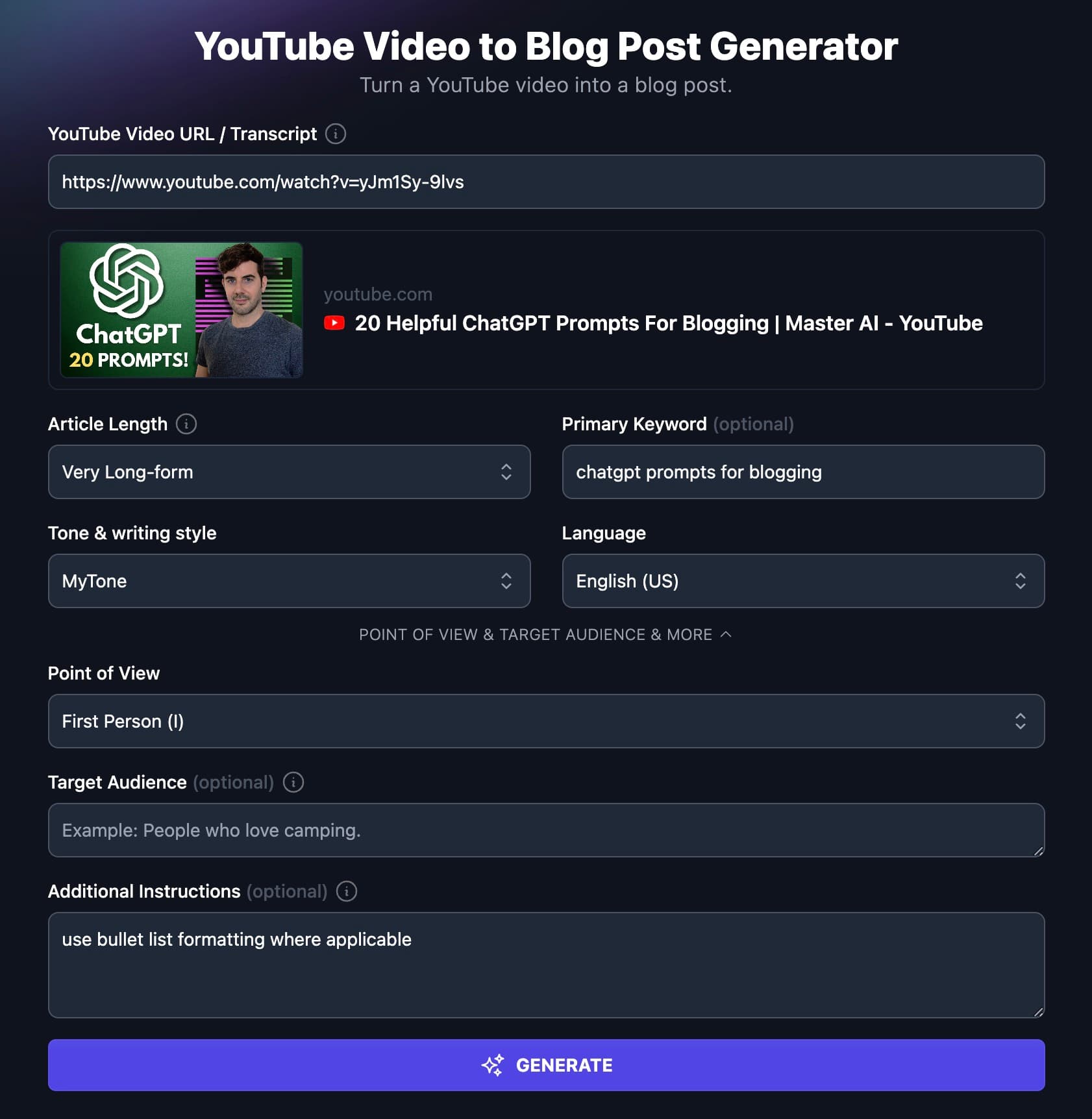
The YouTube Video to Blog Post tool is another powerful feature for creators who want to repurpose their content across platforms. Adding a blog to your channel creates a second traffic source, improves discoverability through search engines, and opens up monetization through affiliate marketing and sponsored posts. If you’re weighing the pros and cons, our guide on blog vs YouTube breaks down when each makes sense.
RightBlogger plans start at $49/mo (Solo, billed annually) with unlimited AI words and every tool included on all paid plans. You can try it for free.
2. ChatGPT

ChatGPT remains the most versatile AI assistant for YouTubers. It handles brainstorming, script drafts, research, thumbnail concept descriptions, and practically anything else you throw at it.
What makes it especially useful for YouTube:
- Script polishing: Paste a rough draft and ask it to tighten the pacing, punch up the hook, or rewrite the call-to-action.
- Research: Summarize complex topics for your niche, compare products, or fact-check claims before filming.
- Content expansion: Turn a single video concept into a full series by asking for five related angles your audience would care about.
The free tier handles basic tasks, with unlimited everyday chats on a lighter model. ChatGPT Plus ($20/mo) adds GPT-6 Sol with deeper Thinking levels, the Work mode for longer multi-step jobs, and higher usage limits, worth it if you’re scripting or researching daily.
3. Descript

Descript takes a unique approach to video editing: you edit the video by editing the text transcript. Delete a sentence from the transcript, and the corresponding video clip disappears. It’s the fastest way to turn raw footage into a polished video.
Key features for YouTubers:
- Filler word removal: Automatically strips “um,” “uh,” and dead air from recordings.
- AI voice cloning: Generate overdubs in your own voice to fix mistakes without re-recording.
- Automatic captions: Add accurate subtitles in minutes, not hours.
- Screen recording: Built-in recording for tutorials, walkthroughs, and reaction content.
Descript starts at $24/mo for the Hobbyist plan. The free tier includes one hour of transcription per month, enough to test whether it fits your workflow.
4. vidIQ
vidIQ is the go-to YouTube SEO and analytics tool for creators serious about growing through search and discovery. It integrates directly with YouTube Studio and surfaces data that helps you make smarter content decisions.
What you get:
- Keyword research: Find search terms with high volume and low competition in your niche.
- Competitor tracking: See what’s working for other channels, including their top-performing videos and upload patterns.
- Title and description scoring: Get real-time optimization scores as you write your video metadata.
- Trend alerts: Get notified when a topic in your niche starts gaining search volume.
vidIQ offers a solid free plan with basic channel analytics. The Pro plan ($16.58/mo billed annually) adds keyword research, competitor insights, and AI-powered title suggestions.
5. ElevenLabs
ElevenLabs leads the AI voice generation space. For YouTubers, it opens up voiceover work, dubbing, and narration without hiring talent or spending hours in a recording booth.
Top use cases:
- Voice cloning: Train a model on your voice, then generate narration from text. Useful for fixing audio mistakes, creating B-roll narration, or producing content when you can’t record.
- Multilingual dubbing: Translate and dub your videos into 90+ languages while keeping your voice’s natural sound.
- Sound effects: Generate custom sound effects and background audio for intros, transitions, and emphasis moments.
Plans start at $5/mo for 30 minutes of voice generation. The free tier gives you 10 minutes per month to experiment.
6. Canva
Canva has become the default design tool for YouTube thumbnails, and its AI features make the process even faster. You don’t need design experience to create thumbnails that compete with channels that have dedicated designers.
AI-powered features for YouTube:
- Magic Design: Describe what you want, and Canva generates thumbnail layouts matching your style preferences.
- Background remover: Instantly isolate yourself from any background for clean thumbnail compositions.
- Magic Eraser: Remove unwanted objects from photos with one click.
- Brand kit: Lock in your fonts, colors, and logo so every thumbnail stays on-brand.
For the right dimensions and design best practices, check out our guide to YouTube thumbnail sizes.
Canva Pro costs $15/mo. The free plan includes thousands of templates and basic AI features, enough for most creators starting out.
7. Opus Clip
Opus Clip automatically repurposes long-form YouTube videos into short-form clips for YouTube Shorts, TikTok, and Instagram Reels. Instead of manually scrubbing through footage to find highlight moments, the AI identifies the best segments and formats them for vertical video.
What it does well:
- Auto-clipping: Upload a video, and it generates 10+ short clips ranked by a virality score.
- Dynamic captions: Adds animated captions that match the trending short-form video style.
- Multi-platform formatting: Exports in the correct aspect ratios for Shorts, Reels, and TikTok simultaneously.
If you’re not repurposing your long-form content into Shorts yet, you’re leaving growth on the table. For more strategies on short-form content, see our short-form video tips and our guide on promoting YouTube Shorts.
Opus Clip starts at $15/mo for 150 minutes of processing on the Starter plan. The free plan lets you post one clip per day to test it out.
8. Synthesia

Synthesia creates professional videos using AI-generated avatars, no camera, lighting, or studio required. Type a script, pick an avatar (or create one modeled on you), and the platform generates a video with natural-looking lip sync and gestures.
Best use cases for YouTubers:
- Faceless channel content: Create educational, news, or explainer videos without appearing on camera.
- Multi-language content: Produce the same video in 140+ languages using AI voice and lip sync.
- Supplemental content: Create quick product demos or sponsor integrations without a full production setup.
Synthesia starts at $29/mo for the Starter plan, which includes 10 minutes of video per month.
9. InVideo AI
InVideo AI generates complete videos from a text prompt. Describe what you want, topic, style, length, audience, and it produces a video with stock footage, voiceover, music, and captions assembled together.
Where it shines:
- Faceless YouTube channels: Generate compilation, listicle, or educational videos without filming anything.
- Fast turnaround: Go from idea to finished video in under 10 minutes.
- Script-to-video: Paste your own script, and InVideo matches visuals and pacing to your narration automatically.
The free plan lets you export with a watermark. Paid plans start at $25/mo for HD exports without watermarks.
10. Runway
Runway is a leading AI video generation platform. For YouTubers, it fills production gaps that would otherwise require expensive stock footage, motion graphics, or VFX work.
Key capabilities:
- Text-to-video: Generate short B-roll clips from text descriptions (e.g., “aerial view of Tokyo at night”).
- Image-to-video: Animate still images into motion clips for intros, transitions, or visual storytelling.
- Video inpainting: Remove or replace objects in existing footage without reshooting.
- Green screen removal: Clean background removal without a physical green screen setup.
Runway’s Standard plan starts at $15/mo with 625 credits to use across its latest Gen-4 models. The free plan includes limited credits to experiment with.
Using AI Ethically as a YouTuber
AI tools speed up production, but they don’t absolve you from responsibility for your content. Here’s what to keep in mind as you add AI to your workflow.
YouTube’s AI disclosure requirements: Since YouTube’s March 2024 policy update, creators must disclose when realistic AI-generated content could be mistaken for real footage. This applies to synthetic voices that sound like real people, AI-generated faces, and fabricated events that look realistic. YouTube does not require disclosure for behind-the-scenes uses like AI scripts, ideas, or auto-captions. You’ll find the disclosure option in YouTube Studio’s upload flow, and skipping it can result in content removal or channel strikes.
Keep your voice front and center: The most effective use of AI is behind the scenes, research, editing, optimization, while your personality, opinions, and stories stay human. Viewers subscribe to you, not to AI-polished content that sounds like everyone else. Use AI for the tedious parts so you have more energy for the creative parts.
Watch for copyright issues: AI-generated images, music, and voice clones can carry copyright risks, especially when trained on copyrighted material. If you use AI-generated assets in monetized videos, verify the licensing terms of each tool. Most tools listed above (ElevenLabs, Runway, Canva) include commercial usage rights in their paid plans, but always double-check before publishing. For a broader look at AI and content creation ethics, we’ve written more on the topic.
FAQs About AI for YouTubers
Does YouTube Penalize AI-Generated Content?
YouTube doesn’t ban AI-generated content outright. The platform’s monetization policies require that AI-assisted content meets quality standards and provides genuine value to viewers. Channels that mass-produce low-quality AI content (sometimes called “AI slop”) do face demonetization and reduced reach. The key is using AI to enhance your content rather than churning out volume at the expense of quality. Always disclose synthetic content where YouTube requires it.
What’s the Best Free AI Tool Stack for YouTubers?
You can build a functional AI workflow at zero cost. Use ChatGPT’s free tier for brainstorming and script outlines, Canva’s free plan for thumbnails, Descript’s free tier for basic editing, and vidIQ’s free plan for SEO optimization. This covers the core production steps without spending a dollar. As your channel grows and your time becomes more valuable, paid plans unlock faster workflows and higher-quality output.
Can AI Completely Replace Human Creativity in Content Creation?
No. AI accelerates the mechanical side of content creation, editing, formatting, SEO, research, but it can’t replicate personal experience, original opinions, or genuine audience connection. The creators who grow fastest use AI for production support while investing their own energy into storytelling, authenticity, and community building.
How Much Do AI Tools Cost for YouTubers?
Individual tools range from free to around $30/mo. A full professional stack covering editing, SEO, thumbnails, and scripting typically costs $50 to $100/mo total. Compared to hiring a video editor ($500+/mo) or a thumbnail designer ($200+/mo), AI tools offer significant savings for solo creators and small teams. Most tools include free tiers, so you can test each one before committing to a subscription.

Ali Faagba is a B2B SaaS content strategist and writer who covers AI, marketing automation, and sales.
Automated SEO Blog Posts for Your Site
Research, write, publish, and share from one account.
7-day free trial. Cancel anytime.





Leave a comment
You must be logged in to comment.
Loading comments...