Best ChatGPT Alternatives for 2026 (Tested & Compared)
Claude leads for writing and reasoning, Perplexity for cited research, and DeepSeek for capable free chat; compare 13 picks by strengths and price.


The best ChatGPT alternatives in 2026 are Claude, Google Gemini, Grok, Perplexity, and DeepSeek. Each one beats ChatGPT at something specific. Claude is better for long-form writing and reasoning. Gemini integrates with Google and handles multimodal tasks well. Grok pulls real-time data from X. Perplexity is built for research with citations. DeepSeek matches GPT-class quality at zero cost.
If ChatGPT isn’t doing what you need (too generic, too expensive, too restricted, or just not built for your workflow), you’re in good company. The chatbot market in 2026 looks very different than it did a year ago. Free Chinese-lab models like DeepSeek and Qwen have erased the price wall. Anthropic’s Claude has become the writer’s preference. Google folded Gemini into search. And xAI’s Grok is the only major chatbot tied to a live social feed.
Below, we break down 13 ChatGPT alternatives, what each one is actually good at, what it costs, and where it falls short. We also built RightBlogger as a more focused alternative for bloggers and creators specifically (more on that further down). If you’re brand new to AI chatbots, it’s worth getting comfortable with how to use ChatGPT first so you have a baseline to compare against.
How to Choose the Right ChatGPT Alternative
As you’re on the hunt for your best ChatGPT alternative (or other AI tools to suit your needs), first, it’s super important to pinpoint exactly why you need an AI tool in the first place. One tool may be excellent for others, but if it doesn’t fulfill your needs, you’ll be instantly frustrated.

So, regardless of what the reviews say, take these considerations into account.
Purpose and Usage
Why do you need a ChatGPT alternative? Here are some questions to ask yourself, that’ll help you find the right answer:
- Is this for personal or business use?
- What are your top 5 specific use cases for this tool?
- How often will you rely on this tool?
- Will other team members use it too?
These questions will guide you on your quest to deciding whether it’s worth investing in a new similar tool, sticking with ChatGPT, or exploring something more powerful.
Cost vs Value
When evaluating the cost of ChatGPT alternatives, consider the value you’ll get in return. Ask yourself these questions to help determine what you’ll be getting for your AI tool spend:
- Does the price reflect the tool’s capabilities?
- Will you get more value from the tool than its monthly cost? How much more?
- Are you sacrificing essential features for a lower cost?
Aim for a tool that balances cost-effectiveness with the functionality you need. Don’t settle for a cheap alternative that falls short, but be careful not to splurge on a pricy tool without justified benefits. Finding a balance is key, here.
Customization
How well a tool can serve you, will depend on how customized it is for your specific needs, or how well you can work to customize it once you’re in.
For example, here in RightBlogger, we’ve curated everything about our AI tools to function in useful workflows for bloggers & content creators that want to create more content, faster:
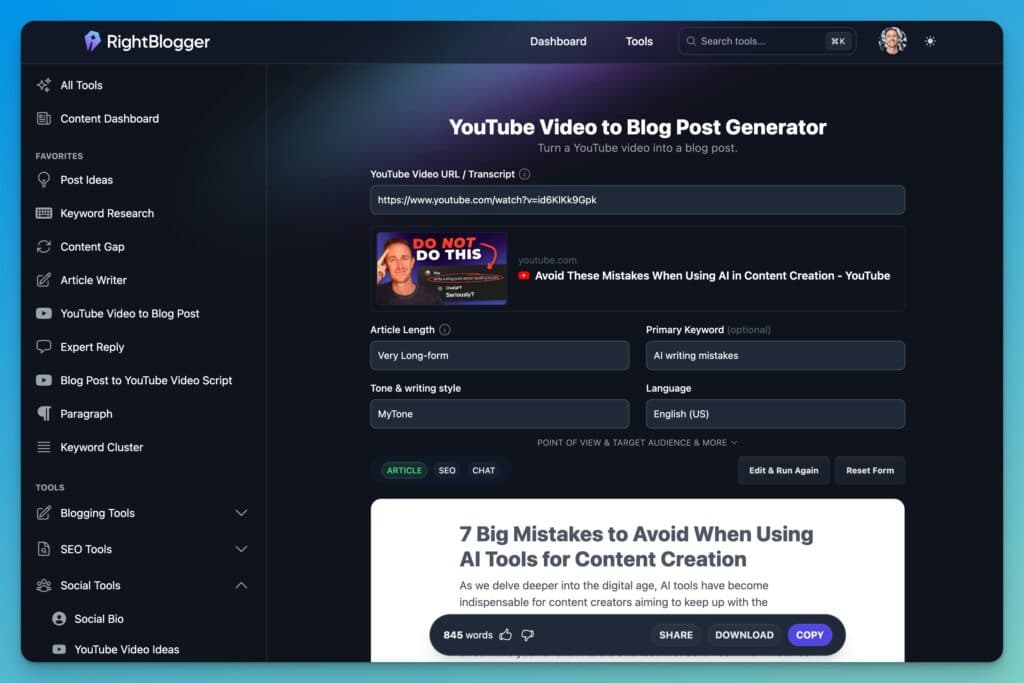
If you’re an academic, for instance, you should look for features in a toolset that are tailored to research and more scholarly activities. Here with RightBlogger, we’ve developed tools for content creators to research, create, SEO-optimize, and promote content quickly.
For you, the right goal is to switch to an AI platform that matches your needs and enhances your workflow, a smarter choice than sticking with a generic solution like ChatGPT where you’re faced with the blank screen dilemma every time you go to generate something new.
Check the AI Model Leaderboard
If you wanna go deep down the AI model rabbit hole in your quest for the best ChatGPT alternative, be sure to spend some time with the Arena leaderboard (formerly LMArena), which ranks hundreds of AI models on blind human preference voting across text, coding, agent, and image categories.
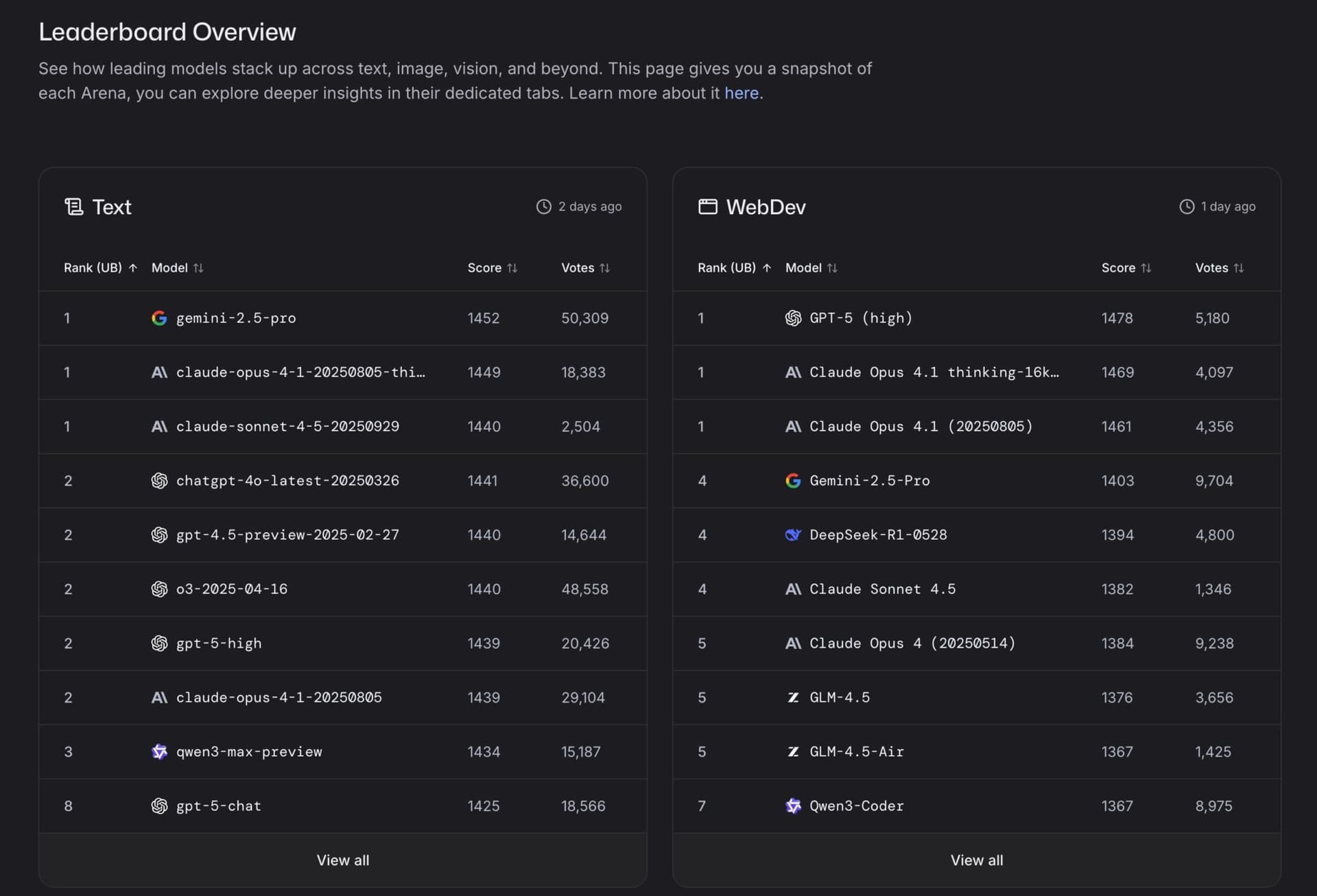
As of October 27, 2026, Google’s Gemini 4 Carbon tops the Arena text board (its score is still marked preliminary, and Google has opened the model only to a small group of cyber defenders so far). Gemini 4 Argon, Claude Opus 5.5, and Meta’s Muse Wonder are right behind, and Claude models hold 6 of the top 10 spots. Rankings shift every few weeks as new models launch, so check the live board before you pick. But again, this is pretty in the weeds for most people.
Now, here are the top ChatGPT alternatives, with the good and bad of each.
13 Best ChatGPT Alternatives to Consider in 2026
Here are our 13 picks for the best ChatGPT alternatives on the market today.
1. Claude
As of October 2026, Anthropic’s lineup is the Claude 5 family: Claude Opus 5.5 (released September 22, 2026) for long-running agentic coding and knowledge work, Claude Sonnet 5.5 for everyday speed, Claude Haiku 5.5 for fast, high-volume tasks, and Claude Fable 5.1, Anthropic’s most capable widely released model. Anthropic’s Fable page covers its top model, and the Claude overview covers the apps.
Claude is strongest at long-form writing, following detailed instructions, and coding. Paid plans also include Claude Code, Anthropic’s coding agent.
Pros of Claude
- Versatility: Claude tackles a wide range of tasks, including coding, writing, and much more, making it one of the highest rated AI models.
- Long context: Claude models handle up to 1 million tokens, so long documents and big codebases fit in one chat.
- Ease of Use: The user-friendly interface makes it accessible to a broader audience.
- Developer-friendly: Claude has an API for building your own tools, plus Claude Code for writing and editing code.
- No ads: OpenAI has started showing ads in ChatGPT, but Anthropic has come out against ads in Claude.
Cons of Claude
- Usage limits: Individual plans cap weekly usage (all but Ultra also cap it every 5 hours), and on Pro the top Fable model is paid for with usage credits.
Pricing for Claude
As of October 2026, Claude Pro is $20 per month (or $17 per month billed annually). They also offer Max ($100/month), Ultra ($200/month, with no 5-hour limit), Team (from $20/user/month billed annually, or $25 billed monthly), and Enterprise plans.
2. Google Gemini
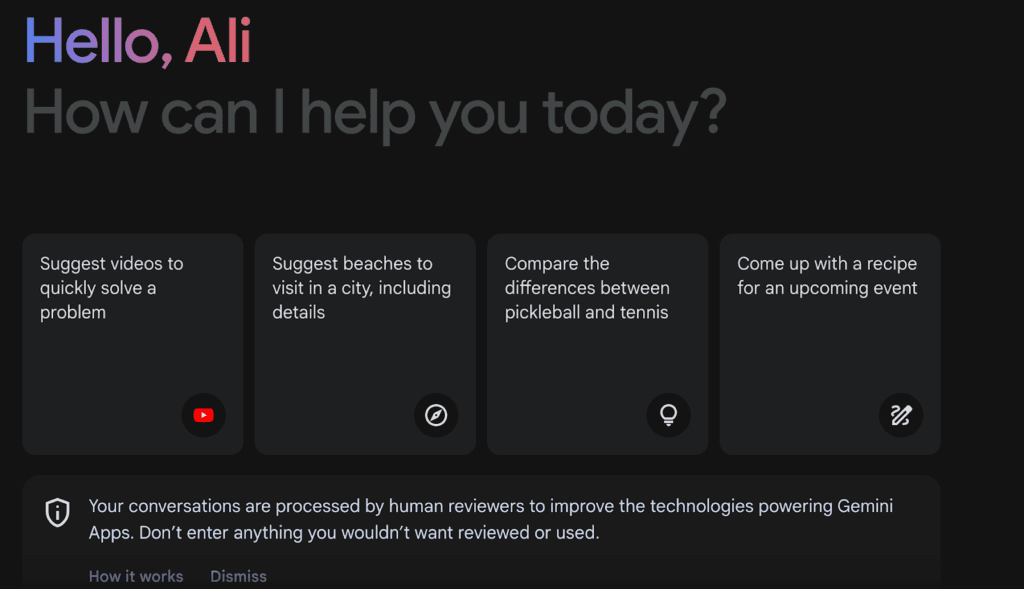
Google Gemini is a suite of artificial intelligence models designed to tackle a vast toolbox of tasks. It’s a direct competitor to ChatGPT, and one of the closest match ChatGPT alternatives you can find if you want a nearly exact replica that interacts and delivers outputs in natural language.
It works in a similar way to ChatGPT and can handle different types of information, like text, code, and even images.
Google Gemini is multimodal in nature, that is, it can process audio, images, and text to understand complex problems across different data forms. It also offers different model variants like Gemini Pro and Gemini Flash, each tailored for specific tasks and devices.
But what I personally like the most about it is the user interface. It looks cool and is very easy to use.
Plus Gemini has gone viral with its Nano Banana image models, which are great at editing existing photos (as of October 2026, Nano Banana 2 is free and the newer Nano Banana 2.1 comes with Google AI plans).

Pros of Gemini
- One of the top AI models (Gemini 4 Argon, launched October 13, 2026, for Google AI Pro and Ultra subscribers. The free plan uses a Flash-Lite model.)
- One of the best AI image models (Nano Banana 2.1 on Google AI plans, Nano Banana 2 on the free tier.)
- The information provided is usually real-time.
- It’s free to use.
- It’s a multimodal model (text, audio, video, etc.)
- Massive context window.
Cons of Gemini
- Some newer models and features arrive as limited previews or only in select countries.
- Sometimes, it confuses context.
Pricing for Gemini
Gemini is free to use. As of October 2026, paid plans are sold as Google AI tiers: AI Plus ($4.99/month), AI Pro ($19.99/month), and AI Ultra ($99.99/month, or $199.99/month for 20x the usage limits of AI Pro).
3. Grok
Grok is the chatbot from SpaceXSI (SpaceX’s AI division, formerly xAI), integrated directly into X. As of October 2026, the flagship is Grok 4.7, released September 21, 2026.
Where Grok stands out is real-time information. It pulls live context from X, so for breaking news, sports scores, and trending discussions, it’s often the most current chatbot you can use. It’s also less filtered than ChatGPT or Claude, which some users prefer and others find a problem, depending on what you’re using it for.
Pros of Grok
- Real-time data: Direct integration with X gives Grok an edge on current events and live conversation.
- Strong reasoning: Grok 4.7 is SpaceXSI’s most powerful model for coding and knowledge work, pitched as twice as fast at half the price of comparable models.
- Less filtered: Fewer guardrails than the major US chatbots, which can be useful for writing, research, and edge-case questions.
- Image generation included: Grok includes image and video generation (via Grok Imagine) without a separate subscription.
Cons of Grok
- Polarizing: Tied closely to X and Elon Musk’s brand, which is a deal-breaker for some users and teams.
- Quality varies: Less filtered also means more inconsistent; Grok will confidently produce things ChatGPT or Claude would caveat.
Pricing for Grok
Free tier available with limits. As of October 2026, x.ai/pricing sells one subscription that covers both Grok and X: Plus ($8/month), Premium ($30/month), Super ($100/month), and Ultra ($200/month), plus Teams and Enterprise plans.
4. Perplexity.ai
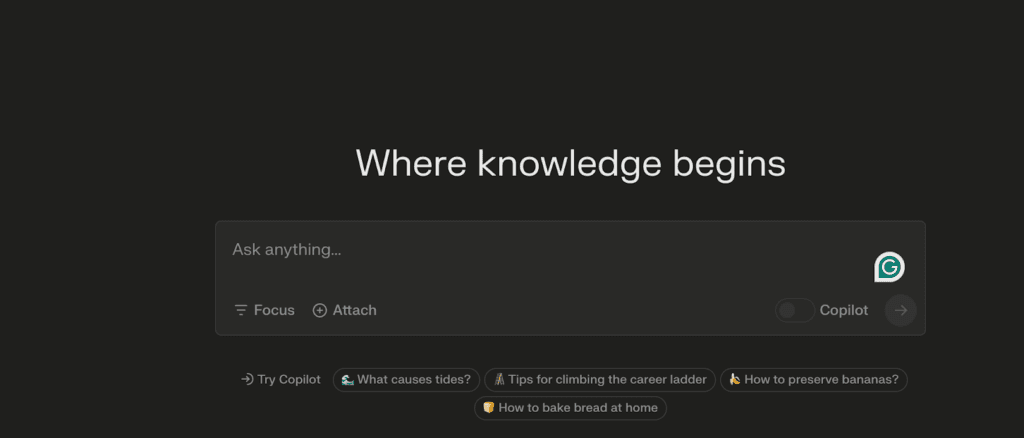
Compared to ChatGPT, Perplexity AI stands out for its focus on research-oriented, source-backed responses, real-time web search capabilities, and citation-backed information.
While ChatGPT offers conversational breadth, Perplexity AI excels in providing accurate and reliable information for users seeking in-depth and comprehensive responses to their queries.
Its top feature is live web search, so answers reflect the most current information available online.
It also cites its sources, so you can cross-check and verify every piece of information with ease.
Pros of Using Perplexity.ai
- Source links: Every answer links to where it came from, which makes fact-checking quick.
- Efficiency: It’s user-friendly and fast.
- Free Version: Perplexity has a forever-free plan, and you can do a lot with it.
- Real-time Information: All information is sourced from various places on the Internet in real-time.
Cons of Using Perplexity.ai
- It occasionally gives incorrect answers, as most AI tools do.
Pricing for Perplexity
Perplexity has a forever-free plan with limitations. Their Pro plan is $17 per month billed annually (as of October 2026), and the Max plan for heavy users is $167 per month billed annually or $200 month to month.
5. DeepSeek
DeepSeek is the Chinese AI lab whose DeepSeek-V3 and DeepSeek-R1 models shocked the AI world in early 2025 by matching the performance of frontier-class models at a fraction of the training cost, and releasing the weights publicly under an open license. Its current API flagship for speed and price is DeepSeek-V4.1-Flash (model id deepseek-flash), which replaced the April 2026 V4-Flash line on September 10, 2026. DeepSeek-V4-Pro remains available on the API at its own rates. Both keep a 1 million token context window while staying radically cheaper than frontier closed models.
For most users, DeepSeek is the answer to one specific question: is there a free, capable ChatGPT alternative I can just use in a browser? The answer is yes. The web app at chat.deepseek.com is free, the model is genuinely good at reasoning and code, and there’s no credit card required.
Pros of DeepSeek
- Free: The web chat is free with generous limits.
- Open weights: You can self-host DeepSeek-V4-Pro or V4.1-Flash, both MIT-licensed, if you want full data control.
- Strong on math and code: V4 is one of the best reasoning models for technical work, especially at its price point.
- Cheap API: As of October 2026, DeepSeek-V4.1-Flash output costs $0.60 to $1.20 per million tokens, versus $10 for OpenAI’s GPT-6.1 Sol and $20 for Claude Opus 5.5.
Cons of DeepSeek
- Hosted in China: If you have data residency or compliance concerns, the hosted version is a non-starter; self-host or use through a third-party provider instead.
- Censorship on hosted version: The official chat.deepseek.com avoids topics sensitive to the Chinese government. Self-hosted versions don’t have this restriction.
Pricing for DeepSeek
Web chat is free. Official DeepSeek-V4.1-Flash cache-miss input is $0.15 per million tokens off-peak and $0.30 per million at peak (DeepSeek API pricing; cut with the V4.1-Flash release on September 10, 2026).
6. Microsoft Copilot
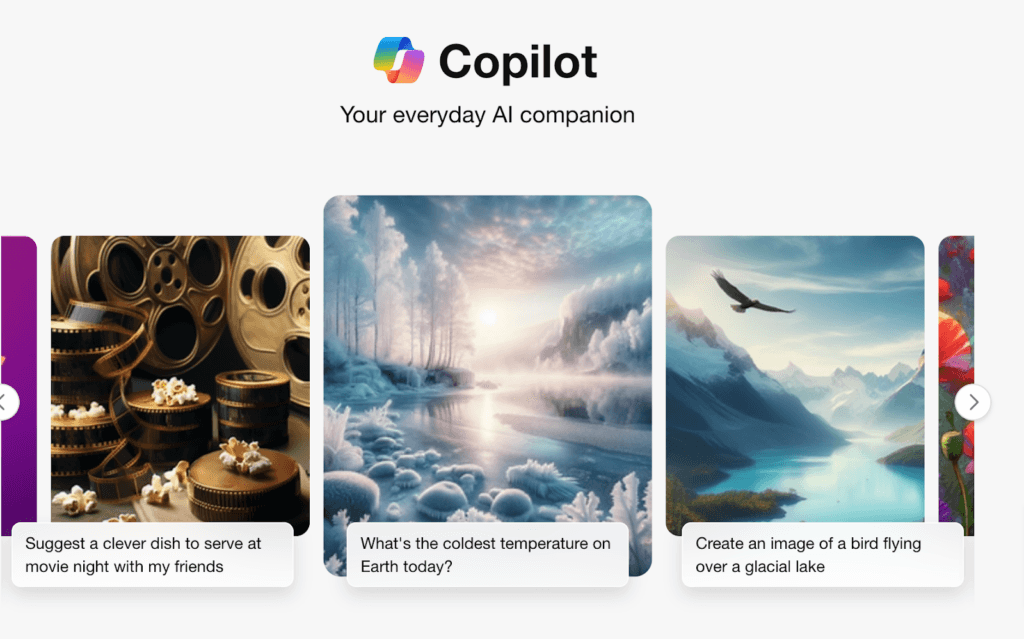
Microsoft Copilot, introduced by Microsoft in early 2023, is a dynamic AI chatbot designed to assist with a variety of tasks, including crafting poems, composing songs, and aiding with citations, among others. It grew out of Bing Chat, which Microsoft renamed Copilot in November 2023.
A standout feature of Copilot is its capability to quickly help you craft documents on a wide array of topics. It excels at analyzing extensive data within spreadsheets, employing analyses and formulas to dig up insights.
Additionally, it enables the creation of detailed illustrations and can produce images based on specified instructions. One of its advantages is the ability to work collaboratively with team members, allowing for the sharing of results and insights in real-time.
Pros of Microsoft Copilot
- Efficient Collaboration: Copilot simplifies document sharing and collaboration within teams by enabling real-time updates and visibility (plus, it plays nicely with Bing). This functionality removes the need for back-and-forth emails or separate systems for document management, enhancing overall workflow efficiency.
- Enterprise Security: The business version comes with Microsoft’s security and compliance controls, which matters for sensitive projects and strict privacy rules.
Cons of Microsoft Copilot
- Privacy Risks: Given that Copilot uses AI technology to analyze data, there’s a potential risk that your personal information might be handled in unexpected ways. It’s essential to thoroughly understand Microsoft’s data handling and privacy policies before using the service.
- Learning Curve: Integrating Copilot into your daily operations can initially be challenging, requiring time to learn and adapt to its features.
- Cost Considerations: For businesses, Microsoft 365 Copilot is a per-user add-on on top of a Microsoft 365 license, so costs add up across a team.
Pricing for Microsoft Copilot
Copilot has a free tier in Windows, Edge, and the web app. For individuals, Microsoft 365 Premium is $199.99/year. For enterprise, Microsoft 365 Copilot is $30 per user per month paid yearly on a qualifying Microsoft 365 plan.
7. Meta AI
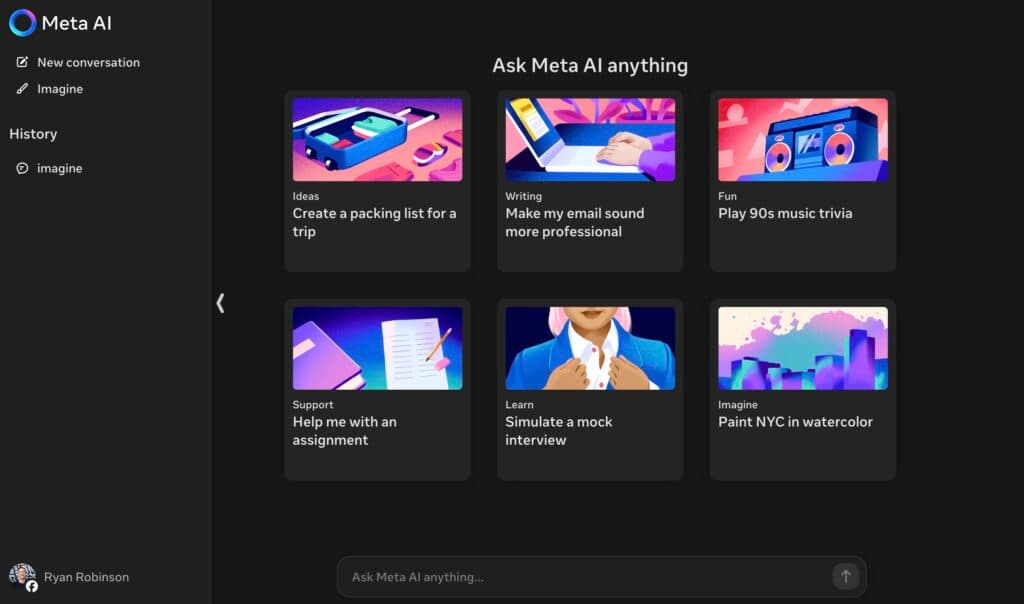
Meta AI now runs on Muse Spark, the proprietary model Meta Superintelligence Labs released in April 2026. It is one of the stronger free contenders for a ChatGPT alternative, largely because it’s pretty good, and it’s free to use on WhatsApp, Instagram, Facebook, Messenger, and the web. Meta’s stronger Muse Wonder model launched on October 12, 2026. Developers can use it now, and Meta says it will soon power its Muse app, rolling out to subscribers first.
Meta AI can also generate images right in the chat: type a description of the image you want and it creates it for you.

It’s pretty cool and useful for generating imaginative stock images to include in your content, but it’s also a bit of a gimmick. So, let’s take a look at some of the real pros and cons of considering Meta AI as an alternative to ChatGPT for your needs.
Pros of Meta AI
- Ease-of-Use: Meta’s AI works as a fairly direct alternative to ChatGPT, with simple chat-style back-and-forth that speeds up information gathering.
- Already in your apps: It’s built into WhatsApp, Instagram, Facebook, and Messenger, so there’s nothing new to install.
Cons of Meta AI
- Data Privacy Concerns: The more data it processes, the bigger the privacy issues, as it needs extensive datasets to learn effectively.
- Potential Biases: If not monitored (like many AI models), it can perpetuate the inherent biases in the data it learns from.
Pricing for Meta AI
Meta AI is free for everyday use on WhatsApp, Instagram, Facebook, Messenger, and the web. Meta’s separate Muse agent app is also free with usage limits, and its Power ($20/month) and Maximum ($100/month) plans unlock Muse Wonder.
8. Mistral Vibe (formerly Le Chat)
Mistral is one of the most popular open source AI model makers for developers and businesses, with models you can customize for a wide range of use cases. If you’re planning on building products with AI woven into the mix, then Mistral should be at the top of your list to explore.
Mistral Large 4, a 1-trillion-parameter multimodal model, is now their flagship. It entered public preview on October 6, 2026, and Mistral released its open weights on October 29 under a modified MIT license. Mistral Small 4 (Apache 2.0) is the efficient small model, and Medium 3.5 is being retired in favor of Large 4. They’ve built their platform around being the go-to open source AI provider, offering compliant access to their technology, model fine-tuning, and more.
But is Mistral a great ChatGPT alternative? While they do offer a direct one-on-one chat-style interface that you can try for free in their Vibe app (formerly Le Chat), Mistral really shines as a developer toolkit to building AI-powered features into your business.
Pros of Mistral
- Free Chat: You can use Mistral Vibe (formerly Le Chat) free of charge, with limited access to Mistral’s latest models.
- Advanced LLM: While Mistral isn’t designed with end-users primarily in mind, Large 4 is one of the strongest open-weight models you can download and run yourself. So if you’re looking for an open source model to power your own app, Mistral is a great starting point.
Cons of Mistral
- Not the Best for Individual Users: As an individual user looking for a ChatGPT replacement, Mistral isn’t likely to be your best bet. They’re going after a B2B market of customers who will use their tech to power features and functionality inside their own products.
- Tight Free Limits: The free plan caps messages and web searches, and agents, long-horizon tasks, and all-day coding require a paid plan.
Pricing for Mistral
Mistral Vibe has a free plan. As of October 2026, Pro is $14.99/month and Team is $24.99 per user per month. Pricing for use of their LLM isn’t very straightforward with Mistral though, because its primary use case is for B2B (companies that are using their technology to power tools and functionality in their own products). You can explore their token-based pricing on the Mistral Studio page.
9. Qwen
Qwen (pronounced “chwen”) is Alibaba’s open-weights model family, and its chat product at chat.qwen.ai is one of the more underrated free ChatGPT alternatives in 2026. As of October 2026, the flagship is Qwen3.8-Max, and Alibaba published open weights for the Qwen3.8 family on Hugging Face in August 2026, including Apache 2.0 models like Qwen3.8-27B. It trades blows with Gemini and Claude on multilingual tasks and coding.
Qwen is strong if you work in multiple languages; it was trained with much heavier weight on Chinese, Japanese, Korean, and Arabic than the US-built models. It’s also fully open weights, which means you can run smaller variants locally on a laptop with Ollama or LM Studio.
Pros of Qwen
- Free chat: chat.qwen.ai is free with high usage limits.
- Multilingual strength: Often better than ChatGPT for non-English work.
- Open weights: Multiple model sizes, from laptop-sized Apache 2.0 models up to the full Qwen3.8 flagship (released under Alibaba’s own Qwen3.8-Max license).
- Vision and code variants: Specialized models for image understanding and coding alongside the general chat model.
Cons of Qwen
- UI is rougher: The chat interface is less polished than ChatGPT or Claude.
- Hosted version is in China: Same data-residency caveat as DeepSeek if you care about that.
Pricing for Qwen
Web chat is free. API access through Alibaba Cloud is competitively priced; smaller models are free to run locally.
10. Kimi
Kimi is built by Moonshot AI and is the third major Chinese-lab chatbot worth knowing about (after DeepSeek and Qwen). Its newest flagship, Kimi K3.1 Pro (October 24, 2026), builds on July’s Kimi K3 and keeps its 1 million token context window. It’s tuned for long-document and long-horizon coding work; uploading a full book or a large codebase and asking questions across it is its signature use case.
It’s also free to use at kimi.com for basic chat. If your bottleneck with ChatGPT is context length or you regularly work with long PDFs, Kimi is worth a try.
Pros of Kimi
- Massive context window: 1 million tokens means full books, long meeting transcripts, or large code repos fit in a single conversation.
- Free: The web chat is free without a paid tier requirement for normal use.
- Strong document analysis: Particularly good at summarizing and answering questions across long uploaded documents.
Cons of Kimi
- Newer and less-tested in English: Kimi is rapidly improving but still feels less polished than the top-tier models for general English chat.
- China-hosted: Same privacy caveats as DeepSeek and Qwen.
Pricing for Kimi
Free for the web chat. Moonshot also offers an API; as of October 2026, Kimi K3.1 Pro costs $2 per million input tokens and $10 per million output tokens (Kimi K3 is $3 and $15), with no surcharge for long context.
11. Gemini Notebook (formerly NotebookLM)
Gemini Notebook (formerly NotebookLM) is Google’s research-focused AI tool, and it’s a different shape from a typical ChatGPT alternative. Instead of one open-ended chat, you upload sources (PDFs, Google Docs, links, YouTube videos) and Gemini Notebook only answers questions grounded in those sources, with citations back to the exact passage it pulled from.
It’s the best tool I’ve used for research-heavy work where hallucinations matter. It also has a popular Audio Overview feature that turns your sources into a surprisingly good podcast-style summary with two AI hosts discussing the material.
Pros of Gemini Notebook
- Source-grounded answers: Every response cites the exact passage in your uploaded materials. Almost zero hallucinations.
- Audio Overviews: Auto-generated podcast summaries are genuinely useful for absorbing dense material on the go.
- Generous free tier: Up to 50 sources per notebook, no payment required for most use cases.
- Multimodal sources: Accepts PDFs, web links, YouTube videos, Google Docs, and pasted text in one notebook.
Cons of Gemini Notebook
- Not for open-ended chat: If you want a model to just answer general questions, Gemini Notebook is the wrong tool; it only works against your uploaded sources.
- Source quality limits output quality: Garbage in, garbage out. The grounding only helps if your sources are good.
Pricing for Gemini Notebook
Free for personal use. Upgrade via Google AI Pro ($19.99/month) for higher Gemini Notebook access, including higher source/notebook limits and team sharing.
12. T3.chat
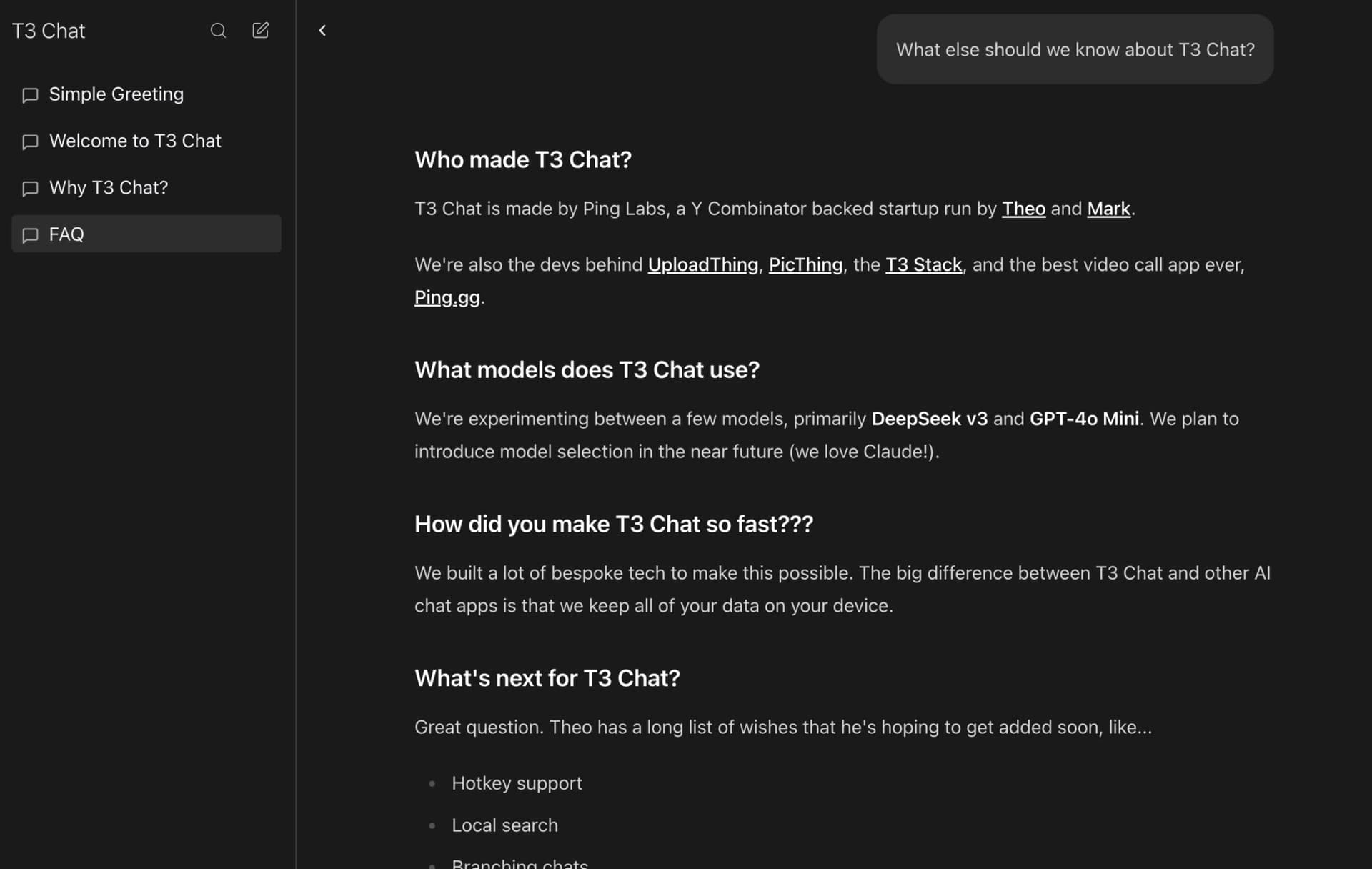
T3.chat is a real-time AI-powered chatbot platform created by Theo Browne. It’s designed for lightning-fast chatting, making it an excellent tool for quick problem-solving, brainstorming, or information gathering. T3.chat is known for its speed and simplicity.
One of the best features of T3 Chat is the ability to switch between almost every popular AI model out there.
Pros of T3.chat
- Speed and Responsiveness: T3.chat is optimized for real-time communication, making it faster than many alternatives.
- Developer-Friendly: Built by the creators of the T3 Stack, it caters especially well to developers looking for reliable and modular tools.
Cons of T3.chat
- Niche Audience: While great for tech-savvy users, its full potential may not be as accessible for non-developers.
- Feature Set Still Growing: Compared to long-established competitors, some advanced features like extensive templates or pre-trained conversational modes might be limited.
Pricing for T3.chat
T3.chat offers higher limits for $8 per month but the site can be used for free with message limits.
13. RightBlogger
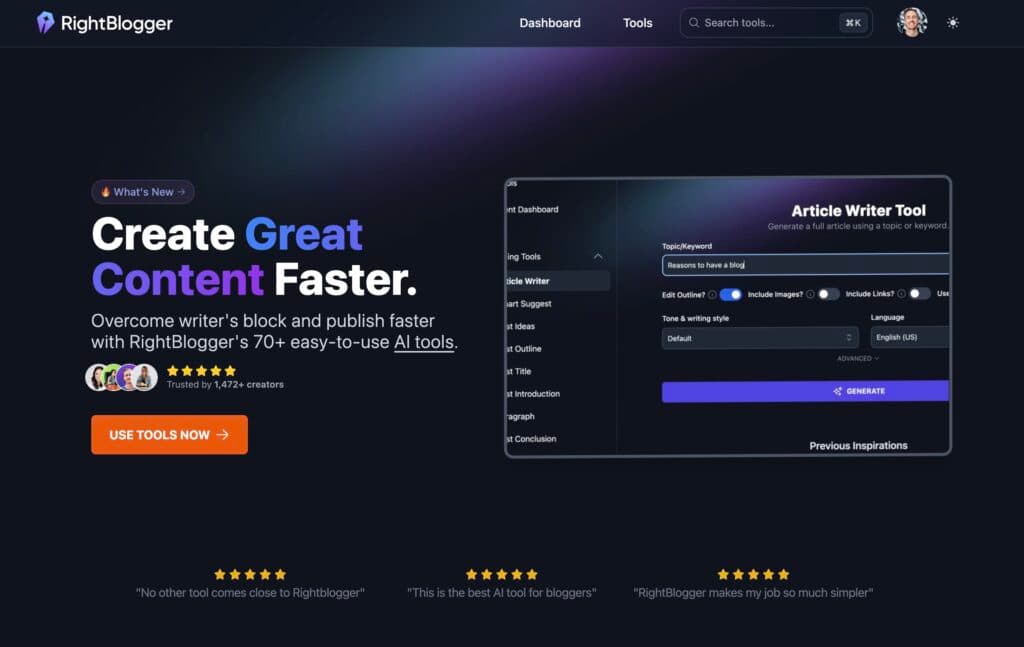
RightBlogger is our suite of AI tools for bloggers, content creators, and marketers (built by seasoned bloggers), covering research, writing, SEO, and promotion. If content is your main use case, RightBlogger is a more focused ChatGPT alternative, and MyTone lets the tools write in your own brand voice.
AI Article Writer
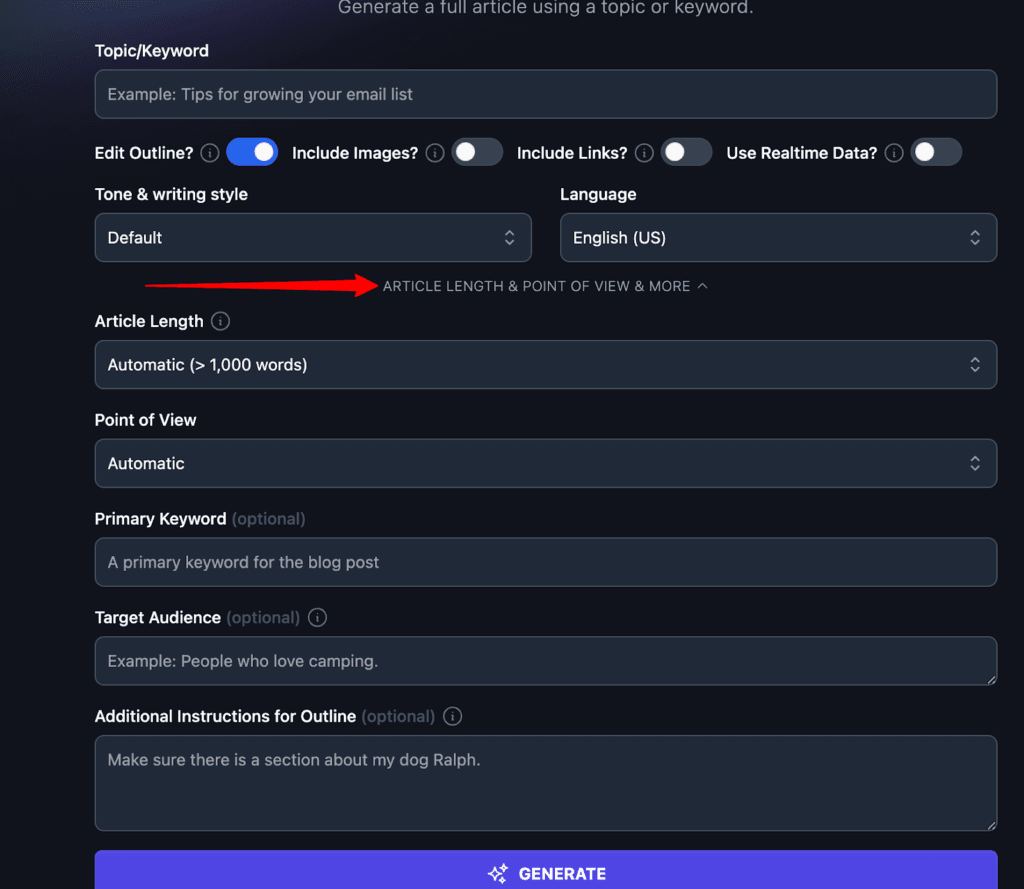
RightBlogger‘s Article Writer creates SEO-optimized articles. Before it writes, you can add your point of view, shape the outline, include links, pull in real-time information, and add images automatically.
When the draft is ready, download it as a Word doc, copy it, or send it straight to your CMS.
Other popular tools include Video to Blog Post, the Summarizer, the Rewriter, the Cold Email Generator, and a free Chrome extension for on-page SEO audits.
RightBlogger Chat
RightBlogger Chat is a full AI chat built into RightBlogger for brainstorming, feedback on drafts, and questions about articles you’ve created. When Google Search Console is connected on the project, Chat can read your Search Console data too; see Connect Google Search Console.
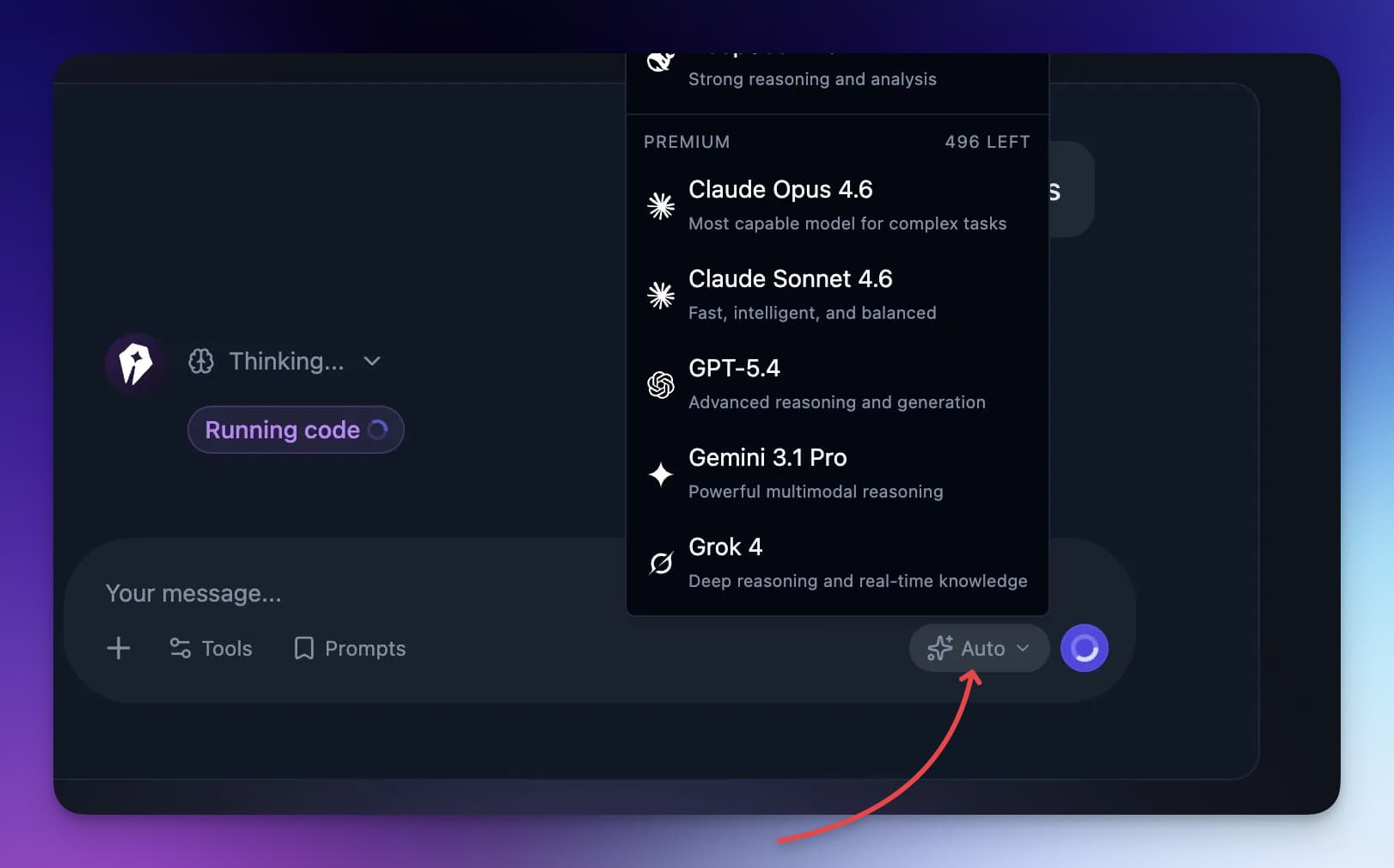
Unlike ChatGPT, it lets you pick the model for each task, with options from OpenAI, Anthropic (Claude), Google (Gemini), Grok, DeepSeek, Kimi, Mistral, and more.
Pros of RightBlogger
- Super Easy to Use: Beginners can get started quickly.
- Full Autoblogging: Queue daily, weekly, or monthly posts that RightBlogger writes and publishes for you.
- 7-Day Free Trial + 30-Day Money-Back Guarantee: Every paid plan includes both, so you can test it before you commit.
- Continuous Improvements: We ship new features often (like SEO reports).
- Great Customer Support: Our team is quick to help when you hit an issue.
Cons of RightBlogger
- Pricier than ChatGPT Plus ($20/month): paid plans start at $49/month billed annually.
- Not as “free-form” as ChatGPT (the tools have a clear structure to them).
- Skip it if you mainly want an all-purpose chatbot: the free tiers of ChatGPT, Claude, or Gemini cover that.
Pricing for RightBlogger
Monthly pricing is Solo $59, Pro $89 (most popular), and Agency $299, or $49 / $69 / $199 per month billed annually. Every paid plan includes unlimited AI words and all tools, and there’s also a free plan with 2,000 AI words a month.
Frequently Asked Questions
Is there any better AI than ChatGPT?
Yes, for certain tasks. Perplexity AI, Google Gemini, and Claude all rival or beat ChatGPT in specific ways. Perplexity is best for live, source-backed research (Google’s AI mode is also great for this.) Gemini is strong for real-time info, images, code, and Google integration. Claude handles long documents well and shows strong reasoning with an easy UI along with strong creative writing skills. “Better” depends on your goal but most high-end chats are great choices.
Is Perplexity AI better than ChatGPT?
Often, for research. Perplexity searches the web live and cites its sources, so it’s great for fact-checking and current info. ChatGPT can feel smoother for creative writing and longer conversations. Try both. If you need fresh, verified facts, Perplexity usually wins. If you want style and flow, ChatGPT is a great choice.
Is Claude better than ChatGPT?
For most writing and reasoning tasks, yes. Claude (especially Claude Opus) tends to produce cleaner long-form prose, follows complex instructions more carefully, and is less prone to filler than ChatGPT. ChatGPT is still strong for image generation, voice, and its growing library of plugins (OpenAI is retiring custom GPTs on December 11, 2026). Most professional writers and developers I know keep both subscriptions and switch based on the task.
What is the Chinese ChatGPT alternative?
The three main Chinese-lab chatbots are DeepSeek, Qwen (Alibaba), and Kimi (Moonshot AI). All three are free to use in a browser, and all three release open weights you can run locally if you don’t want to use the hosted version. DeepSeek is the most well-known and competitive on reasoning. Qwen is strong multilingually. Kimi has a massive 1 million token context window for long-document work. All three are hosted in China; keep that in mind for any sensitive data.
What’s the best ChatGPT alternative for coding?
For pure code quality, Claude (Sonnet and Opus) and DeepSeek are the two strongest non-OpenAI options as of October 2026. Claude is the favorite among developers using Cursor or Claude Code for daily work. DeepSeek is the best free option, especially for reasoning-heavy problems. Grok is also surprisingly competitive on coding benchmarks. Gemini is solid for code generation inside Google’s ecosystem.
Which ChatGPT alternative is best and free?
The strongest free ChatGPT alternatives in 2026 are DeepSeek, Google Gemini, Qwen, Meta AI, and Mistral Vibe. DeepSeek is the most surprising; it matches frontier-class quality for free, with no credit card required. Gemini is the best free option if you want polish and Google integration. Qwen is the underrated pick. ChatGPT’s own free tier now runs GPT-6 Luna for everyday chat, with tighter limits on uploads, image creation, and deep research than its paid plans.
How do I pick the best ChatGPT alternative?
Start with your main goal. For blogging and SEO content, RightBlogger speeds up draft-to-publish with tools built for creators. For fresh, cited research, use Perplexity. For free chat and ideas, try Meta AI or Mistral Vibe. For images, code, and real-time data, use Google Gemini. For business workflows and Office docs, look at Microsoft Copilot. If coding and cost control matter, keep an eye on DeepSeek. Weigh cost, ease of use, output quality, and limits. Then test two or three before you decide.
Which ChatGPT Alternative Should You Pick?
It depends on what your needs are, really. We chose these tools as our picks for the best ChatGPT alternatives, because they offer a variety of options and ways to interact with generative AI.
While there are tons of alternatives to ChatGPT that offer a specialized features and capabilities that didn’t make this list, we’re a little biased, we built RightBlogger to be the go-to toolkit for people focused on blogging, marketing, and content creation.
Whether you’re crafting SEO-optimized articles, engaging in effective outreach through personalized emails, or repurposing content across multiple channels, RightBlogger will steer you in the right direction.
If you find ChatGPT’s customization options limiting, take RightBlogger for a spin and sign up today with a 7-day free trial and a 30-day refund.

Ali Faagba is a content strategist who writes about AI, marketing automation, and sales for B2B SaaS companies like Close and Userpilot.


Automated SEO Blog Posts for Your Site
Research, write, publish, and share from one account.
7-day free trial. Cancel anytime.





Leave a comment