Are you putting together a listicle blog post? Get it written in a fraction of the time using RightBlogger’s AI listicle writer. It’ll instantly draft a full post for you, in listicle format, designed to be popular with readers and to rank well in search engines through good SEO (search engine optimization).
A listicle or list post is a blog post in the form of a list. They’re hugely popular because they’re easy to read, and easy to promote on social media, as you can give one or two items from the list. Listicles are also really straightforward to put together as they have a built-in structure.
You’ll find listicle posts on all kinds of blogs. They’re great for entertainment, but they’re also useful for top tips, lessons learned, top resources, or other guides that suit a wide range of niches. It’s a great fit for both B2C and B2B blogs.
Writing a high-quality listicle post takes time, though … and that’s where AI comes in. RightBlogger can put together engaging listicles for you in seconds.
How to Use the Free AI Listicle Writer
Ready to give the listicle writer a try (and beat writer’s block)? Here’s what to do.
Step 1. Enter Your Topic or Keyword
The listicle writer needs a topic or keyword to base your listicle on. Type that into the box.
Tip:If you’re not sure what you want to write about, try using our keyword research tool to find relevant keywords for your audience.
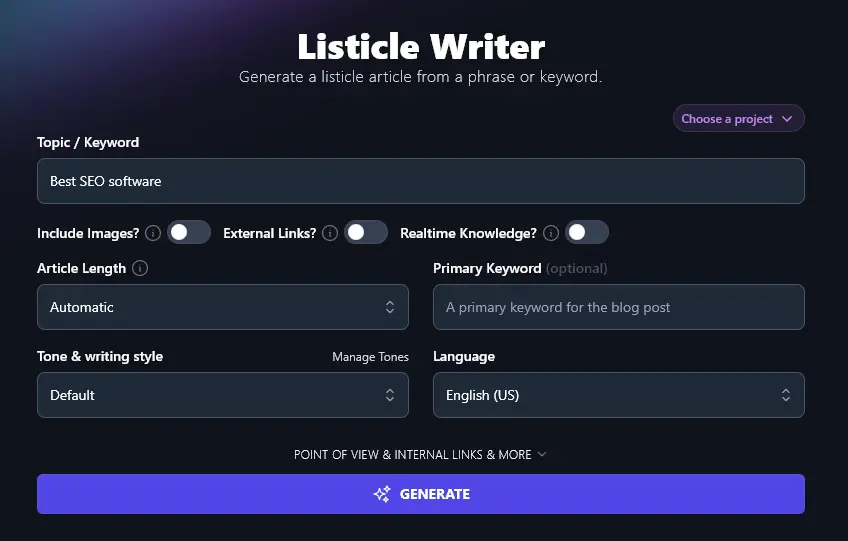
Step 2. Select Whether to Include Images, External Links, and Realtime Knowledge
The AI can include copyright-free images, links to other sites, and up-to-date facts and statistics in your blog post. Just toggle on whichever of these options you want to use for your generated listicle.
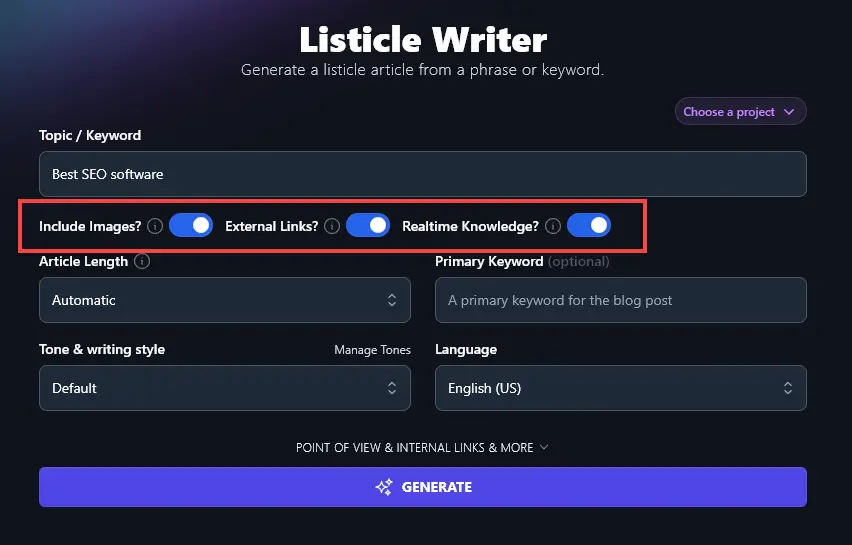
Step 3. Choose the Length for Your Listicle Article
How long do you want your listicle to be? Some listicles don’t have much text: they might be focused on images or videos instead. Others could be thousands of words long.
You can let the AI choose automatically, or you can select your preferred length from the dropdown.
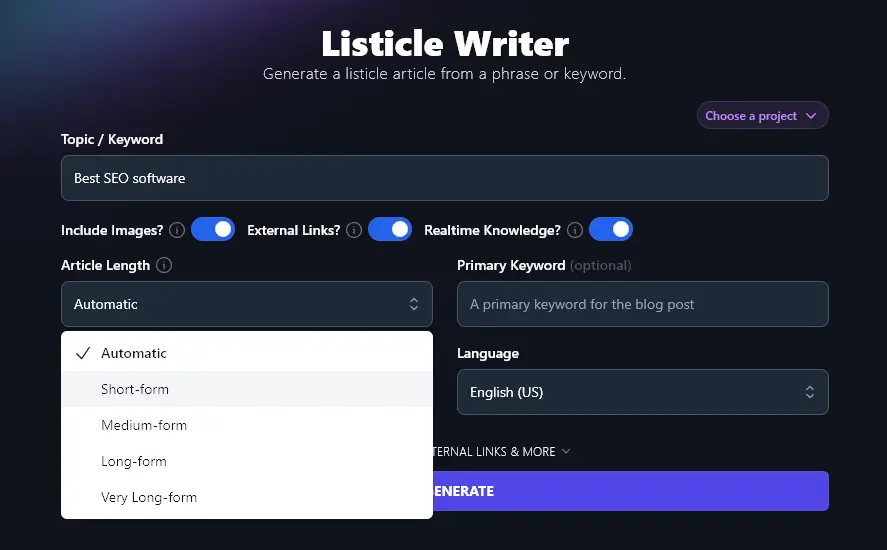
Step 4. Enter Your Primary Keyword to Optimize For
If you want to optimize your post to rank for a specific keyword, put that keyword in here.
(Even if you’ve included the keyword for your Topic/Keyword, add it here too: that way, the AI knows you want to optimize for this specific keyword.)
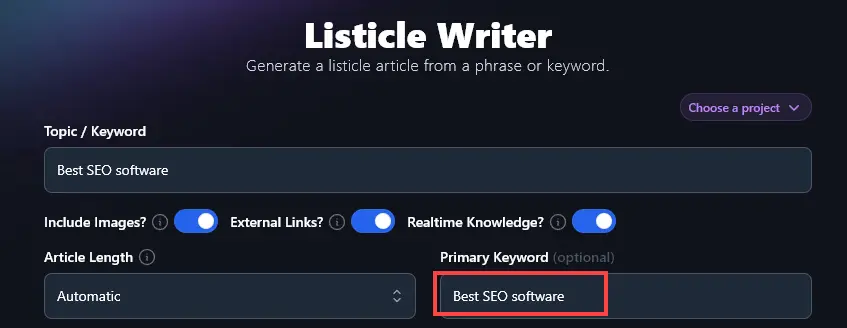
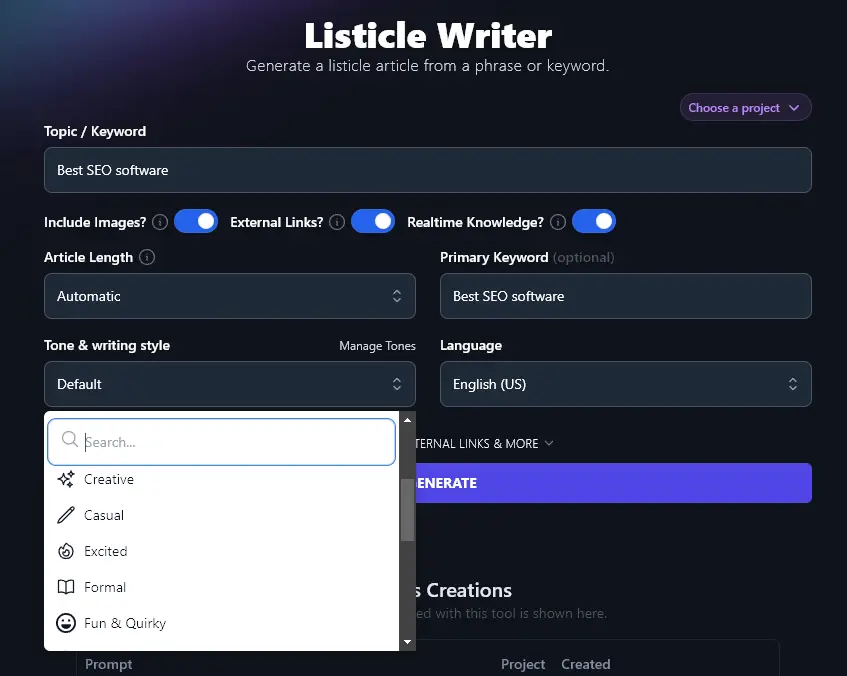
Step 5. Select the Tone & Writing Style (Match Your Usual Writing Voice)
You want all your blog content to fit your brand voice, and that’s what the “tone & writing style” helps you with. RightBlogger has 16 preset styles you can choose from, with options like Casual, Fun & Quirky, Professional, and Academic.
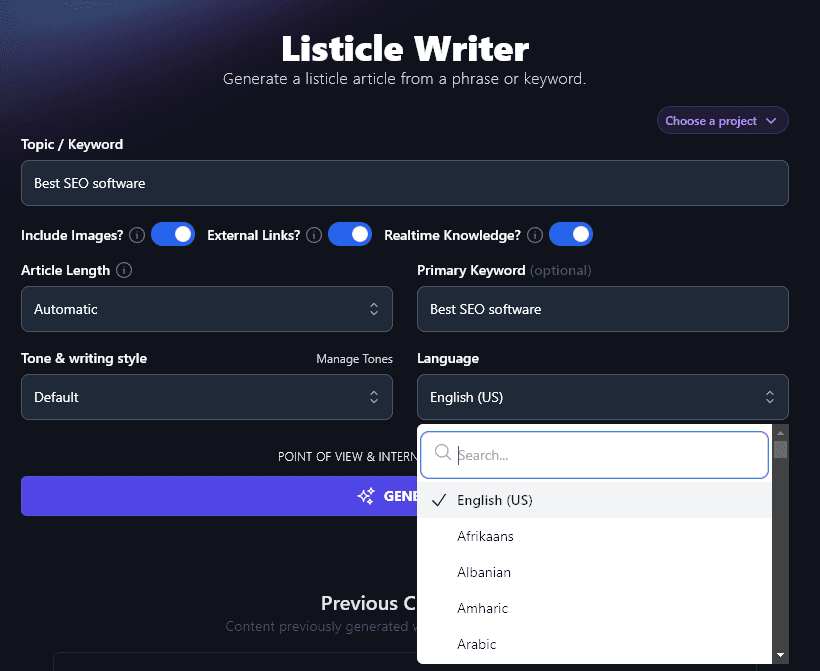
Step 6. Pick a Language
RightBlogger defaults to English (US) … but the AI can write in over 100 other languages. If you’re creating content for a non-English audience, or if you have a multilingual site, simply select your preferred language from the dropdown.
Once you’ve entered your topic/keyword and set any of the other options, go ahead and click the “Generate” button to create your listicle.
Bonus: Use This Free SEO Checklist Along With This Tool
You’ve probably created your listicle to drive traffic to your blog … and that means making sure it’s well-optimized for search engines.
While the AI will make sure your keyword appears in your title and within the text of your post, it’s also a good idea to follow my SEO checklist to optimize your post further:
- If you haven’t already, install and use a good SEO plugin like Yoast or RankMath
- Make sure you’ve used a suitable keyword phrase for your site and audience
- Use keywords within your headings where possible (encourages rich snippets and faster indexing)
- Only have one H1 header on your page, in your post title at the top
- Follow correct header hierarchy, with H2 subheadings and H3 sub-subheadings
- Don’t go overboard with using your primary keyword in the text, make sure it reads naturally
- Have at least 3-5 external links, along with a similar number of internal links
- Craft an engaging meta description that uses your keywords
- Add alt text to all your images, using keywords where appropriate
- Make sure your listicle is long enough to rank well (usually 1,500+ words)
- Write a meta title (SEO title) that’s optimized for search engines
- Use your primary keyword in the permalink (URL) for your blog post
How Does The AI Listicle Generator Work?
The listicle generator is straightforward to get started with. It has a lot of advanced features, however, that you might want to dig into. These let you create incredibly high-quality content that suits your site perfectly.
1. Topic / Keyword (What’s Your Listicle About?)
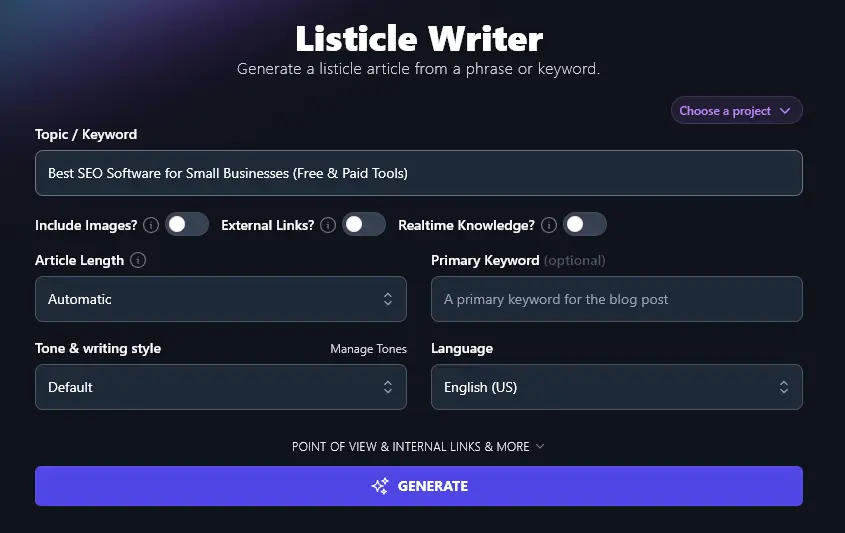
The only required input for the listicle generator is the Topic / Keyword field. After all, the AI can’t write a good listicle without knowing what you want the listicle to be about.
The more specific you can be here, the better. If you already have a title, go ahead and include it. You can add your keyword later.
2. Include Images? (Add Relevant Images to Your Listicle)
If you opt to include images, the AI will search for copyright-free images on Pexels (a popular free stock photo website).
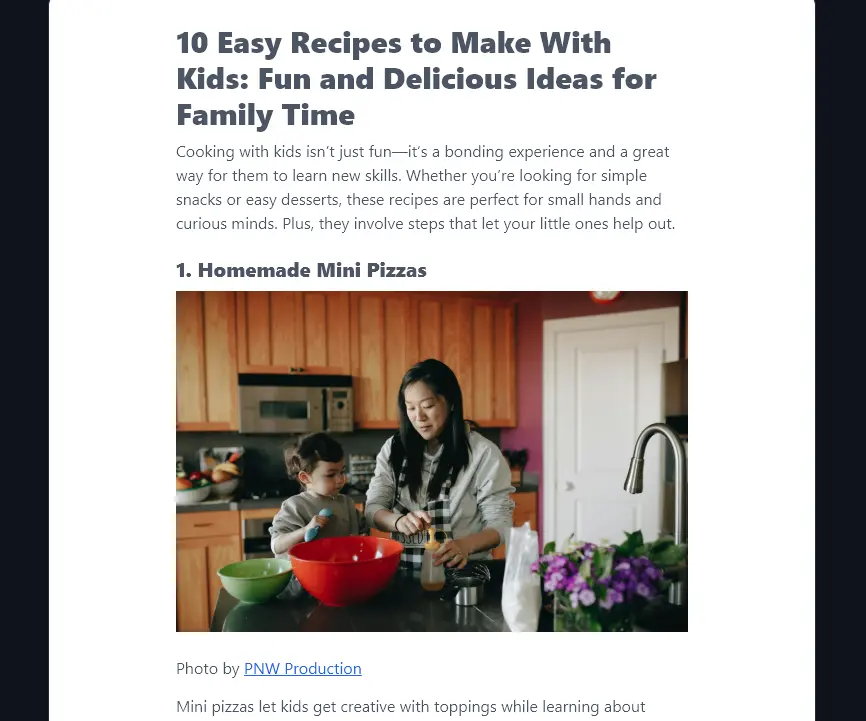
Tip: Prefer to use unique AI-generated images in your articles? Try our AI Image generator.
3. External Links? (Include Relevant Links to Other Sites)
It’s important to link to other posts on your own blog, to help boost your SEO … but you can also improve your SEO by linking out to other sites. The AI will aim to find relevant, high-quality links for your list post, adding these in with relevant anchor text.
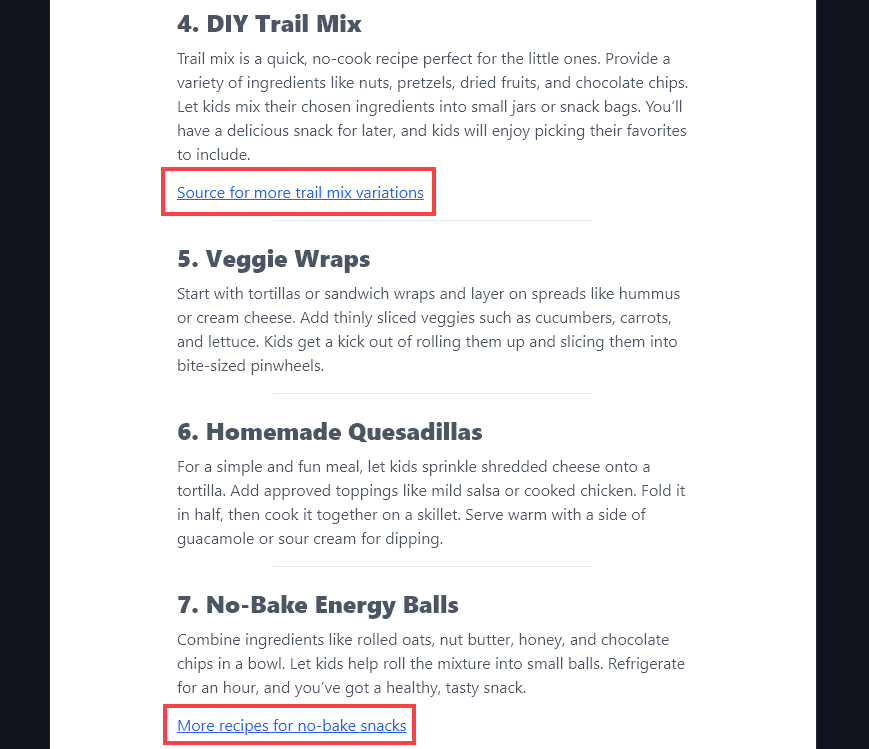
4. Realtime Knowledge? (Use Up-to-Date Info from Google)
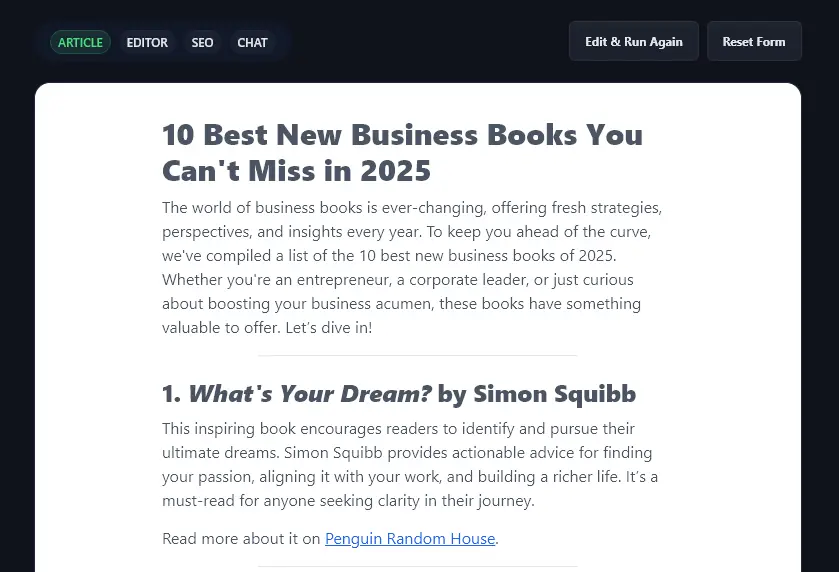
In some cases, very recent knowledge isn’t necessary for the content creation process. Perhaps you’re creating an evergreen post, for instance, and it’s fine to draw on sources that might be from a year or more ago.
With other listicles, you may need more up-to-date information (e.g. if you’re writing a post about the top 10 TV shows right now or the best recent books on a particular subject). If that’s the case, make sure you toggle “Realtime Knowledge” on.
5. Article Length? (Choose How Short or Long Your Listicle Should Be)
The Article Length dropdown lets you decide on the rough length of your listicle. (Note that the exact length will also depend on the scope of your topic.)
While the AI will pick a sensible length by default, adjusting the length here gives you more control.
6. Primary Keyword (Enter Your Main Keyword to Boost SEO)
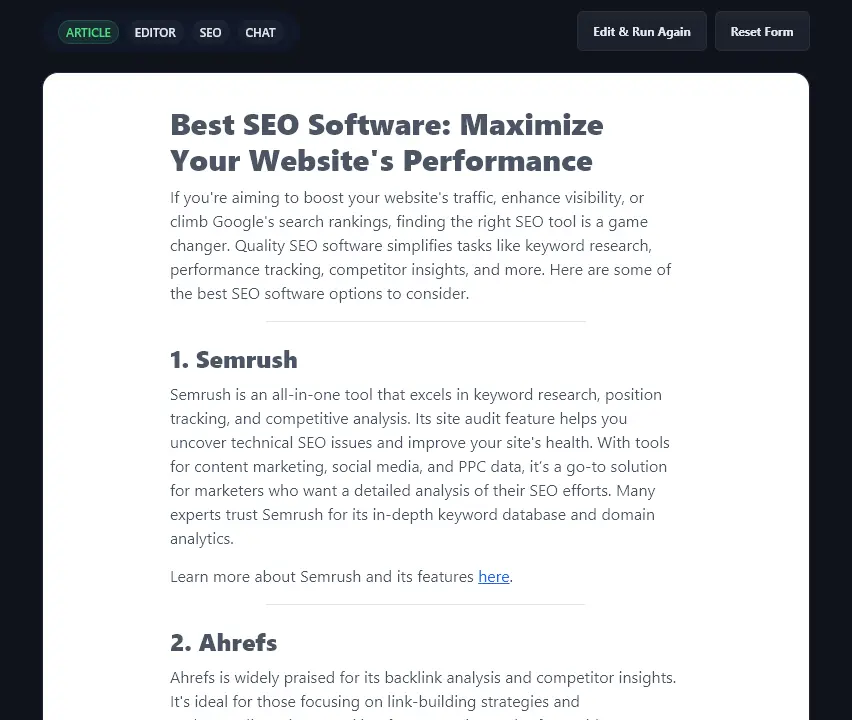
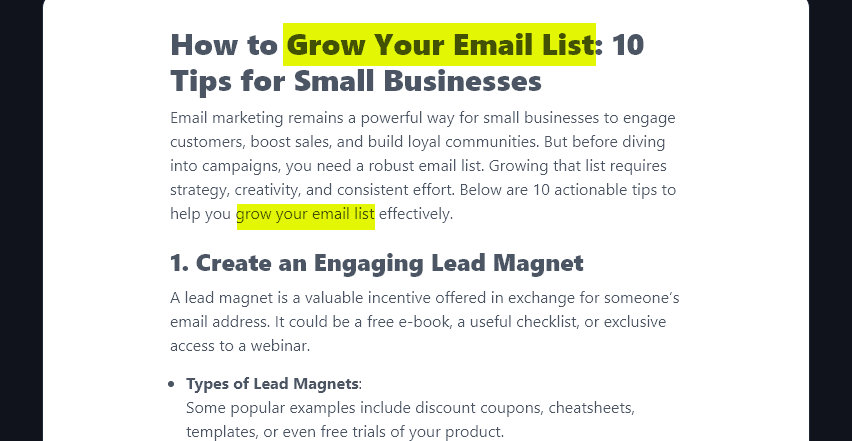
When you add a primary keyword, the AI will use that keyword in the title of your listicle as well as in key places within the body text (like your intro). This helps to improve your SEO.
Here’s a quick example, with the primary keyword (grow your email list) highlighted in the text.
7. Tone & Writing Style (Select a Tone or Make Your Own)
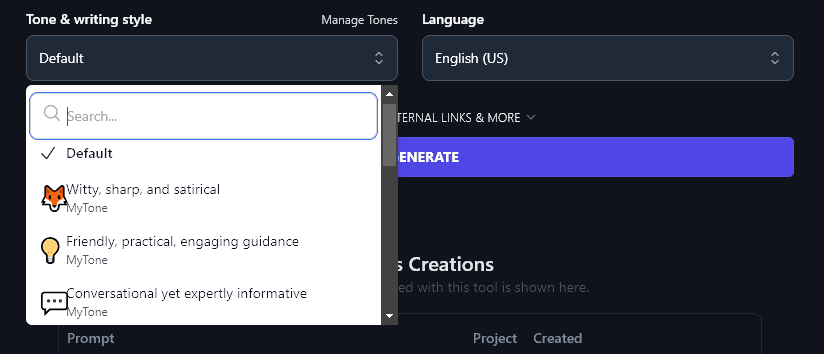
We saw above how you can choose from the pre-set tones in the Tone & Writing Style dropdown … but RightBlogger Pro subscribers can also create a custom tone.
The MyTone functionality lets you set up a tone based on a writing sample or even a YouTube video. The AI analyzes the tone, saving this to use for future content.
Every plan includes MyTone, and paid plans save 5 (Solo), 15 (Pro), or 50 (Agency) MyTones. To use one, just select it from the dropdown.
8. Language (Choose from Over 100 Different Languages)
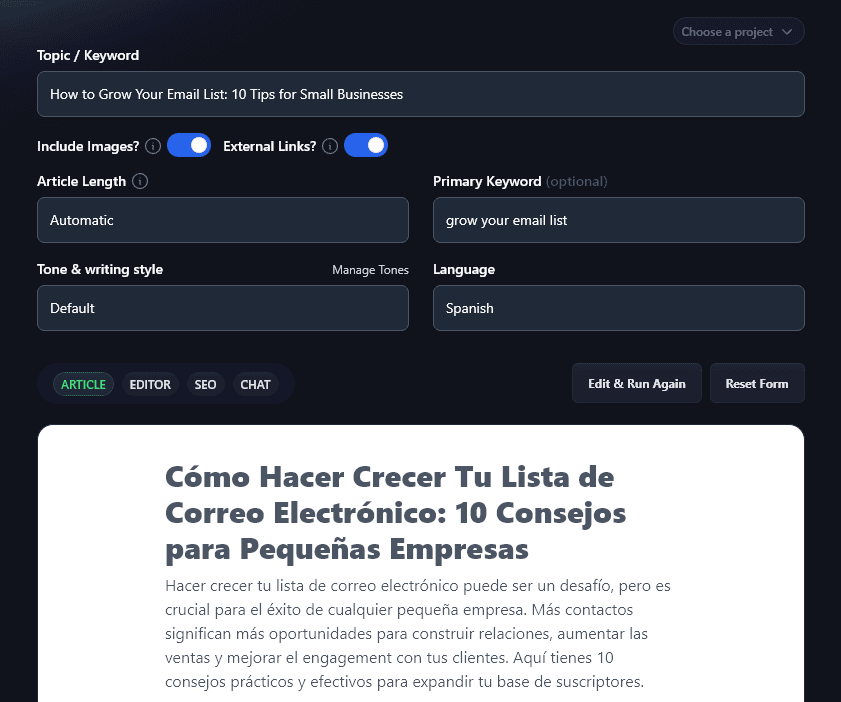
The RightBlogger AI can come up with content in over 100 languages, a big advantage for multilingual websites. Just select the language from the dropdown and generate your article.
9. Point of View (What’s the Focus of Your Listicle?)
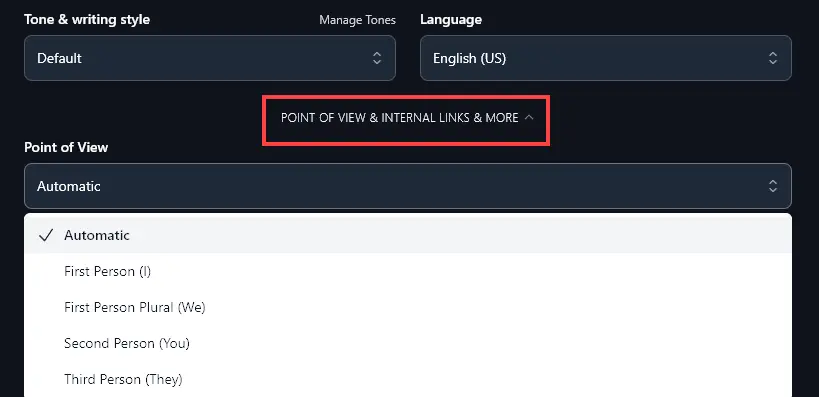
To see the Point of View options and other advanced features, click on the “Point of View & Internal Links & More” link.
Most blog articles are written to “you”, the reader. But depending on your topic and audience, you may feel it makes more sense to take an “I” or “we” perspective, concentrating on your own experience … or conversely, you might want to use the more neutral “they” point of view to talk about challenges that your readers may face.
You can select the point of view for your listicle from the dropdown list.
10. Internal Links (Include Links to Your Own Site)
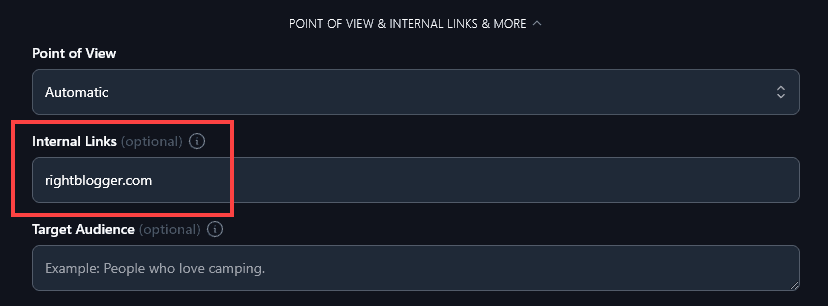
The next advanced option is Internal Links. This lets the AI automatically add links to other content on your own site. Simply enter your site’s URL here.
11. Target Audience (Who is the Listicle Aimed At?)
The AI can tailor its writing to your audience, making it relevant to their needs and situation. Just add details here about your typical reader or ideal customer.
You could describe their demographics (e.g. “college-educated men in their 40s and 50s”) or psychographics (e.g. “new business owners who can quickly feel overwhelmed by technology”).
12. Additional Instructions (Give More Details or Constraints for the AI)
What if you have some other requirements for your listicle? Perhaps you use specific templates for your content or you always end with bullet points that sum up your post. Maybe you want to include quick sharable pull-out quotes within the article for readers to include in their social media posts. You might also want the article written to a specific readability level.
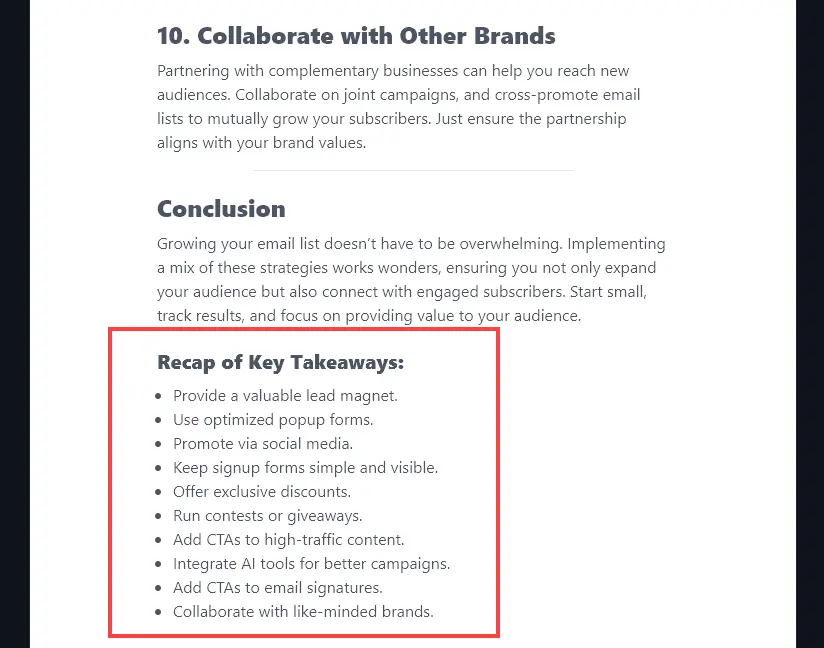
Use the “Additional Instructions” box to ask the AI for whatever you like. We asked RightBlogger to “Include a list of bullet points at the end of the post to quickly recap the main takeaways.”
It did exactly what we asked:
13. Creativity (How Unusual Should Your Listicle Be?)
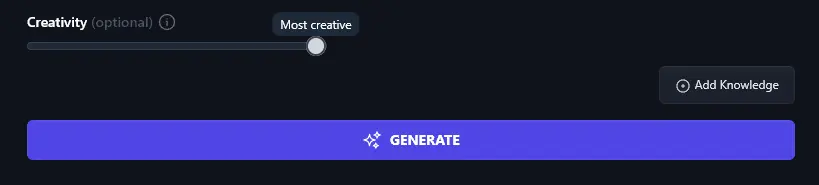
RightBlogger lets you set the AI’s creativity. The more creative, the more unusual the word choices will be in your listicle … the less creative, the more conventional it will be. Most people find the midpoint is just right, but you can adjust the slider up or down if you want to.
14. The Chat Feature
Want to make changes to your listicle? The AI can rewrite it however you like: just use the Chat feature (above your generated article) to ask for changes.
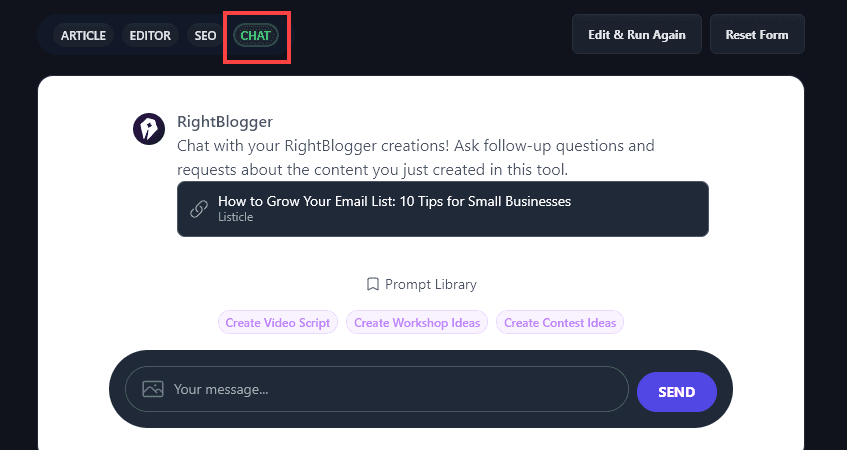
Note: Chat is available on every paid plan.
You can also use the “Editor” tab to make manual or AI edits to your content. This is available on both the free and Pro plans.
The “SEO” tab automatically generates your meta title, meta description, and permalink/URL.
AI Listicle Generator FAQs (Frequently Asked Questions)
Got questions about the listicle generator … or about writing great listicle posts in general? Here are the answers you need.
What’s the Difference Between a List and a Listicle?
A list can be very short, like a bullet point list within a post.
A listicle is an extended list, where each item normally takes up at least a paragraph or two. You’ll sometimes hear a listicle called a “list post”, as it’s a blog post in the format of a list.
What Are Some Examples of Listicles?
You can see plenty of examples of listicles on the RightBlogger blog, including:
9 Free AI SEO Tools to Get More Traffic (Easy to Use) – this is a good example of a “tools roundup” style listicle
18 Best AI Prompts for Email Marketing (ChatGPT Prompts & More) – this listicle is an “ideas” style post, where you could usefully use any one of the items on the list
5 Cool Things You Can Do with RightBlogger’s All New Editor – here’s a “features” listicle, which is a great type of post for promoting your own product/service or an affiliate product
Are Listicles Good for SEO?
Yes! Listicles have some fantastic SEO advantages. They’re normally structured with multiple subheadings (particularly helpful for SEO if you can include relevant keywords in these). Listicles are also generally quite shareable, meaning they may get attention and links from other bloggers.
Listicles are easy for readers to scan and take in, making them popular both with readers and with search engines.
What Other AI Tools Can I Use to Write Content?
Need some help with your content creation or even your overall content strategy? RightBlogger is packed with tools to help you.
Take a look at these:
- Article Writer: Like the listicle generator, the article writer produces full blog posts from just a title/keyword.
- Blog Post Ideas Generator: Not sure what to write about? This tool is perfect for brainstorming post ideas.
- Meta Title Generator: Come up with a well-optimized and engaging SEO title for your listicle.
- Meta Description Generator: Write the perfect meta description (SEO description) for your post.
- Keyword Cluster Tool: Create SEO keyword clusters to build content around.
- FAQ Tool: Instantly create an FAQ list to include in your blog post (can help with SEO).
As well as blogging and SEO tools, we also have sales tools (like our Product Description Generator) and social media tools (like our YouTube Video to Blog Post tool).
How Do I Sign Up for RightBlogger and How Much Does it Cost?
Create your RightBlogger account and start building listicles right away.
For less than most AI writing tools charge per seat, you get the entire RightBlogger suite. Monthly plans start at Solo $59 (annual billing, charged monthly, is $49) (Solo), monthly $89 (annual $69) (Pro, most popular), or monthly Agency $299 (annual $199). Every paid plan includes unlimited words, and every plan comes with a 7-day free trial and a 30-day money-back guarantee. View pricing.