Ahrefs Domain Rating (DR) vs Moz Domain Authority (DA): What’s the Difference?
DR reacts quickly to backlink changes, while DA more gradually estimates ranking potential; neither score guarantees rankings.


The difference between Ahrefs DR (Domain Rating) vs Moz DA (Domain Authority) is that Ahrefs DR measures raw backlink strength and updates quickly, while Moz DA runs similar link data through a machine-learning model to predict how likely a site is to rank, and it moves more slowly. Both scores are built from backlinks; DR is a live link-equity score and DA is a rank-prediction score.
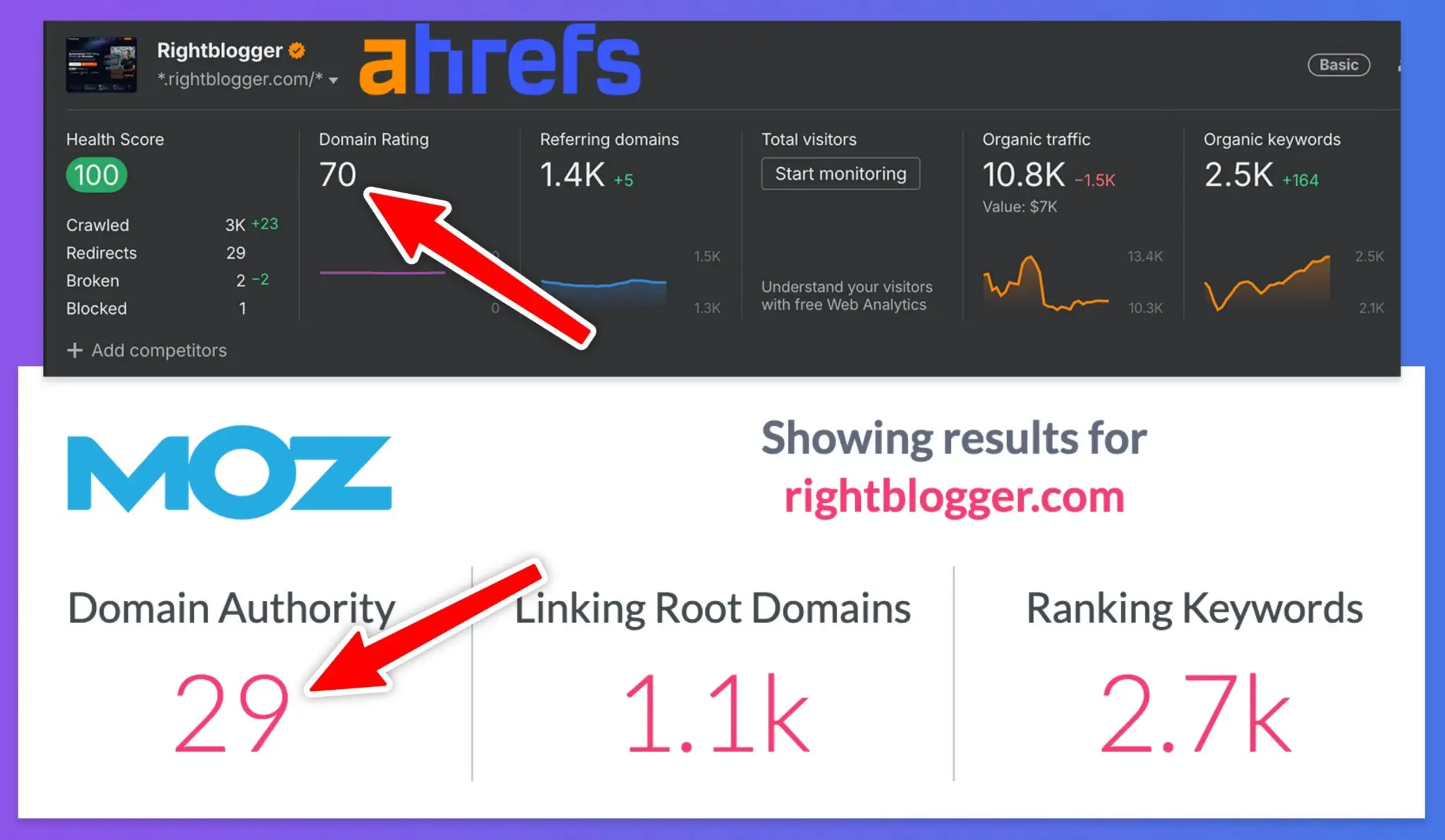
Whether you’re a fellow SEO nerd like me or you’ve spent 5 minutes in blogging communities, you’ve no doubt seen people ask the same question over and over again… “What’s better, Ahrefs Domain Rating or Moz Domain Authority?“
I used to stare at those numbers and wonder why my Domain Rating (DR) dropped while my Domain Authority (DA) stayed flat, or why a site with lower DA still outranked me. Once I understood what each metric really measures as a proxy for website authority, a lot of that confusion went *poof*.
Today, I’ll break down Ahrefs DR vs Moz DA in simple terms, show how I use both of these scores as a blogger, and share some practical rules to avoid obsessing over scores, and start using them to actually grow your traffic.
Blog Automation That Keeps Your Posts Ranking
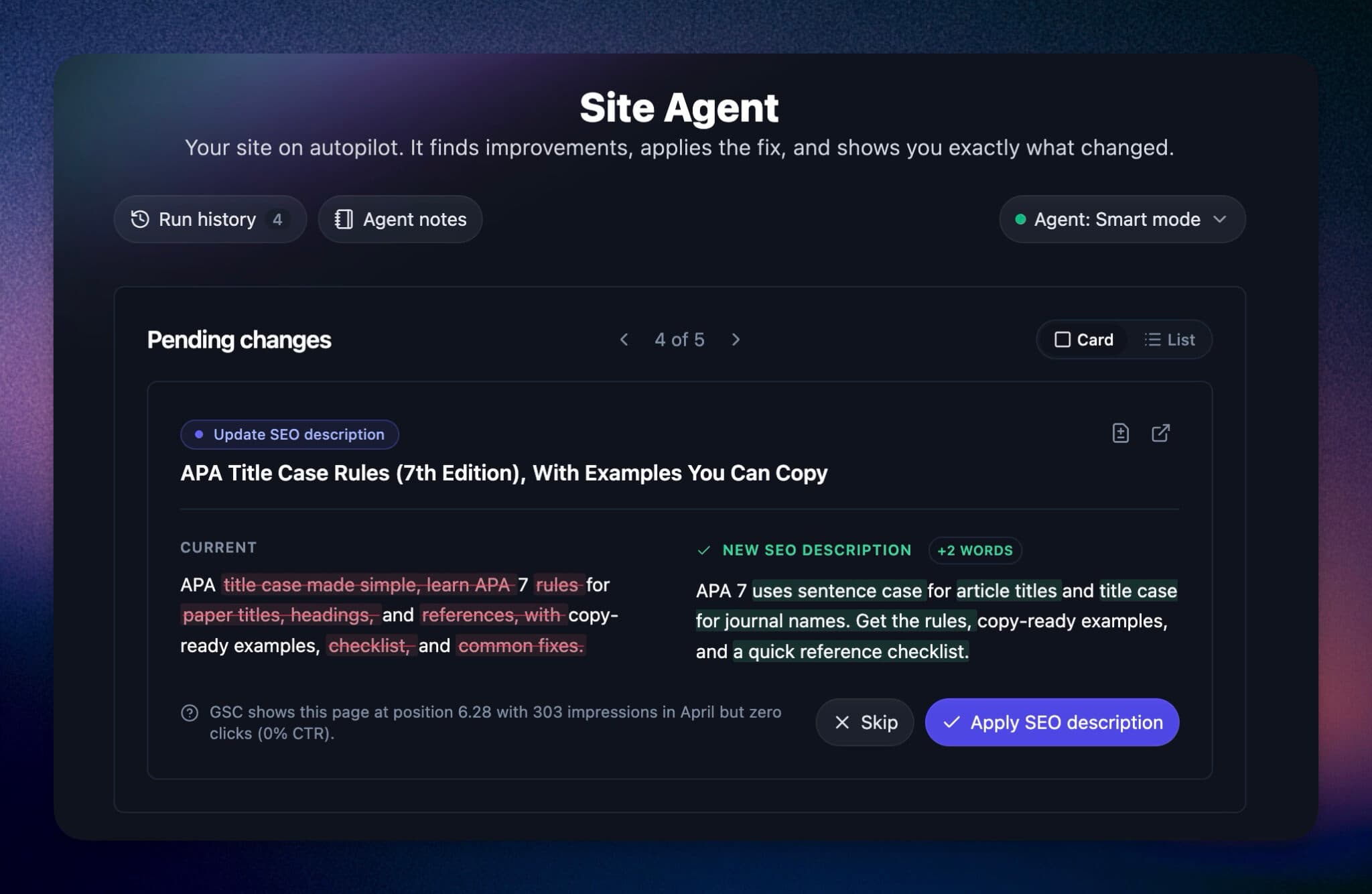
RightBlogger finds keywords, writes SEO articles, and publishes them to your blog. Then its Site Agent uses your Search Console data to keep older posts in shape, adding internal links, sharpening weak meta descriptions, and fixing stale years and broken links. Join 51,000+ bloggers using it to grow traffic from Google and ChatGPT.
What Ahrefs DR and Moz DA Actually Measure
Both Domain Rating (DR) and Domain Authority (DA) try to answer one simple question:
How strong does this website look compared to others on the Internet?
However, they answer it in different ways.
Ahrefs Domain Rating (DR) Measurements
Ahrefs Domain Rating is all about backlinks. It looks at:
- How many referring domains from unique domains link to a domain
- How strong those linking sites are
- How link authority flows across the web
Ahrefs feeds Domain Rating (DR) from its live backlink index, which gets fresh data every 15-30 minutes (index processing speed, not crawl speed), so DR can move within a day when you gain or lose backlinks. If you’re deep into link earning, Domain Rating (DR) feels like a live scoreboard. Scored on a scale between 0 and 100, DR is relative: Ahrefs says a good DR is one that’s higher than or comparable to similar sites. Scores of 70 and above are rare, since the vast majority of domains sit between DR 0 and 10. The higher you climb in DR, the more difficult it is to score higher, so changes will take longer as your score increases.
If you want a more technical look at how these scores relate to actual rankings, Onely’s correlation study of DA, DR, and Google rankings is a great extra read. Published in 2022, it looked at 2,000 SERPs and found both metrics show a modest but real correlation with rankings, strongest on medium-difficulty keywords.
Moz Domain Authority (DA) Measurements
Moz Domain Authority (DA) tries to predict how likely a domain is to rank in Google. Here’s the part most people get wrong: DA is also built from link data, not content or technical signals. The difference is the method. Moz feeds its Link Explorer link index through a machine-learning model trained against real search results, weighing:
- How many unique root domains link to the site
- The quality and quantity of those links
- How closely that link profile matches the patterns of sites that already rank
Moz retired its old monthly index years ago. Link Explorer now gathers new link data daily, and your DA moves whenever the index picks up new or lost links, though in practice it still shifts more slowly than DR. DA runs on a scale from 1 to 100 (new sites start at 1), and only the world’s most linked-to websites like YouTube, Google, and Facebook come close to the top. The upside is that DA tends to be a more stable metric. The downside is that it reacts slower.
The key idea I keep in mind:
- DR is a fast, backlink-focused score
- DA is a slower score that predicts how likely you are to rank
| Ahrefs DR | Moz DA | |
|---|---|---|
| Full name | Domain Rating | Domain Authority |
| Measures | Backlink profile strength | Overall SEO ranking potential |
| Scale | 0-100 (logarithmic) | 1-100 (logarithmic) |
| Update frequency | Live index ~15-30 min (DR moves as links process) | Continuous index; score moves as links change |
| Main data source | Backlinks only (link-equity math) | Mainly backlinks (ML model trained on real SERPs, plus spam signals) |
| Volatility | High (reacts fast to link changes) | Low (stable over time) |
| Best used for | Tracking link building progress | Long-term SEO health assessment |
| Can be gamed? | Easier (via link spam) | Harder (spam and link-quality checks dampen junk links) |
Neither metric comes from Google, and neither guarantees rankings, of course. They’re just models built by smart SEO companies, trying to mirror reality and estimate your ranking potential in organic search.
Key Differences Bloggers Should Care About
When I compare Domain Rating (DR) vs Domain Authority (DA) for my own sites, a few differences matter more than the rest.
1. Focus: Link Equity vs Rank Prediction
Domain Rating (DR) gives me a quick read on my backlink profile. If I land a strong guest post on a 70+ DR site (through backlink outreach), I know my DR might bump soon.
Domain Authority (DA) filters those same links through its rank-prediction model. I have seen cases where:
- DR moves up after a burst of new links
- DA barely moves, because those links didn’t change how my profile stacks up against sites that already rank
So if I want a snapshot of raw link power, I lean on DR. If I want an estimate of how that profile translates into ranking likelihood, I look at DA.
2. Update Speed and Volatility
Because DR tracks a fast-moving backlink index, it is jumpy. Lose a few strong links, and you can see a drop overnight.
DA still tends to move more gradually even though Link Explorer ingests links continuously.
The mental model:
- DR is a heartbeat monitor
- DA is a periodic health check
Both are helpful; they just tell different stories, sometimes showing low correlation.
3. How Easy These Metrics are to “Game”
Any metric that relies on backlinks can be inflated with spammy tactics, which is something to keep in mind if you’re buying a website and factoring in DR as a metric in the sale price.
In practice:
- DR is easier to move quickly with aggressive link building, but on a logarithmic scale, it becomes much harder at higher numbers
- DA is harder to move quickly, because Moz’s model weighs link quality and spam signals, not just link counts
Ahrefs is refreshingly upfront that DR is purely link-based (its AhrefsBot crawls constantly to keep that link index fresh). Only followed links count, only the first link from each domain counts, and the value passed depends on the linking site’s own DR, diluted by how many other domains it links out to. DR deliberately ignores traffic, domain age, and even link spam; Ahrefs itself warns that a flood of low-quality links can raise DR rather than lower it. So if you see a site jump 20 DR points in a month from spammy directory placements, treat the score with skepticism, that’s a pattern, not authority.
DA is harder to spike because it’s graded on a curve: Moz’s model scores your link profile against every other domain and real search results, so junk links that don’t change your competitive position barely register.
Common Mistakes with Ahrefs DR and Moz DA
I see the same traps over and over on Reddit, in blogging Facebook groups, Slack communities, and even in client reports regarding Domain Rating (DR) and Domain Authority (DA).
Here are a few to avoid:
- Treating DA 50 as equal to DR 50: The scales for Domain Authority (DA) and Domain Rating (DR) are not interchangeable; there’s only a loose correlation between Ahrefs Domain Rating and Moz Domain Authority (DA). DA 50 on one site does not equal DR 50 on another.
- Judging a site only by DR or DA: I always also check organic traffic, keyword rankings, content quality, and page-level metrics like URL Rating (UR) from Ahrefs or Page Authority (PA) from Moz. A high-score site with no traffic is a red flag.
- Expecting Page Authority (PA) to move with DA or DR: PA is Moz’s page-level score. It comes from the same Moz link index as DA but is calculated separately for each URL, so a page’s PA can stay flat while the domain’s DA moves. Ahrefs DR has no effect on either.
- Chasing numbers instead of results: You can waste months trying to raise Domain Rating (DR) from 45 to 50 on a logarithmic scale when your content still does not match search intent. Focus on a strong SEO content strategy first.
- Ignoring your niche: In some small niches, DA 20 can dominate. Comparing your food blog to huge media sites only stresses you out (this is one of the most common blogging mistakes that drains motivation).
Authority metrics are helpful, but they are still just tools, like a bathroom scale. The goal is better health. The number is just a readout.
How to Check DR and DA for Any Site (Free Methods)
You don’t need a paid subscription to either tool to check basic authority numbers. Both Ahrefs and Moz offer free checkers, and there are a few faster ways to get both scores at once.
Check Ahrefs DR for free
Go to Ahrefs’s free Website Authority Checker, paste in any domain, and you’ll get the DR plus a snapshot of referring domains and backlinks. The free version caps the data you can see (total backlinks vs the full profile), but the DR score itself is the same number you’d see inside a paid Ahrefs account.
Check Moz DA for free
Moz has a similar free Domain Authority Checker (formerly called Domain Analysis). No login is needed: paste a domain and you’ll get DA, linking root domains, ranking keywords, top pages by links, and top search competitors. Free use is capped at 3 reports per day (as of October 2026), and Moz Pro removes the cap.
The faster way: check both at once
Browser extensions are even quicker. MozBar (free with a free Moz account) shows DA and PA right in the SERP, under each result. Ahrefs SEO Toolbar shows DR and UR for any site you visit once you sign in with a free Ahrefs account, but DR under every search result needs a paid Ahrefs plan (as of October 2026). That’s the fastest way to evaluate competitors when you’re researching what to write next, or when you’re vetting guest post targets.
RightBlogger’s Backlink Checker pulls a similar snapshot if you want to see the actual backlinks, with a Domain Rank and Page Rank for each linking page and the date each link was first seen.
So Which is Better: Ahrefs DR or Moz DA?
You might be asking, is Ahrefs more accurate than Moz for domain ranking? The short answer is no. Neither metric is inherently more accurate because they measure different signals.
Ahrefs Domain Rating (DR) focuses almost entirely on backlink strength. It updates quickly as new links are acquired, which makes it useful for evaluating link building progress and commercial pages.
Moz Domain Authority (DA) converts similar link data into a rank-likelihood prediction and tends to be more stable, which makes it better suited for long-term comparisons.
The right metric depends on the decision you are making.
- Picking guest post targets: I check both DR and DA
- Tracking link building: I focus on DR
- Reporting long-term growth: I pair DA with traffic and rankings
Using multiple authority metrics reduces reliance on any single model and helps offset the occasional recalculation that shifts one vendor’s scores across the board. The next section covers the other authority scores worth knowing (Semrush Authority Score, Majestic Trust Flow) and how I weight them.
Other Authority Scores Worth Knowing (Semrush AS, Majestic TF)
DR and DA are the two scores most bloggers reference, but they’re not the only options. A complete picture pulls from a few sources:
- Semrush Authority Score (AS): A 1-100 score that blends link power, estimated organic traffic, and spam checks on whether the link profile looks natural. Those spam factors make it harder to game with link buying alone.
- Majestic Trust Flow (TF) and Citation Flow (CF): Trust Flow measures link quality, Citation Flow measures link quantity. The ratio between them (TF/CF) is the useful read, a high CF with a low TF is a flag for thin, low-quality links.
- Moz Page Authority (PA): The page-level equivalent of DA. Useful for evaluating individual URLs (a strong PA on a guest-post target matters more than the domain’s DA).
- Ahrefs URL Rating (UR): Ahrefs’s page-level equivalent. Same principle, scored 0-100, useful for understanding individual page strength.
My honest take: pick one as your primary (I use Ahrefs DR + UR because I’m in the tool daily), check a second one quarterly to triangulate, and stop there. Tracking five scores eats time you should be spending on content and outreach.
Frequently Asked Questions
Can I check DA and DR without a paid subscription?
Yes. Ahrefs’s free Website Authority Checker shows the DR for any domain, and Moz’s free Domain Authority Checker shows the DA. Both have caps (Ahrefs limits the backlink list you can see, and Moz allows 3 free reports per day as of October 2026), but the headline DR and DA scores are identical to what you’d see in a paid account.
Do AI search engines like ChatGPT and Google AI Overviews use DA or DR?
No. Google’s AI Overviews and AI Mode are built on Google’s regular index and ranking systems, while ChatGPT’s web search uses OpenAI’s own crawler (OAI-SearchBot) alongside third-party search providers such as Microsoft. Neither queries Ahrefs or Moz, and Google’s John Mueller has been blunt that Google doesn’t use DA at all. That said, DA and DR correlate with the same underlying signals (backlinks, content quality, site trust) that influence what both Google and AI search engines surface. The metrics matter as proxies for the work that actually moves AI Overview placement, not as direct inputs.
How often does Ahrefs DR update?
Ahrefs’ live backlink index (what DR is calculated from) updates every 15-30 minutes. Crawl discovery can still take days, but once links are in the index, DR can shift within a day. Moz’s Link Explorer index updates continuously, but DA typically shifts more gradually, since the score only moves when your link profile changes relative to other sites.
What is a good Ahrefs Domain Rating?
There’s no universal cutoff, because DR is relative: Ahrefs says a good DR is one that’s higher than or comparable to the sites you compete with, and the vast majority of domains sit between DR 0 and 10. As a rough rule of thumb for bloggers, DR 30-50 reflects a healthy backlink profile growing over time, DR 50-70 puts you in competitive territory, and DR 70+ is rare. Keep in mind that DR uses a logarithmic scale, so each point gets harder to earn as you climb higher.
Can you compare DA and DR scores directly?
No. A DA of 50 and a DR of 50 do not mean the same thing. They use different data sources and different algorithms, plus different update cycles. It is common for a site to have a DR of 40 and a DA of 55, or vice versa. Use each score for what it measures best rather than trying to equate them.
Final Guidance on Using DR and DA the Smart Way
If you felt confused by authority metrics like Domain Rating (DR) and Domain Authority (DA) before, you are not alone. I spent years chasing those scores without a clear plan, and now that AI Overviews and answer engines are shifting how authority gets evaluated, the temptation to obsess over a number is even stronger.
Now I treat Domain Rating (DR) and Domain Authority (DA) as supporting metrics. The main goal is something else entirely. My main goals are still simple: publish better content and earn high-quality backlinks, which is what grows traffic.
Here is my challenge for you: next time you open Ahrefs or Moz, ask yourself what decision you want to make before you look at the numbers. Use the metrics to guide that choice, then get back to creating.
And if you want help turning those decisions into consistent publishing, tools like RightBlogger make it much easier to plan topics, check your backlink profile, run SEO reports on individual pages, and build a topical authority map for your niche, while those DR and DA scores quietly rise in the background as a byproduct of doing the actual work.

RightBlogger Co-Founder Ryan Robinson teaches bloggers how to grow online businesses and has written for Forbes, Fast Company, and more.



Automated SEO Blog Posts for Your Site
Research, write, publish, and share from one account.
7-day free trial. Cancel anytime.





Leave a comment