How to Start a Blog in a Crowded Niche (Without Burning Out)
Find an underserved audience, build around experience only you can offer, and broaden your topics after earning readers’ trust.


Starting a blog in a popular niche like fitness, nutrition, or food can feel intimidating. With thousands (sometimes millions) of creators already producing content, it’s natural to wonder if there’s room for your voice.
The good news is, there absolutely is. Almost every “saturated” niche still has room for the right person with the right angle, because topic saturation and audience saturation are not the same thing.

This guide covers what actually works when blogging in a crowded niche in 2026: how to find your gap, how to pick a defensible sub-niche, real examples of bloggers who won “saturated” spaces, and the mistakes that send most new blogs to die in the page-30 wilderness.
Topic Saturation Is Real. Audience Saturation Almost Never Is.
“Fitness” is saturated. There are thousands of fitness blogs. But “strength training for women in their 50s recovering from joint surgery” is wide open. Most bloggers call their niche full because they stop reading at the topic level. Zoom in on a specific audience and the gaps show up fast.
Every popular niche has the same pattern: a few giants own the head term, and a long tail of specific sub-audiences are underserved or completely ignored. Your job is to find the audience the giants either can’t or won’t speak to specifically, and become the obvious choice for them.
Real Bloggers Who Won “Saturated” Niches
Every one of these started after their niche was already declared “too crowded”:
- Pinch of Yum (Lindsay and Bjork Ostrom) started in 2010, years after food blogging was supposedly oversaturated. They won by combining obsessive photography quality with the unusual move of publishing transparent income reports.
- James Clear built a massive personal-development audience in a niche dominated by Tony Robbins, Tim Ferriss, and Mark Manson. His angle: ultra-concise, single-idea posts citing actual behavioral science.
- Budget Bytes (Beth Moncel) entered food blogging by anchoring every recipe to cost-per-serving. Same topic as everyone else, completely unique data point.
- Adventurous Kate launched into travel blogging after every “best travel blog” list had already been written. Her angle: honest solo female travel reviews, including the destinations she’d skip.
The pattern is the same in every case: each one picked a specific angle their crowded niche didn’t already have, then went deep on it for years. For more examples worth studying, see our roundup of 21 real blogs across 7 niches.
How to Find Your Gap in a Crowded Niche
Don’t pick your sub-niche from a brainstorm. Pick it from the SERP. The exercise that works:
- Open the top 10 blogs in your broad niche and read what they actually publish.
- List the audience segments they all serve (usually 3-4 overlap heavily).
- List the segments that nobody serves well or that everyone serves only superficially.
- Pick one underserved segment where you have either real experience or strong genuine interest. Both are better than one.
Sub-niche examples beyond the usual ones to show how specific you can get:
- Fitness → strength training for women over 50
- Food → sourdough for people with small apartments and no stand mixer
- Personal finance → FIRE strategies for nurses and other shift workers
- Parenting → twin and triplet parenting, specifically the logistics
- Productivity → focus systems for ADHD adults
- Travel → slow travel in places that don’t appear on Instagram
If you can’t find your gap from this exercise, your niche probably isn’t crowded enough yet, or you haven’t done the listening work. Our guide on building a topical authority map walks through how to turn a chosen sub-niche into 30-50 connected post ideas.
Make Authenticity a Strategy, Not a Slogan

“Be authentic” is the most overused, least actionable piece of blogging advice. Here’s what it actually means: weave your specific lived experience into every post in ways nobody else can replicate. The story of why you started, the mistake that cost you something, the workflow you built after the third failure. That’s your moat. AI can’t fake it, and no other blogger has it.
Focus on providing value, educating, and entertaining your readers in a way only you can. When you stay specific to your own experiences and the audience you’ve picked, you naturally stand out. That same specificity is also what Google’s E-E-A-T framework rewards: the first E (Experience) is the one AI Overviews and AI search models can’t fake.
Listen Before You Publish More
Once you start attracting readers, treat their questions as your content roadmap. Ask them what they’re struggling with, respond to comments, send a “what should I cover next?” email to your list every few months.
The bloggers who win crowded niches almost always have a tighter feedback loop with their audience than the giants do. The giants can’t email 100 readers personally; you can. Use that.
Earn the Right to Broaden

With consistency and depth in your sub-niche, you’ll build a recognizable brand. As your reputation grows, you can expand to broader topics within the larger niche and the audience tends to follow because they already trust your voice.
The mistake is broadening too early. Pinch of Yum spent years narrowly focused before they expanded into food blogging business education. James Clear wrote on habits for years before the book deal. The pattern is: own the small thing first, then earn the bigger thing.
Mistakes That Sink New Blogs in Crowded Niches
- Trying to compete on the head term. “Best workout routines” is owned by domains with DR 90+. Don’t go there. Go where they aren’t.
- Publishing the same article every competitor already wrote. If a search for your post title returns 20 near-identical results, you wrote the wrong post.
- Posting inconsistently. Three deep posts a month for two years beats 12 thin posts a month for three months.
- Skipping the keyword reality check. Use free keyword research tools to verify there’s real search demand in your sub-niche before you commit a year of writing to it.
- Trying to sound like an authority instead of being one. Read a few posts from giants in your space, then close the tab and write what only you would write.
The Bottom Line
Don’t let competition discourage you from starting a blog in a popular niche. Almost every “crowded” niche has an underserved audience segment with no real champion. The opportunity is to be the obvious answer for an audience the giants don’t speak to specifically.
Pick a real sub-niche, anchor your content in your actual experience, listen to your readers more than you talk at them, and stay consistent for longer than feels reasonable. That’s how new blogs still win in 2026.
Blog Automation That Keeps Your Posts Ranking
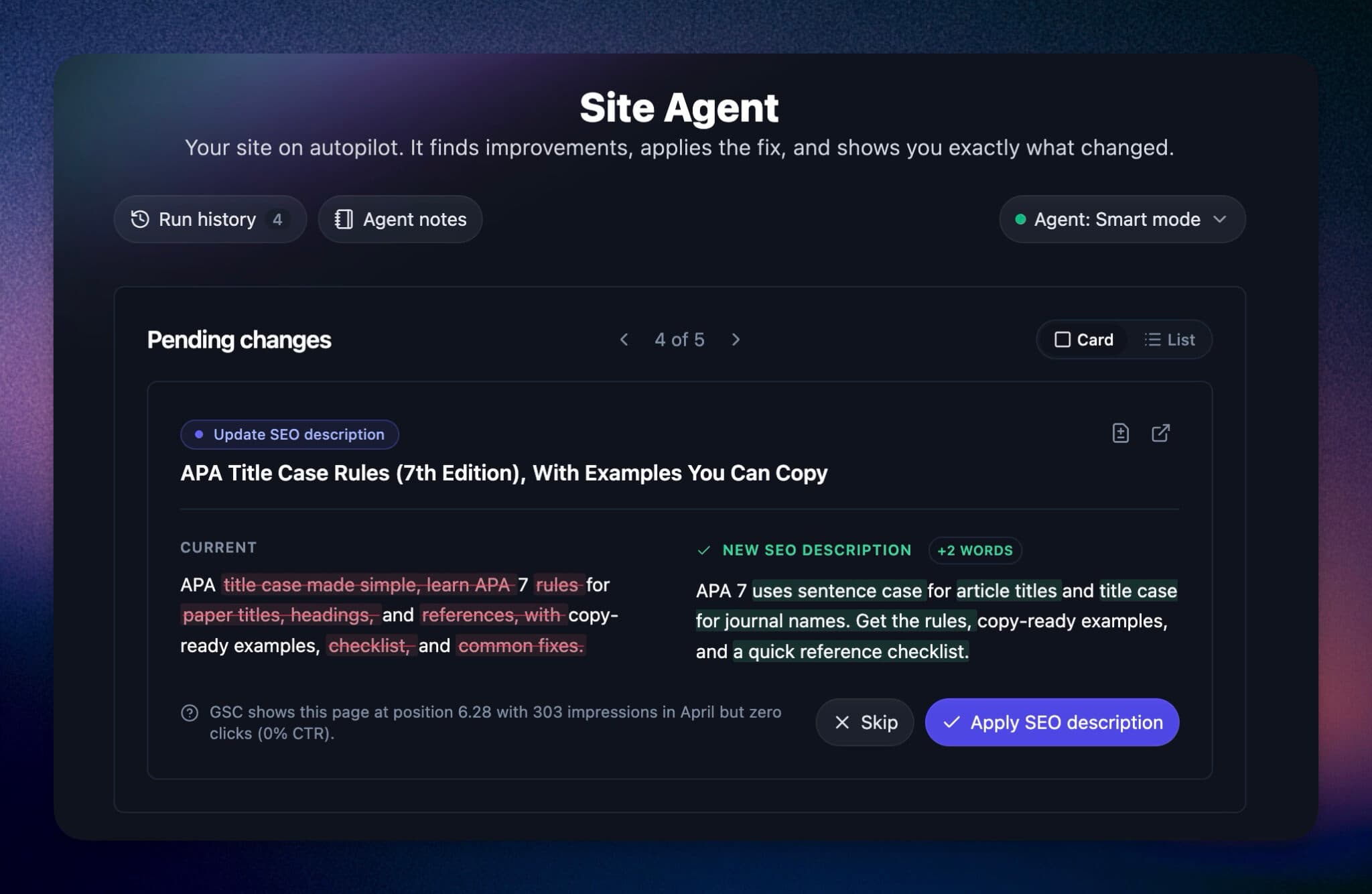
RightBlogger finds keywords, writes SEO articles, and publishes them to your blog. Then its Site Agent uses your Search Console data to keep older posts in shape, adding internal links, sharpening weak meta descriptions, and fixing stale years and broken links. Join 51,000+ bloggers using it to grow traffic from Google and ChatGPT.

Article by
RightBlogger Co-Founder, Ryan Robinson teaches hundreds of thousands of readers how to grow an online business and stand out in crowded niches.




Automated SEO Blog Posts That Work
Try RightBlogger for free, we know you'll love it.
7-day free trial. Cancel anytime.





Leave a comment
You must be logged in to comment.
Loading comments...